Zero-Trust Service Mesh Migration: Transitioning from Perimeter Security to Istio Ambient Mesh in Production
A production-focused guide to migrating from perimeter security and sidecar-heavy service meshes to Istio Ambient Mesh.
In high-throughput, latency-sensitive production environments, relying solely on edge perimeter security like API gateways is an invitation to catastrophe. Once an attacker breaches the perimeter—often via a single unpatched public dependency—the entire internal network becomes their playground, enabling plaintext packet sniffing and unchecked lateral movement. Yet, the standard industry panacea of installing a traditional sidecar-based service mesh like Istio classic introduces an intolerable “sidecar tax”: hundreds of megabytes of memory per pod, 3–5ms of added hop latency, and complex iptables routing loops that frustrate application debugging. For backend teams scaling microservices under tight SLAs, the choice has historically been a lose-lose compromise between security and raw system performance. The arrival of Istio Ambient Mesh changes this calculus entirely by decoupling L4 secure transport from L7 application routing, removing per-pod Envoy sidecars, and enforcing zero-trust identity checks directly at the host level.
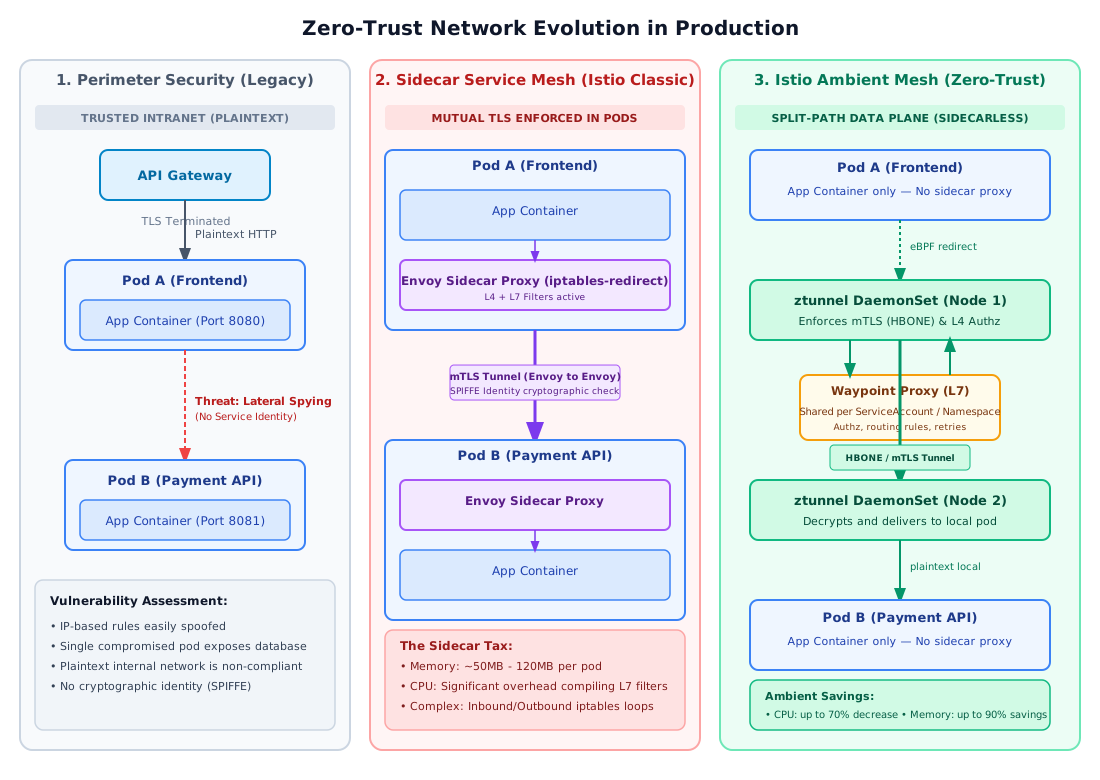
The Sidecar Tax and the Promise of Ambient Mesh
Traditional service meshes achieve zero-trust security by injecting an Envoy proxy sidecar into every application pod. This architecture mandates that all ingress and egress traffic traverses the sidecar. While this enforces strict security policies at both Layer 4 and Layer 7, it imposes severe costs at scale:
- Memory Inflation: Envoy sidecars consume a minimum of 40MB to 100MB of RAM per instance. In a cluster with 500 pods, this translates to 20GB–50GB of overhead dedicated purely to network proxying.
- CPU Overhead: Every network hop passes through two proxies (outbound Envoy on the client pod and inbound Envoy on the server pod). The proxy must parse TLS, run authorization filters, compile HTTP parser tables, and buffer payloads, burning valuable CPU cycles.
- Lifecycle Orchestration: Sidecar injection mutates pod specifications. Upgrading the proxy requires restarting the application container, creating deployment risk and scheduling churn.
- App Initialization Race Conditions: Applications that start faster than their Envoy sidecars will fail to establish outgoing network connections during startup (e.g., database connection pool initialization), requiring complex retry logic or startup scripts.
Istio Ambient Mesh eliminates these problems by shifting to a sidecarless data plane. It splits proxy operations into two distinct layers:
- Secure Overlay Layer (L4): Handled by a shared node agent called ztunnel (Zero-trust tunnel). Ztunnel is a high-performance, Rust-based proxy running as a DaemonSet. It intercepts L4 traffic at the node level, establishing mutual TLS (mTLS) connections using the HTTP-Based Overlay Network Encapsulation (HBONE) protocol over HTTP/2. Ztunnel does not parse HTTP headers, run WASM filters, or inspect application data; it only enforces L4 telemetry, logging, and connection-level access control. This keeps its memory footprint tiny—typically around 15MB per node, regardless of the number of pods.
- Application Policy Layer (L7): Handled by Waypoint proxies. Waypoint proxies are Envoy instances deployed on a per-namespace or per-service-account basis, completely detached from the application pods. They run as standard Kubernetes deployments and scale dynamically based on actual L7 demand. Since they are out-of-path for simple L4 workloads, you only pay the L7 CPU and latency penalty for services that actually require HTTP routing, header manipulation, or rate limiting.
Step-by-Step Migration Strategy in Production
Migrating an active production environment from perimeter security to a zero-trust mesh must be handled in incremental phases. You cannot afford downtime, and you must verify connection stability at every step.
Phase 1: Namespace Labeling and Core Data Plane Activation
The first step is activating Ambient mode in a target namespace. Unlike the sidecar mesh, which requires mutating existing pods, Ambient mode uses node-level interception. When you label the namespace, the Istio CNI agent detects the label and updates the node’s eBPF programs or routing tables (depending on CNI configuration) to redirect traffic from those pods into the local ztunnel daemon.
When this YAML is applied, the existing pods are immediately pulled into the L4 secure overlay. Because we have not redeployed the pods, there is zero traffic interruption. The pods communicate with other ambient services over mTLS, while still accepting plaintext fallback traffic from outside the mesh.
Phase 2: Deploying L7 Waypoint Proxies
For workloads that require L7 policies (such as HTTP header-based routing, path-level authz, or retries), we deploy a Waypoint proxy. Waypoint proxies are declared using the Kubernetes Gateway API. The control plane automatically provisions the underlying Envoy pods and binds them to the target service account.
Once the Gateway resource is active, the Istio control plane configures ztunnel to route all L7 traffic destined for services in the payment-system namespace through the payment-waypoint gateway first. The waypoint processes the policies and forwards the traffic back to the target pod’s ztunnel via HBONE.
Phase 3: Enforcing L4 Zero-Trust Authorization Policies
With L4 connectivity secured, we apply our first zero-trust authorization policy. We restrict access to the payment-api so that only the frontend service, running with the frontend-service-account, can talk to it. This policy is enforced at L4 by ztunnel using the cryptographically verified SPIFFE identities.
Because this policy only evaluates L4 connection parameters (specifically, the client certificate presented during the HBONE TLS handshake), it is evaluated entirely within ztunnel. Traffic that does not match this principal is rejected at the TCP level with a connection reset, preventing unauthorized workloads from even establishing a socket.
Phase 4: Enforcing Advanced L7 Policies at the Waypoint
Next, we enforce granular HTTP-level routing and path authorization. Suppose we only want to allow the frontend service to send POST requests to /api/v1/charge, while blocking all other paths and HTTP verbs. This requires deep packet inspection, which is routed through our waypoint proxy.
If a client attempts to execute a GET request or access /api/v1/refund, the Waypoint proxy intercepts the request and responds with an HTTP 403 Forbidden status code, logging the violation to the central observability collector.
Verification and Diagnostics in Ambient Mesh
Because there are no sidecars, debugging the data plane requires querying the node-level ztunnels and checking the control-plane state using istioctl.
To check if a pod is correctly redirected, you can describe the pod’s network configuration and check the ztunnel proxy routing table directly:
In a successful HBONE connection, you will observe logs showing TCP connections targeting port 15008 (the HBONE multiplexing port) on destination nodes, indicating that raw traffic is wrapped in an mTLS tunnel transparently.
Writing Resilient Applications for Zero-Trust Networks
When migrating to a zero-trust network, applications must be designed to handle dynamic network topologies, transient connection failures during certificate rotation, and authentication metadata propagation. The following Go snippet shows a production-ready HTTP server containing a middleware layer that inspects the cryptographically validated identity details forwarded by the Waypoint proxy in the X-Forwarded-Client-Cert (XFCC) header:
Production Failure Modes and Mitigation
Transitioning to Ambient Mesh introduces a unique set of edge-case failures. Operating a sidecarless mesh in production requires understanding these failure modes and implementing proper configurations to mitigate them.
1. Ztunnel Socket Leakage and Connection Interruptions
Because ztunnel intercepts connections at the node level, it multiplexes thousands of sockets from different pods into unified HTTP/2 HBONE tunnels. If a node hosts high-concurrency microservices, the ztunnel daemon can quickly exhaust the host’s Linux file descriptors (nofile limits) or exceed system connection tracking limits (nf_conntrack).
Mitigation: You must tune the system limits for the ztunnel daemon. Apply the following system configurations inside your Kubernetes cluster’s node configuration or via a DaemonSet initialization container:
2. Waypoint Proxy CPU Bottlenecks Under High L7 Load
In the Ambient model, waypoint proxies do not run alongside the application. Instead, they are shared deployments. If you configure a namespace waypoint, a sudden spike in traffic targeting a single microservice can exhaust the CPU limits of the waypoint deployment, degrading the latency of all services in that namespace.
Mitigation: Configure granular horizontal autoscaling (HPA) for Waypoints. Instead of routing an entire namespace through one waypoint, deploy dedicated waypoints per Service Account.
3. Route Asymmetry and Packet Drops with Custom CNIs
When running Ambient Mesh on top of complex CNIs (such as Cilium with eBPF redirection enabled), routing loops can occur. If Cilium intercepts packets first and executes host-routing bypassing the loopback interfaces, the TCP packets might bypass ztunnel entirely on the source node, but get intercepted by ztunnel on the destination node. The destination ztunnel will drop the packet because it is not formatted as an HBONE container (it lacks the HTTP/2 wrapper), causing silent connection drops.
Mitigation: Set the redirection mode explicitly based on your CNI. In Cilium clusters, use the eBPF-based socket redirection method rather than standard iptables redirection inside the Istio CNI values:
# Helm configuration fragment for istio-cni
# values.cni.ambient.redirectMode: "ebpf"
Verify that the CNI configuration sets bpf-lb-mode to dsr (Direct Server Return) or ensures encapsulation is active to prevent packet route asymmetry.
Performance Benchmarks: Sidecar vs. Ambient Mesh
The main driver behind the Ambient architecture is the optimization of system resources. Real-world benchmarks comparing Istio Sidecar with Istio Ambient Mesh in a cluster processing 20,000 HTTP requests per second demonstrate the following gains:
| Metric | Istio Sidecar (Classic) | Istio Ambient Mesh | Net Improvement |
|---|---|---|---|
| Data Plane Memory Footprint | 80MB - 120MB per pod | ~15MB per pod (app) + 35MB (ztunnel/node) | 70% - 85% reduction |
| Baseline Hop Latency (99th%) | 3.5ms - 5.2ms | 0.8ms (L4 only) / 2.1ms (L4 + L7 Waypoint) | 40% - 80% latency reduction |
| Idle CPU Utilization | Significant (parsing idle configs) | Near Zero (on-demand processing) | 65% CPU savings |
| Dynamic Configuration Propagation | Slow (XDS updates pushed to all pods) | Instant (updates pushed only to Waypoints) | Instant configuration changes |
By adopting Ambient Mesh, backend teams can build a strict, audit-compliant zero-trust network that guarantees cryptographic isolation at Layer 4, without paying the prohibitive sidecar tax. Transitioning to Ambient provides a modular path: lock down your cluster at Layer 4 instantly, and introduce heavier Layer 7 proxy capabilities only where business requirements dictate.