System Design: Rate Limiting Algorithms Explained
A deep dive into rate limiting algorithms — fixed window, sliding window, token bucket, and leaky bucket — with implementation examples.
Rate limiting is one of those topics that appears in every system design interview — and for good reason. Every production API needs it. Let’s explore the algorithms and implementation strategies.
Why Rate Limit?
- Prevent abuse — Stop one bad actor from hammering your API
- Ensure fairness — Every user gets a fair share of resources
- Protect downstream — Prevent cascading failures from traffic spikes
- Cost control — Many cloud services bill by the request
Algorithm 1: Fixed Window Counter
The simplest approach. Count requests in fixed time windows.
Problem: Boundary burst. A user can make 100 requests at 11:59:59 and 100 more at 12:00:00 — effectively 200 requests in 2 seconds.
Algorithm 2: Sliding Window Log
Track exact timestamps of each request. No boundary burst problem.
Problem: Memory intensive. Stores every request timestamp.
Algorithm 3: Sliding Window Counter (Best for Most Cases)
Combines fixed window simplicity with sliding approximation. Low memory, no boundary burst.
Algorithm 4: Token Bucket
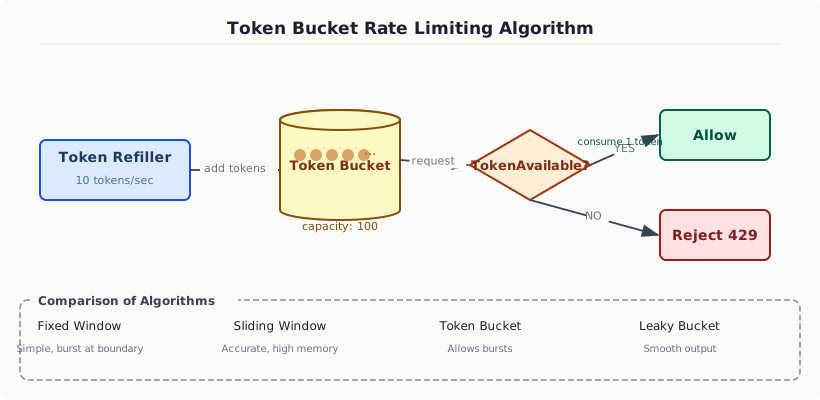
Tokens accumulate at a constant rate up to a maximum. Each request consumes one token. Allows bursts up to bucket size.
Distributed implementation using Redis + Lua (atomic):
Algorithm 5: Leaky Bucket
Requests queue up. They’re processed at a fixed rate. The queue has a maximum size (excess requests dropped).
Good for smoothing bursty traffic into a steady stream. Used at the infrastructure layer.
Choosing the Right Algorithm
| Algorithm | Burst Allowed | Memory | Accuracy | Best For |
|---|---|---|---|---|
| Fixed Window | Yes (boundary) | Low | Low | Simple throttling |
| Sliding Window Log | No | High | Perfect | Low-traffic, strict limits |
| Sliding Window Counter | Minimal | Low | ~95% | Most API rate limiting |
| Token Bucket | Yes (controlled) | Low | High | APIs with burst allowance |
| Leaky Bucket | No | Medium | High | Traffic shaping |
Implementation in HTTP Middleware
Rate Limit Tiers
Real APIs often have tiered limits:
Rate limiting is one of those features that seems trivial until you’re under attack. Build it in from day one.