Structuring High-Impact Architectural Reviews: Preventing Design Debt in Microservices
How to design a high-throughput, automated architectural review workflow that eliminates design debt without bottlenecking your engineering velocity.
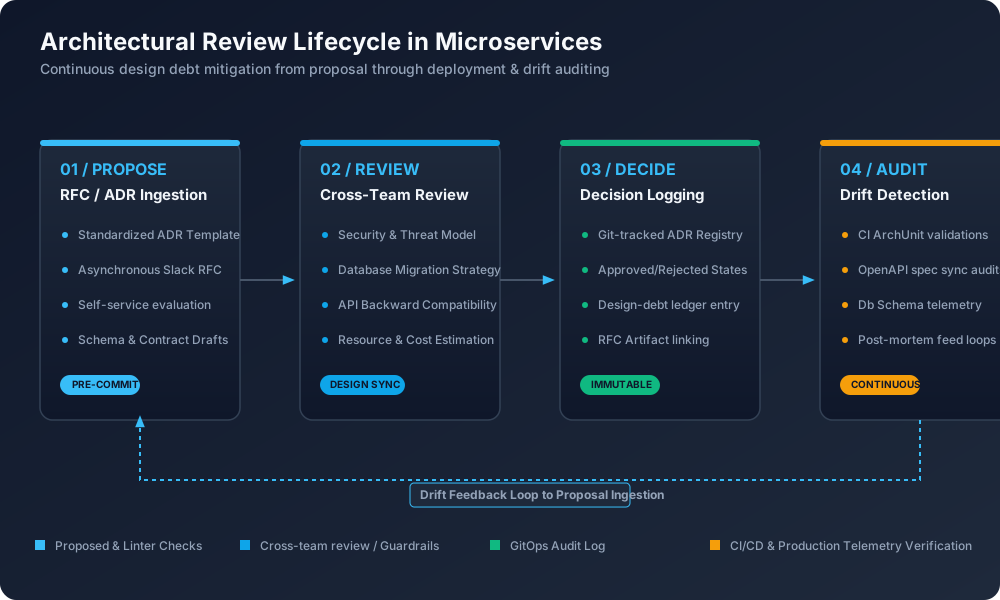
At 3:14 AM on a Tuesday, the p99 latency of your core checkout service spikes from 85ms to 14.2 seconds, triggering a cascade of connection pool exhaustions in the upstream gateway. The post-mortem reveals that a mid-level engineer on the inventory team, working under a tight product deadline, solved a local data consistency issue by querying the order database directly via a newly introduced cross-database view. This bypasses the API boundary entirely, introducing a cyclic dependency and an un-indexed lock contention. The feature went live without an architectural review because the team wanted to avoid the weekly “Architecture Review Board” (ARB) meeting—which they viewed as a slow, bureaucratic tribunal where designs go to die. This is the real cost of design debt: not just messy code that a linter can highlight, but systemic architectural drift that compromises reliability, scaling limits, and organizational velocity.
The Silent Killer: How Design Debt Accumulates in Microservices
Code debt is easy to track. Tools like SonarQube, checkstyle, and standard CI linters will flag a cyclomatic complexity violation, missing test coverage, or an unhandled exception block. Design debt, however, is structural, invisible to automated static analysis of single repositories, and far more catastrophic.
In a microservices topology, design debt manifests in several distinct patterns:
- Transactional Boundaries Leaks: Services performing dual-writes across separate databases (e.g., writing to Postgres and publishing to Kafka without using the transactional outbox pattern), leading to permanent state desynchronization.
- Cyclic Service Dependencies: Service A calls Service B, which queries Service C, which asynchronously calls Service A to resolve a status. This creates a distributed runtime deadlock when traffic spikes.
- Data Ownership Violations: A service reading directly from another service’s underlying database instance, blocking schema migrations and creating tight coupling.
- API Spec Drift: Modifying a JSON response payload by removing a deprecation field without notifying downstream consumers, resulting in deserialization failures in legacy mobile clients.
Design debt is rarely introduced out of malice or ignorance. It is almost always a rational compromise made by engineers optimizing for local velocity (getting their feature shipped in the sprint) at the expense of global stability (the long-term health of the platform). If your architectural review process relies on manual, gatekeeper-style reviews, teams will actively circumvent it, leading to a silent accumulation of design flaws until the system breaks under load.
The Friction of Centralized Architecture Boards
The traditional centralized Architecture Review Board (ARB) is a relic of monolithic, quarterly release cycles. In an organization running 50+ microservices with multiple deployments a day, a weekly 2-hour ARB meeting creates a severe bottleneck.
The failure modes of the centralized ARB are predictable:
- The Ivory Tower Effect: The reviewers are often principal architects who do not write code daily. Their guidance is frequently detached from the current codebase realities and developer toolchains.
- Low Throughput: If a team has to wait five business days for a slot on the ARB agenda to discuss a new message-broker integration, they will find ways to implement it under the guise of an “experimental feature” to avoid the delay.
- Ad-hoc Standards: Decisions are often made based on who speaks loudest or who has the most organizational seniority, rather than on standardized, objective criteria.
- Zero Feedback Verification: Once a design is approved on a slide deck, there is no verification that the code actually built matches the approved diagram. The diagram becomes “shelfware” the moment the first line of code is written.
To prevent design debt without halting velocity, we must replace the centralized bottleneck with a decentralized, automated, and tier-based review workflow.
A Lightweight, High-Impact Review Framework: The 3-Tier System
Not every architectural change deserves the same level of scrutiny. Changing an internal data structure does not require the same rigor as changing the primary database engine. We can categorize all architectural modifications into a clear three-tier system, each with its own SLA, reviewers, and checklist.
| Tier | Scope of Decision | Review Mechanism | SLA | Primary Evaluators |
|---|---|---|---|---|
| Tier 1 (Local) | Internal service refactoring, library upgrades, local database schema migrations (non-breaking). | Standard Pull Request (PR) review; automated CI linters. | Same-day | Team Peers |
| Tier 2 (Domain) | Introducing a new HTTP/gRPC endpoint, changing event schemas, adding a new database table with foreign keys. | Asynchronous RFC (Request for Comments) via Markdown PR to a central registry. | 24 - 48 Hours | Tech Lead + Domain Architect |
| Tier 3 (Global) | Introducing a new database engine, changing service boundaries, high-impact data ownership changes, cross-org event contracts. | Synchronous design sync preceded by a formal Architecture Decision Record (ADR). | Weekly | Principal Architects + Impacted Leads |
Defining the Triggers
To implement this, write clear, immutable triggers in your organization’s engineering handbook. For instance:
- You are in Tier 3 if: Your design introduces a new network dependency, changes a database write path that handles PCI/PII data, or adds a new state-management technology (e.g., introducing Redis for caching when the stack is exclusively Postgres).
- You are in Tier 2 if: Your design impacts an external consumer API or modifies an event schema consumed by more than one downstream service.
- You are in Tier 1 if: None of the above apply.
By codifying this, developers immediately know what path they must follow, removing the ambiguity that often leads to skipped reviews.
Automating Architectural Guardrails: Shifting Left
Human review should be reserved for conceptual alignment, trade-off evaluation, and threat modeling. Structural rules must be automated in the CI/CD pipeline. Just as we use ESLint or GoLint for code style, we must use tools to enforce architectural constraints.
1. Enforcing Package and Dependency Rules with ArchUnit
If you are running on the JVM (Java/Kotlin), you can write unit tests that fail if code dependencies cross architectural boundaries.
Here is a concrete example of an ArchUnit test enforcing that domain services never query controllers and that database adapters are isolated behind ports:
package com.production.architecture;

import com.tngtech.archunit.junit.AnalyzeClasses;
import com.tngtech.archunit.junit.ArchTest;
import com.tngtech.archunit.lang.ArchRule;

import static com.tngtech.archunit.library.Architectures.onionArchitecture;

@AnalyzeClasses(packages = "com.production.checkout")
public class ArchitectureGuardrailsTest {

    @ArchTest
    public static final ArchRule onionArchitectureRule = onionArchitecture()
        .domainModel("com.production.checkout.domain.model..")
        .domainServices("com.production.checkout.domain.service..")
        .applicationServices("com.production.checkout.application..")
        .adapters(
            "db", "com.production.checkout.infrastructure.db..",
            "api", "com.production.checkout.infrastructure.api.."
        );
}
For Go projects, you can use go-arch-lint to define permitted import rules in a YAML file, preventing database clients from importing HTTP routing components.
2. Preventing API Contract Drift with Spectral
API drift is a common source of design debt. A team changes a field from string to object inside a JSON response, breaking downstream clients. To prevent this, compile your OpenAPI/Swagger specification during build time and run a linter like Spectral.
Create a .spectral.yaml file in your root repository to enforce strict schema policies:
extends: ["spectral:oas", "recommended"]
rules:
  # Enforce versioning in the URL path
  api-version-in-path:
    description: "API path must contain a version prefix (e.g., /v1/checkout)"
    message: ""
    severity: error
    given: "$.paths"
    then:
      field: "@key"
      function: pattern
      functionOptions:
        match: "^\/v[0-9]+\/"

  # Prevent numeric IDs to discourage database ID enumeration
  no-numeric-ids:
    description: "Identifier properties should use UUID strings rather than auto-incrementing integers"
    severity: warn
    given: "$..properties[?(@property === 'id')]"
    then:
      field: type
      function: pattern
      functionOptions:
        notMatch: "^(integer|number)$"
Running spectral lint openapi.yaml in your GitHub Actions runner blocks the merge if these rules are violated. This shifts the architectural review of API designs directly into the development cycle.
The Anatomy of a High-Impact RFC / ADR
When a decision scale reaches Tier 2 or Tier 3, engineers must write an Architecture Decision Record (ADR). Avoid long, 20-page Word documents filled with high-level hand-waving. Instead, use a structured markdown template versioned directly in your service’s git repository.
A high-impact ADR must fit on a single screen and focus on the why and the consequences, rather than just the what.
Here is an example of an ADR document used in production to resolve a critical microservices coupling problem:
# ADR-024: Async Processing for Order Dispatching via Transactional Outbox

## Status
Approved

## Context & Problem Statement
Currently, when a user completes a checkout, the `checkout-service` performs a direct synchronous HTTP call to the `shipping-service` to schedule a courier.
If the `shipping-service` experiences a network timeout or database lock contention:
1. The checkout transaction remains open, holding database connection slots.
2. The user receives a 504 Gateway Timeout error, even though their payment was captured.
3. This creates a data mismatch between `payment-service` and `shipping-service` that requires manual reconciliation scripts.

## Considered Options
1. **Option 1:** Increase HTTP timeouts and implement retry policies with exponential backoff on the client.
2. **Option 2:** Use a Kafka topic for asynchronous order dispatching.
3. **Option 3:** Implement the Transactional Outbox Pattern to capture shipping events in the checkout database and publish them asynchronously via a Debezium connector to Kafka.

## Decision Outcome
Chosen Option: **Option 3**

### Rationale
While Option 2 decouples the network call, it introduces a dual-write failure mode where a database commit in the checkout table succeeds but publishing to Kafka fails (or vice versa). Option 3 guarantees "at-least-once" delivery of events by utilizing the database transactional boundary. This completely decouples checkout latency from shipping subsystem availability.

## Consequences & Accepted Design Debt
* **Positive:**
  * Average checkout API latency drops from 450ms (p95) to 45ms.
  * Shipping service downtime no longer interrupts checkout processes.
* **Negative/Trade-offs:**
  * **Operational Overhead:** We must configure and monitor Kafka, Kafka Connect, and Debezium.
  * **Eventual Consistency:** The frontend cannot assume the shipment record is immediately queryable upon checkout redirection.
* **Design Debt Accepted:**
  * To hit the Q3 launch target, we will start with a polling publisher query instead of Debezium. This introduces a read-load overhead on the checkout DB master node.
  * **Mitigation Plan:** We must migrate from polling to Debezium by October 2026. This task is filed as ticket `TECHDEBT-812`.
By explicitly listing the Accepted Design Debt and linking a tracking ticket, you ensure that shortcut decisions are documented and scheduled for remediation, rather than forgotten.
Detecting and Measuring Architectural Drift in Production
An approved ADR is useless if the system drifts during implementation. Tech leads must set up continuous auditing mechanisms to ensure compliance.
1. Database Joining Audits
In microservices, services must own their database schema. One of the most common ways design debt enters production is when DBA teams or developers create database views that join tables across service boundaries.
- Prevention: Configure your database user permissions such that the
checkoutservice’s database credentials do not have read access to theinventorydatabase tables. - Telemetry: Run a weekly script against your database logs to query
pg_stat_statements(for PostgreSQL) to detect queries joining tables across schemas. Flag these in a tech-debt Slack channel.
2. Real-Time Topology Mapping
Modern microservices setups rely on distributed tracing. You can leverage OpenTelemetry to generate runtime architecture maps and compare them against your intended design.
- Kiali & Istio: If you run on Kubernetes with an Istio service mesh, use Kiali to visualize the service graph. If Kiali shows an edge from the
payment-serviceto themarketing-servicethat was never authorized in an ADR, you have detected architectural drift. - Distributed Tracing Assertions: Write integration tests that parse Jaeger/Zipkin trace graphs to assert that the path from Service A to Service D does not exceed a maximum hop limit of 3, or contains prohibited paths.
3. The Design Debt Ledger
To ensure debt is paid down, establish a “Design Debt Ledger” in your repository directory alongside the code. Every time a shortcut is taken (e.g., using a short-term polling mechanism instead of a robust event-driven pattern), write an entry:
[
  {
    "id": "DD-CHECKOUT-001",
    "description": "Polling db instead of outbox listener",
    "impact": "High read-amplification on DB master during peak sales",
    "mitigation_target": "2026-10-31",
    "ticket": "TECHDEBT-812",
    "risk_level": "Orange"
  }
]
Review this ledger during quarterly planning. If a service has more than three open “Orange” or “Red” risks, block new feature work on that service and dedicate the next sprint entirely to structural remediation. This transforms architectural reviews from a gatekeeper process into a continuous, data-driven engineering practice.