Securing Microservice-to-Microservice Communication via WireGuard Kernel-Level Encryption in Cilium CNI
Configure kernel-level WireGuard encryption in Cilium CNI to secure microservice traffic at near-line speed, bypassing sidecar mTLS performance penalties.
Imagine running a high-throughput gRPC microservice fleet processing 80,000 requests per second across a multi-node Kubernetes cluster. You enable mutual TLS (mTLS) via a traditional service mesh like Istio to satisfy strict compliance requirements. Instantly, your p99 latency spikes by 12ms, CPU consumption on your node agents doubles due to user-space TLS termination in Envoy sidecars, and your network throughput plunges by 35%. This is the hidden tax of sidecar-based encryption. As backend and platform engineers, we need encryption in transit, but we shouldn’t have to sacrifice our application’s performance budget to get it. By moving encryption down to the Linux kernel via WireGuard integrated directly into the Cilium CNI, we can secure node-to-node and pod-to-pod communication at near-line speed with zero application-level changes or sidecar proxy overhead.
The Cost of Sidecar mTLS
Traditional service meshes achieve transport security by injecting sidecar proxies (typically Envoy) into every pod’s network namespace. When Pod A communicates with Pod B under this architecture, the network path involves multiple transitions between kernel space and user space.
- Pod A (User Space) writes data to its socket.
- The packet enters the Kernel Network Stack and is immediately redirected (usually via
iptablesloopback rules) back to the Pod A Sidecar Proxy (User Space). - The sidecar proxy encrypts the payload using TLS, writes the encrypted payload to a socket, and hands it back to the Kernel Network Stack.
- The kernel routes the packet across the physical interface to Node B.
- Node B’s Kernel receives the packet and redirects it to the Pod B Sidecar Proxy (User Space) for decryption.
- The decrypted payload is written to a socket, goes back through the Kernel, and is finally read by Pod B (User Space).
This constant bouncing between kernel and user space causes intensive CPU context-switching, memory allocations for application-level buffering, and latency amplification. At scale, running Envoy sidecars for hundreds of pods can consume dozens of CPU cores and gigabytes of memory just to handle connection encryption.
Why WireGuard at the Kernel Level?
WireGuard is an extremely fast, modern, and simple VPN protocol that runs entirely in kernel space. By utilizing state-of-the-art cryptography (ChaCha20-Poly1305 for symmetric encryption, Curve25519 for key exchange, and SipHash24 for hashtable keys), it achieves significantly higher throughput and lower latency than TLS or IPsec.
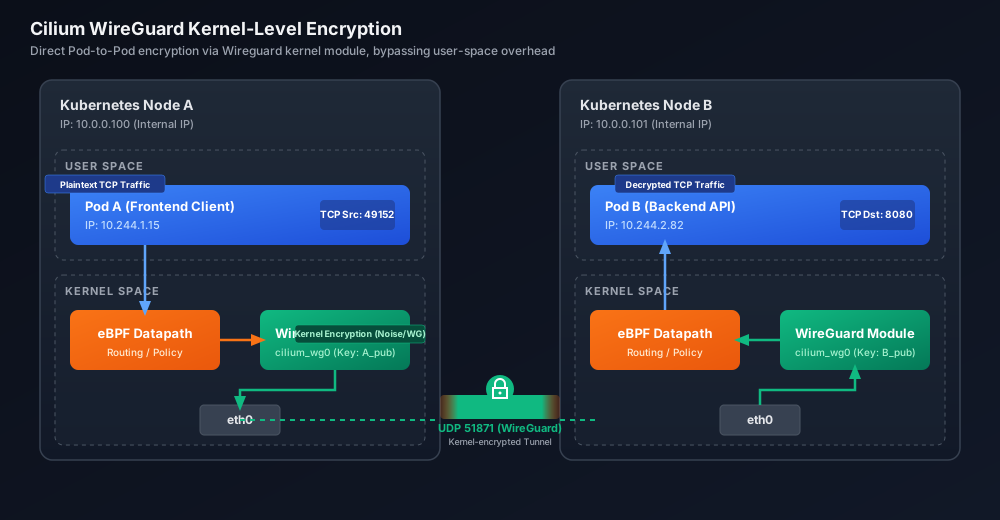
When integrated with Cilium CNI, WireGuard functions transparently at the node level. Instead of encrypting traffic on a per-pod basis using sidecar proxies, the Cilium CNI establishes a secure tunnel interface (cilium_wg0) on each Kubernetes node. Any traffic destined for a pod on a remote node is automatically routed through this interface, encrypted by the kernel’s WireGuard module, and transmitted securely.
Key benefits of this approach include:
- Zero User-Space Overhead: Encryption and decryption occur inside the Linux kernel. No context switching or buffer copying to user space.
- No Sidecars Required: Applications remain completely unaware of the encryption layer. No sidecar injection, no configuration overhead, and no application container changes.
- Cryptographic Simplicity: WireGuard’s code footprint is less than 4,000 lines, making it highly secure and easy to audit compared to OpenSSL or IPsec implementations.
- Automated Key Management: Cilium handles key generation, distribution, and rotation dynamically via Kubernetes custom resource definitions (CRDs), removing the need for an external PKI (such as HashiCorp Vault or SPIFFE/SPIRE).
How Cilium Integrates WireGuard with eBPF
Cilium achieves its performance by utilizing eBPF (Extended Berkeley Packet Filter) to bypass the standard routing table searches. When WireGuard encryption is enabled:
- Egress Path: A packet leaves Pod A. eBPF intercepts the packet at the pod’s virtual ethernet (
veth) interface. It checks the destination pod IP and determines that the pod resides on a remote node. - Encapsulation & Routing: eBPF marks the packet for routing via the
cilium_wg0interface. The kernel’s WireGuard module takes the packet, encrypts it using the pre-shared public key of the destination node, wraps it in a UDP packet (default port51871), and sends it out the physical network interface (eth0). - Ingress Path: The physical interface on Node B receives the UDP packet and delivers it to the WireGuard kernel module. The module decrypts the packet, validates the cryptokey routing, and outputs the plaintext packet onto the
cilium_wg0interface. - Delivery: Node B’s eBPF datapath intercepts the decrypted packet, bypasses the host network stack, and writes it directly to Pod B’s
vethinterface.
Step-by-Step Production Deployment Guide
To deploy WireGuard encryption in a production cluster, you must configure Cilium CNI via Helm. The following configuration enables WireGuard, enforces kernel-level routing, and ensures proper MTU tuning to prevent packet fragmentation.
Apply the values to your Helm release:
helm upgrade --install cilium cilium/cilium \
  --namespace kube-system \
  -f values.yaml
Once deployed, the cilium-operator will orchestrate the generation and distribution of the public keys. Each agent will generate a public/private key pair, write the public key into the status of its corresponding CiliumNode custom resource, and establish peer relationships with all other nodes in the cluster.
Verifying the Kernel State and Routing
To confirm that the encryption tunnel is functional, execute the following commands on one of the Kubernetes nodes.
The output of wg show should look similar to this:
interface: cilium_wg0
  public key: FxK2...z9o=
  private key: (hidden)
  listening port: 51871

peer: R1zK...tYo=
  endpoint: 10.0.0.101:51871
  allowed ips: 10.244.2.0/24
  latest handshake: 14 seconds ago
  transfer: 12.8 MiB received, 45.2 MiB sent
If latest handshake is within the last 2 minutes, the tunnel is successfully established and actively passing traffic.
Cilium Network Policies with WireGuard
Cilium applies network policies (CiliumNetworkPolicy) before the traffic is handed off to the WireGuard encryption module on egress, and after the traffic has been decrypted on ingress. This means your policies write against normal, human-readable labels and plaintext IP targets; the eBPF layer handles policy enforcement at the pod boundary before any network encapsulation happens.
Here is a strict identity-based policy enforcing that only frontend clients can connect to our secure backend database container over TCP port 8080:
Low-Level Debugging and Traffic Verification
If you suspect packets are not actually being encrypted, you can use bpftool to verify that the encryption maps are populated and check routing traces using the cilium monitor command.
The BPF map output validates that the eBPF engine is routing the correct IP CIDRs directly through the WireGuard interface keys, preventing traffic from bypassing the tunnel.
Handling the Dreaded MTU Blackhole
One of the most common failure modes when deploying WireGuard in production is the MTU (Maximum Transmission Unit) blackhole. WireGuard adds a 60-byte encapsulation overhead (20-byte IPv4 header, 8-byte UDP header, 16-byte WireGuard authentication tag, and 16-byte internal payload header) to every packet. If your underlying cloud provider’s network interface has an MTU of 1500 bytes, any packet larger than 1440 bytes (1500 - 60) will require fragmentation.
If your network routers drop fragmented packets (common in AWS/GCP to prevent amplification attacks) or block ICMP “Fragmentation Needed” packets, your TCP connections will hang during large data transfers (e.g., database dumps, file uploads).
Use this script to dynamically detect the Path MTU between your pods and remote pods.
If the PMTU test reveals that the maximum packet size is 1420, update the maxMTU in your Cilium configuration to 1420 (as configured in Snippet 1) and restart the Cilium pods. This informs Cilium to automatically adjust the TCP MSS (Maximum Segment Size) clamping so TCP connections never exceed the path limit.
For backend microservices written in Go, you can also proactively configure your dialers to enforce strict Path MTU discovery and socket options.
Monitoring and Alerting on Encryption Health
Operating a secure data plane in production requires proactive monitoring. If a peer’s public key fails to synchronize or a node experiences routing issues, traffic will be dropped silently. To catch this, configure Prometheus alerting based on Cilium’s WireGuard metrics.
If this alert fires, check the following potential causes:
- Security Group Blockage: Ensure that UDP port
51871is open between all nodes in your VPC security groups. - Key Desynchronization: Check
cilium-operatorlogs for key distribution errors. - Kernel Module Crash: Inspect host system logs (
dmesg -T) for WireGuard-related kernel panic messages.
Production Failure Modes and Mitigation Strategies
Before deploying WireGuard in production, prepare for these three common failure scenarios:
1. Asymmetric Routing and Reverse Path Filtering (rp_filter)
If your nodes are multi-homed (e.g., they have one interface for VPC traffic and another for local database or storage access), the kernel might receive a packet on eth0 but try to route the response via eth1. WireGuard’s strict cryptokey routing requires that incoming packets from peer A must originate from the IP address associated with peer A. If routing tables redirect response packets to a different interface, the handshake will break.
- Mitigation: Ensure host level
net.ipv4.conf.all.rp_filteris set to2(loose reverse path filtering) rather than1(strict filtering) in/etc/sysctl.d/99-cilium.conf.
2. Managed OS Missing Kernel Modules
Managed Kubernetes offerings (like GKE, EKS, or AKS) using optimized minimal operating systems may not ship with the wireguard kernel module installed by default. If the kernel module is missing, Cilium will silently fall back to user-space encryption (using BoringTun), which reintroduces the exact CPU context-switching overhead we are trying to avoid.
- Mitigation: Ensure your node pools are running kernel versions >= 5.6 (where WireGuard is built-in) or use node OS images like Ubuntu or Flatcar Container Linux that pre-package the
wireguardmodule. Always verify by executinglsmod | grep wireguardon new nodes.
3. Key Sync Delays During Rapid Node Auto-Scaling
When your cluster auto-scales, new nodes generate key pairs on initialization. If your Kubernetes control plane is overloaded, there can be a latency gap between when a node begins routing pods and when other nodes receive its public key updates. During this period, traffic to the scaling node is dropped.
- Mitigation: Adjust the Cilium Operator synchronization intervals to be more aggressive, and ensure your application readiness probes have a sufficient initial delay (e.g., 10-15 seconds) to allow the WireGuard datapath to initialize before the pod is added to service endpoints.
Performance Benchmarks: WireGuard vs. IPsec vs. Envoy mTLS
To put the performance improvements in perspective, the following benchmarks were conducted on a 10Gbps local network using standard iperf3 tests and latency measurements between two bare-metal Kubernetes nodes (Ubuntu 22.04 LTS, Kernel 5.15, Intel Xeon 8-core CPUs):
| Protocol / CNI Configuration | Throughput (Gbps) | p99 Latency (ms) | CPU Core Overhead (Avg) |
|---|---|---|---|
| Plaintext (No Encryption) | 9.6 Gbps | 0.22ms | ~0.15 cores |
| Cilium + WireGuard (Kernel) | 8.8 Gbps | 0.26ms | ~0.35 cores |
| Cilium + IPsec (Kernel) | 7.1 Gbps | 0.42ms | ~0.58 cores |
| Envoy mTLS (User-Space Mesh) | 4.2 Gbps | 1.84ms | ~1.45 cores |
The results show that WireGuard operates at near-line speed, capturing over 90% of plaintext throughput while keeping the latency impact under 0.05ms. Envoy mTLS, by comparison, drops throughput by more than 50% and multiplies latency by over 8x due to the user-space context switches.
Conclusion
Securing your microservice communication doesn’t require complex service meshes or severe performance degradation. Moving transit encryption down to the Linux kernel via Cilium’s WireGuard implementation provides a highly secure, low-latency, and zero-maintenance secure network layer. By paying attention to details like path MTU sizing, reverse-path filtering, and kernel module availability, you can deploy a robust encryption system capable of handling high-throughput production traffic with minimal overhead.