A Quantitative Framework for Assessing Team Cognitive Load via Repository Coupling and Ownership Fragmentation
A mathematical, data-driven approach to measuring and mitigating team cognitive load by analyzing Git repository coupling and code ownership fragmentation.
Imagine a Tuesday afternoon production outage: your checkout service is throwing HTTP 500 errors because a developer on the Payments team modified a shared data model in a shared library repository, unaware that the Fulfillment team’s service relied on a legacy serialization format. In a frantic Slack thread spanning three channels, senior engineers from different teams trade screenshots of stack traces, each trying to determine where their service boundaries end and where the failure actually originated. The underlying root cause isn’t a lack of testing or bad code; it is cognitive load. When system complexity outstrips a team’s mental capacity, delivery velocity collapses, and production stability degrades. Instead of relying on qualitative surveys or gut feelings, engineering organizations must treat team cognitive load as a first-class metric. By analyzing repository coupling and code ownership fragmentation using git history metadata, we can build a quantitative framework to identify and remediate organizational friction before it manifests as production downtime.
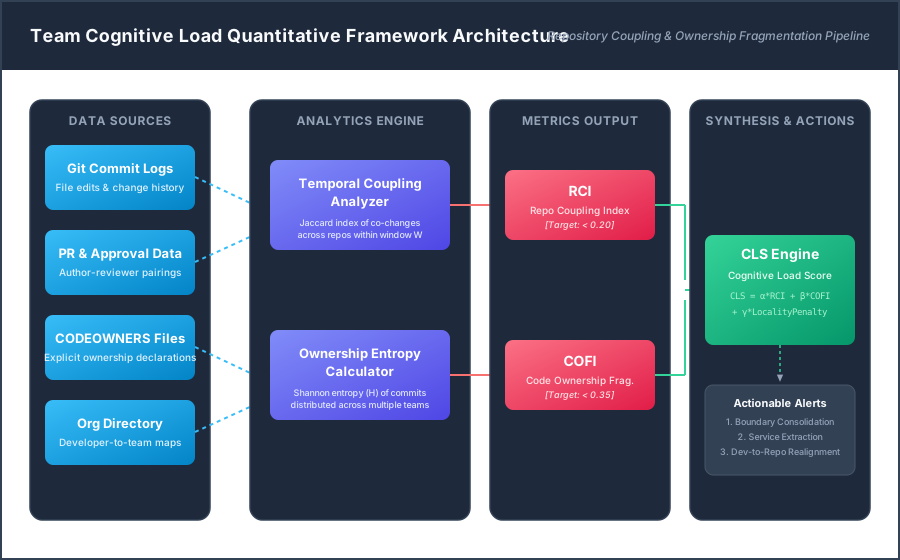
The Cost of Unmeasured Cognitive Load in Production
In microservice architectures, we often talk about decoupling services, but we rarely talk about decoupling the teams that build them. When team boundaries and codebase boundaries diverge, the organization enters a state of architectural friction. This is Conway’s Law in action: an organization that designs systems is constrained to produce designs which are copies of the communication structures of these organizations. If your teams are highly cross-functional but must coordinate changes across multiple shared repositories to deploy a single feature, your architecture is not decoupled—it is a distributed monolith.
The production consequences of unmeasured cognitive load are severe:
- The Deployment Coordination Lock: A release requires deploying Service A, then Service B, then Service C in a precise sequence. If Service B fails, the rollback path is undocumented and risky, leading to database schema mismatches and cascading failures.
- Architecture Drift: When multiple teams modify the same repository without a single clear owner, the codebase develops split personalities. You will find three different HTTP clients, conflicting logging configurations, and duplicate helper functions.
- Dependency Rot: Shared libraries or services with fragmented ownership rarely get upgraded. No single team wants to take responsibility for upgrading Spring Boot or Node.js versions because they are afraid of breaking downstream consumers they don’t understand.
To solve this, we must transition from subjective feedback (“our velocity feels slow”) to objective metrics. We do this by measuring two critical dimensions: Repository Coupling and Ownership Fragmentation.
Quantifying Systemic Friction: The Metric Dimensions
To build a quantitative model of cognitive load, we analyze two distinct dimensions of git metadata over a rolling time window $T$ (typically 90 days):
- Repository Coupling Index (RCI): This measures the degree to which codebases are temporally coupled. If changes to Repository A routinely require simultaneous changes to Repository B, they are logically coupled, regardless of their separate deployability.
- Code Ownership Fragmentation Index (COFI): This measures the dispersion of code contributions across different teams. A repository with high contribution dispersion lacks a single guardian, leading to architectural entropy.
By combining these two metrics, we can map every repository and team onto a quadrant, identifying high-risk areas where cognitive load exceeds sustainable thresholds.
Dimension 1: Repository Coupling Index (RCI)
Temporal coupling occurs when two or more repositories are modified in tandem to deliver a single logical change. We define this using commit history metadata.
Let $P$ be the set of all logical change units (such as Pull Requests or Jira ticket IDs) completed within the time window $T$. For a given repository $R_x$, let $P(R_x)$ be the subset of pull requests that modified files within $R_x$.
The Repository Coupling Index ($RCI$) between two repositories $R_1$ and $R_2$ is calculated using the Jaccard similarity coefficient:
\[RCI(R_1, R_2) = \frac{|P(R_1) \cap P(R_2)|}{|P(R_1) \cup P(R_2)|}\]Where:
-
$ P(R_1) \cap P(R_2) $ is the number of pull requests that modified both $R_1$ and $R_2$. -
$ P(R_1) \cup P(R_2) $ is the total unique pull requests that modified either $R_1$ or $R_2$ or both.
Interpreting RCI Thresholds
- $RCI < 0.10$ (Low Coupling): The systems are decoupled. Teams can work on $R_1$ independently of $R_2$.
- $0.10 \le RCI \le 0.25$ (Moderate Coupling): Typical for shared API contracts or client libraries. Acceptable, but should be monitored.
- $RCI > 0.25$ (High Coupling): Warning boundary. Changes to $R_1$ require changes to $R_2$ in more than 25% of cases. This indicates that their domain boundaries are leaky and developers must maintain mental models of both codebases simultaneously.
If a developer must submit concurrent pull requests to both order-service and payment-service to implement a new payment method, they are paying a cognitive context-switching tax. If the RCI between these two repositories is 0.35, they are effectively a single service split by a network boundary.
Dimension 2: Code Ownership Fragmentation Index (COFI)
When ownership is fragmented, code quality decays because no single team is responsible for the long-term health of the codebase. We quantify ownership fragmentation using Shannon Entropy, which measures the uncertainty or dispersion of contributions.
Let $T_{teams}$ be the set of all engineering teams in the organization. For a repository $R$, let $C_t$ be the volume of changes (measured in commits or lines of code modified) contributed by members of team $t \in T_{teams}$ during the time window $T$.
The total change volume for the repository is:
\[C_{total} = \sum_{t \in T_{teams}} C_t\]The contribution proportion for team $t$ is:
\[p_t = \frac{C_t}{C_{total}}\]The Raw Ownership Entropy $H(R)$ is calculated as:
\[H(R) = -\sum_{t \in T_{teams}} p_t \log_2(p_t)\]To normalize this metric across repositories with varying numbers of contributing teams, we divide the raw entropy by the maximum possible entropy for the number of active teams ($N$):
\[COFI(R) = \frac{H(R)}{\log_2(N)}\]Where $N$ is the number of teams that made at least one contribution ($C_t > 0$) during the window. If $N \le 1$, then $COFI(R) = 0$.
Interpreting COFI Thresholds
- $COFI < 0.20$ (Strong Ownership): A single team dominates the contributions. The codebase has clear custodians who understand the architecture.
- $0.20 \le COFI \le 0.50$ (Shared Ownership): Two or three teams contribute regularly. This is common in joint platform/product initiatives but requires alignment.
- $COFI > 0.50$ (Fragmented Ownership): The codebase is a “tragedy of the commons.” Many teams make drive-by contributions, but no single team owns the technical debt, library upgrades, or test suite maintenance.
Synthesizing the Cognitive Load Score (CLS)
An individual team doesn’t work in a vacuum; they interact with a portfolio of repositories. To calculate the Cognitive Load Score ($CLS$) for a specific team $T_x$, we evaluate the repositories they interact with, weighted by the team’s effort distribution.
Let $R(T_x)$ be the set of repositories where team $T_x$ contributed at least 5% of the total commits during window $T$. For each repository $r \in R(T_x)$, we define the effort weight $w(r)$ as the proportion of team $T_x$’s total commits that were committed to repository $r$:
\[w(r) = \frac{\text{Commits}(T_x, r)}{\sum_{r' \in R(T_x)} \text{Commits}(T_x, r')}\]The Cognitive Load Score ($CLS$) for team $T_x$ is:
\[CLS(T_x) = \sum_{r \in R(T_x)} w(r) \cdot \left[ \alpha \cdot COFI(r) + \beta \cdot \max_{r' \neq r} RCI(r, r') \right]\]Where:
- $\alpha$ and $\beta$ are calibration weights (we recommend $\alpha = 0.6$ and $\beta = 0.4$, prioritizing internal ownership health over external coupling).
- $\max_{r’ \neq r} RCI(r, r’)$ is the maximum coupling index between repository $r$ and any other repository in the system.
Concrete Example Calculation
Let’s compute the CLS for Team Alpha, who split their time between three repositories:
| Repository | Commits by Alpha | Total Commits | COFI | Max RCI (with partner repo) |
|---|---|---|---|---|
order-api |
140 (70%) | 150 | 0.12 | 0.35 (with inventory-service) |
payment-lib |
40 (20%) | 200 | 0.82 | 0.08 (with payment-gateway) |
reporting-db |
20 (10%) | 100 | 0.45 | 0.40 (with order-api) |
- Calculate Weights:
- $w(\text{order-api}) = 0.70$
- $w(\text{payment-lib}) = 0.20$
- $w(\text{reporting-db}) = 0.10$
- Compute Repository Scores (using $\alpha = 0.6, \beta = 0.4$):
- $\text{Score}(\text{order-api}) = 0.6 \cdot 0.12 + 0.4 \cdot 0.35 = 0.072 + 0.14 = 0.212$
- $\text{Score}(\text{payment-lib}) = 0.6 \cdot 0.82 + 0.4 \cdot 0.08 = 0.492 + 0.032 = 0.524$
- $\text{Score}(\text{reporting-db}) = 0.6 \cdot 0.45 + 0.4 \cdot 0.40 = 0.27 + 0.16 = 0.430$
- Synthesize CLS:
- $CLS(\text{Alpha}) = (0.70 \cdot 0.212) + (0.20 \cdot 0.524) + (0.10 \cdot 0.430)$
- $CLS(\text{Alpha}) = 0.1484 + 0.1048 + 0.0430 = 0.2962$
At 0.296, Team Alpha is operating near the yellow warning threshold. While order-api is healthy from an ownership perspective (low COFI), its high coupling with inventory-service drags down the team’s focus. Meanwhile, their minor contributions to the highly fragmented payment-lib expose them to disproportionate cognitive friction.
Tooling and Implementation: Automating the Pipeline
You don’t need expensive enterprise software to run this analysis. The following Python script parses git log data, maps authors to teams using a teams.yaml configuration, and computes both RCI and COFI.
First, create a teams.yaml to map committer emails to organizational teams:
teams:
  billing-team:
    - primary.developer@company.com
    - secondary.developer@company.com
  fulfillment-team:
    - shipping.expert@company.com
  platform-team:
    - infra.wizard@company.com
Next, write the analysis script:
import subprocess
import yaml
import math
import json
from collections import defaultdict

def load_teams(config_path):
    with open(config_path, 'r') as f:
        config = yaml.safe_load(f)
    email_to_team = {}
    for team_name, emails in config.get('teams', {}).items():
        for email in emails:
            email_to_team[email.strip().lower()] = team_name
    return email_to_team

def get_git_commits(repo_path):
    # Retrieve commit hash, author email, commit time, and list of files changed
    cmd = ["git", "-C", repo_path, "log", "--pretty=format:COMMIT:%h|%ae|%at", "--name-only"]
    try:
        result = subprocess.run(cmd, capture_output=True, text=True, check=True)
    except subprocess.CalledProcessError as e:
        print(f"Error reading repository {repo_path}: {e}")
        return []

    commits = []
    current_commit = None

    for line in result.stdout.splitlines():
        line = line.strip()
        if not line:
            continue
        if line.startswith("COMMIT:"):
            if current_commit:
                commits.append(current_commit)
            parts = line[7:].split("|")
            current_commit = {
                "hash": parts[0],
                "author": parts[1].lower(),
                "time": int(parts[2]),
                "files": []
            }
        elif current_commit:
            current_commit["files"].append(line)

    if current_commit:
        commits.append(current_commit)

    return commits

def calculate_cofi(commits, email_to_team):
    team_commit_counts = defaultdict(int)
    total_mapped_commits = 0

    for commit in commits:
        team = email_to_team.get(commit["author"], "Unknown/External")
        # Exclude automated bot accounts
        if "bot" in commit["author"]:
            continue
        team_commit_counts[team] += 1
        total_mapped_commits += 1

    if total_mapped_commits == 0 or len(team_commit_counts) <= 1:
        return 0.0

    entropy = 0.0
    for team, count in team_commit_counts.items():
        p = count / total_mapped_commits
        entropy -= p * math.log2(p)

    num_teams = len(team_commit_counts)
    normalized_entropy = entropy / math.log2(num_teams)
    return normalized_entropy

def calculate_temporal_coupling(repo_commits_dict, time_window_seconds=600):
    # Identify temporal coupling based on changes within a 10-minute window by same author
    author_timeline = defaultdict(list)

    for repo_name, commits in repo_commits_dict.items():
        for commit in commits:
            author_timeline[commit["author"]].append({
                "repo": repo_name,
                "time": commit["time"],
                "hash": commit["hash"]
            })

    co_changes = defaultdict(set)
    individual_changes = defaultdict(set)

    for author, timeline in author_timeline.items():
        # Sort commits chronologically
        timeline.sort(key=lambda x: x["time"])
        for i, c1 in enumerate(timeline):
            individual_changes[c1["repo"]].add(c1["hash"])
            for j in range(i + 1, len(timeline)):
                c2 = timeline[j]
                if c2["time"] - c1["time"] > time_window_seconds:
                    break
                if c1["repo"] != c2["repo"]:
                    # Found a co-change between different repos within time window
                    pair = tuple(sorted([c1["repo"], c2["repo"]]))
                    co_changes[pair].add(c1["hash"])
                    co_changes[pair].add(c2["hash"])

    coupling_results = {}
    for pair, changes in co_changes.items():
        r1, r2 = pair
        union_size = len(individual_changes[r1]) + len(individual_changes[r2]) - len(changes)
        jaccard = len(changes) / union_size if union_size > 0 else 0
        coupling_results[f"{r1} <-> {r2}"] = jaccard

    return coupling_results

# Example execution flow
if __name__ == "__main__":
    email_to_team = load_teams("teams.yaml")
    repos = {
        "order-api": "/path/to/order-api",
        "payment-lib": "/path/to/payment-lib",
        "reporting-db": "/path/to/reporting-db"
    }

    repo_commits = {}
    cofi_results = {}

    for name, path in repos.items():
        commits = get_git_commits(path)
        repo_commits[name] = commits
        cofi_results[name] = calculate_cofi(commits, email_to_team)

    rci_results = calculate_temporal_coupling(repo_commits)

    print("COFI Analysis:")
    print(json.dumps(cofi_results, indent=2))
    print("\nTemporal RCI Analysis:")
    print(json.dumps(rci_results, indent=2))
This tooling can be integrated into your CI/CD pipelines as a nightly cron job, exporting output metrics to a Prometheus push gateway or an Elasticsearch index to be visualized in Grafana dashboards.
Real-World Interventions and Remediation Playbook
When these metrics start breaching acceptable limits, qualitative solutions (like “let’s communicate more”) will fail. You need concrete architectural and organizational interventions.
Pattern 1: Service Consolidation
When the RCI between two services exceeds 0.30, they are no longer independent. The network boundary between them is acting as a latency generator and a cognitive barrier.
- Action: Merge the repositories. Move the codebases into a single repository (either as a monorepo or a single deployment unit). This eliminates the cost of cross-repository pull requests, simplifies local debugging, and collapses the deployment pipeline down to a single artifact.
Pattern 2: Domain Realignment via CODEOWNERS
If a core database schema or shared service has a COFI higher than 0.60, it is subject to competing design paradigms and unstable contracts.
- Action: Implement strict
CODEOWNERScontrols. Define directory boundaries inside the repository. Team A might own the/billingsubtree, while Team B owns the/checkoutsubtree. The root config files should require approval from a platform team. Additionally, start deprecating shared code pathways in favor of clean internal package APIs.
Pattern 3: Interface Separation
If a repository is highly coupled ($RCI > 0.25$) but cannot be merged because it is owned by a separate team, you have a leaky abstraction interface.
- Action: Introduce a formal contract layer. Implement protocol buffers (Protobuf) or OpenAPI specifications with backward compatibility checks (using tools like
buf). Force teams to interact through defined APIs rather than shared library structures or shared database access.
Summary
By instrumenting your git metadata to track Repository Coupling and Code Ownership Fragmentation, you move cognitive load from a hand-wavy complaint to a measurable mathematical reality. Use these metrics to justify platform refactoring work to non-technical stakeholders, align your team structures with Conway’s Law, and restore delivery velocity to your engineering organisation.