Optimizing PostgreSQL Hot Standby Conflict Resolution under High-Write Workloads
A deep dive into managing query cancellations, database bloat, and replication lag in high-throughput PostgreSQL primary-replica architectures.
At 3:14 AM, the alerting system fires: replication lag on your read-replica fleet is spiking exponentially. On the primary node, disk I/O metrics climb to 95% saturation, while free storage alerts indicate disk space is dropping by gigabytes per minute. You trace the incident to a heavy reporting query running on a physical hot standby replica. To keep this critical query from failing, a team member had previously set max_standby_streaming_delay = -1, instructing the replica to pause log application indefinitely while a query is running. The replica paused recovery to let the query finish, but the primary kept churning out writes, forcing WAL files to pile up on the primary’s disk. Had the delay been left at its default 30-second value, the query would have been aborted with the dreaded ERROR: canceling statement due to conflict with recovery. This scenario highlights the classic, zero-sum dilemma of PostgreSQL Hot Standby replication under high-write workloads: you can prioritize real-time read consistency, or you can allow long-running analytical queries, but without deliberate architectural engineering, you cannot have both.
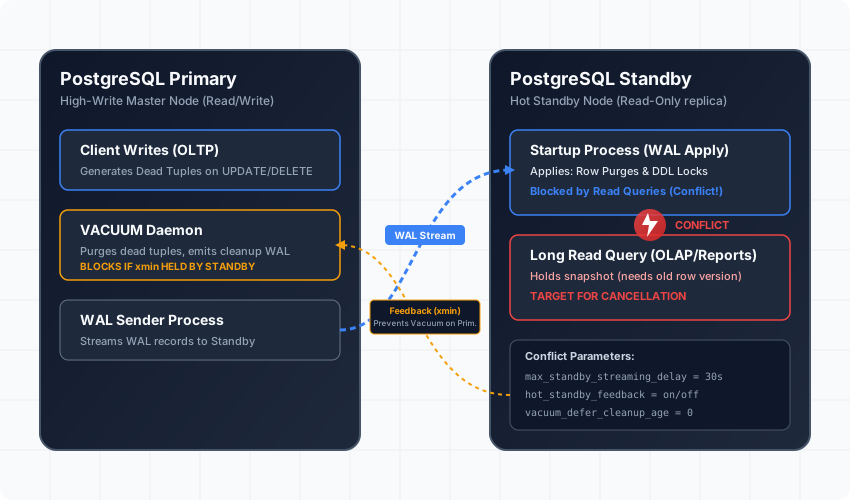
Under the Hood: MVCC, WAL, and the Genesis of Conflicts
To understand why standby conflicts occur, we must examine the physical storage mechanics of PostgreSQL. PostgreSQL uses Multi-Version Concurrency Control (MVCC) to ensure that write operations do not block read operations, and vice versa. Under MVCC, when a row is updated or deleted, PostgreSQL does not physically overwrite or remove the data on the disk block. Instead, it creates a new version of the row (a tuple) and updates the visibility metadata of both the old and new tuples using transaction IDs (specifically xmin and xmax).
When a transaction deletes a row, the row is marked as dead by setting its xmax to the deleting transaction’s ID. Once this transaction commits and there are no other active transactions in the database that still need to see the older state of the row, the dead tuple becomes eligible for cleanup. The autovacuum daemon periodically scans the database blocks, purges these dead tuples, updates the Free Space Map (FSM), and defragments the page.
In a primary-replica topology, replication is physical. The primary streams Write-Ahead Log (WAL) records representing raw page-level modifications to the standby. When the replica’s Startup Process receives these WAL records, it applies them sequentially to maintain block-level parity with the primary.
This design creates a structural conflict. When autovacuum cleans up dead tuples on the primary, it writes WAL records indicating that those specific heap tuples are being removed. When these cleanup records arrive at the standby, the replica’s Startup Process must apply them to keep the physical pages synchronized. However, a read-only query running on the standby might hold an active snapshot that still needs to see those exact tuples to maintain read consistency (i.e., the query’s snapshot xmin is older than the transaction ID that deleted the tuples).
If the standby applies the WAL record immediately, it physically deletes the tuples out from under the active read query, breaking isolation guarantees. If it waits for the read query to finish, it pauses recovery, causing the standby to fall behind the primary. This standoff is the root cause of Hot Standby conflicts.
Anatomy of Hot Standby Conflicts in Production
PostgreSQL classifies replication conflicts into several distinct categories. Understanding the technical mechanics of each conflict type is crucial for diagnosing replica degradation:
1. Snapshot Conflicts (Vacuum Cleanup)
This is the most common conflict in production. It occurs when a query on the standby needs to read a row version that the primary’s autovacuum has already determined is dead and has removed. When the WAL record containing the cleanup information reaches the standby, the Startup Process must remove the tuple. If a standby backend is running a transaction whose snapshot still needs to see that tuple, a conflict arises.
- Log Signature:
ERROR: canceling statement due to conflict with recovery
DETAIL: User query might have needed to see row versions that must be removed.
2. Lock Conflicts
Lock conflicts occur when a DDL command (such as ALTER TABLE, DROP TABLE, VACUUM FULL, or TRUNCATE) executes on the primary. These operations acquire an AccessExclusiveLock on the target relation. This lock is recorded in the WAL. When the standby Startup Process applies this WAL record, it attempts to acquire the AccessExclusiveLock on the replica’s local table metadata. However, active read queries on the replica hold a shared AccessShareLock on the same table. Because AccessExclusiveLock conflicts with all other lock types, the Startup Process is blocked.
- Log Signature:
ERROR: canceling statement due to conflict with recovery
DETAIL: User query might have needed to acquire shared lock on relation.
3. Buffer Pin Conflicts
When the Startup Process needs to modify a page in shared buffers (for example, to clean up index pointers or defragment a page) and a standby query is currently pinning that page in memory to read it, the Startup Process must wait. It cannot modify pinned buffers. If the pin is not released within the configured delay, the query holding the pin is terminated.
- Log Signature:
ERROR: canceling statement due to conflict with recovery
DETAIL: User query might have needed to hold buffer pin.
4. Deadlock and Tablespace Conflicts
If a tablespace is dropped on the primary, the replica must drop its local representation of the tablespace. If a standby query is actively using temp files in that tablespace, a conflict occurs.
- Log Signature:
ERROR: canceling statement due to conflict with recovery
DETAIL: User query might have needed to access tablespace.
Tuning Parameters and Their Failure Modes
PostgreSQL provides two primary parameters to govern standby conflict behavior: max_standby_streaming_delay and hot_standby_feedback. While they appear to offer simple solutions, tuning them under high-write workloads requires evaluating critical engineering trade-offs.
Parameter 1: max_standby_streaming_delay
This parameter defines the maximum time the Startup Process will wait before canceling a standby query that conflicts with incoming streaming WAL records. The default is 30s.
- Tuning Low (e.g.,
5s):- Benefit: Recovery lag is strictly capped. The replica stays closely aligned with the primary.
- Failure Mode: Read queries are frequently terminated. This disrupts application read paths, leading to high error rates and client retry storms that can overwhelm the replica.
- Tuning High or Infinite (e.g.,
10minor-1):- Benefit: Long-running reporting queries are allowed to run to completion.
- Failure Mode: Recovery lag spikes. Under high-write workloads (e.g., 20,000 writes/sec), pausing recovery for even 5 minutes causes the standby to fall millions of write operations behind. This leads to three severe failure modes:
- Stale Reads: Application reads routed to the replica return outdated data, violating read-after-write consistency (e.g., a user updates their profile, refreshes, and sees old data).
- Extended RTO (Recovery Time Objective): If the primary fails, the replication lag dictates how long it will take the standby to catch up and promote itself. A replica with a 30-minute lag means a minimum of 30 minutes of downtime during failover.
- Disk Exhaustion: If replication slots are used, the primary must retain WAL files until the replica has acknowledged them. A paused replica forces the primary to accumulate WAL files. If
max_slot_wal_keep_sizeis not configured, the primary’s disk will fill up, crashing the entire database cluster.
Parameter 2: hot_standby_feedback
To address snapshot conflicts without increasing replication lag, PostgreSQL provides hot_standby_feedback = on. When enabled, the standby sends the xmin (the oldest transaction ID it needs to see) of its active transactions back to the primary via the replication channel. The primary uses this feedback to adjust its global cleanup threshold. Autovacuum on the primary will respect this threshold and refuse to clean up any dead tuples that are younger than the standby’s active xmin.
This seems like an ideal solution: no snapshot conflicts, no query cancellations. However, under high-write workloads, it introduces a severe production risk: Primary Table Bloat.
Consider an application performing 5,000 updates/deletes per second on the primary. A user runs a reporting query on the standby replica that takes 1 hour to execute. With hot_standby_feedback = on, the standby registers its old xmin with the primary. For that hour, the primary’s autovacuum cannot clean up any dead tuples created after that xmin.
- Over 1 hour, the primary accumulates $5,000 \times 3600 = 18,000,000$ dead tuples.
- The physical sizes of the tables and indexes on the primary expand rapidly.
- Cache efficiency collapses as active data is evicted from shared buffers to make room for dead pages.
- Index scans on the primary degrade because queries must traverse massive numbers of dead pointers.
- When the standby query finally completes and the
xminadvances, autovacuum wakes up to purge the 18 million dead tuples. This triggers a massive, prolonged spike in disk write I/O, saturating storage throughput and degrading primary transaction latencies.
Additionally, hot_standby_feedback only prevents snapshot conflicts. It does not prevent lock conflicts (e.g., DDL execution on the primary).
Designing a Resilient Read Replica Architecture
Resolving standby conflicts under high-write workloads requires moving away from single-parameter tuning and implementing structural architectural changes. Below are four strategies used in modern high-performance database architectures.
Strategy 1: Segregating Workloads via Logical Replication
Physical replication replicates the physical storage layout. Logical replication replicates raw SQL changes (DML). Because logical replication does not replicate physical page cleanups or MVCC layout structures, read queries running on a logical replica do not experience snapshot conflicts or buffer pin conflicts. You can run a 24-hour analytical query on a logical replica without blocking recovery or causing bloat on the primary.
- When to use: For heavy BI reporting, data warehousing, OLAP, and analytics.
- Trade-off: Logical replication has higher CPU overhead, does not support DDL changes automatically, and does not provide an instant HA failover target.
Strategy 2: Workload Partitioning on Physical Standbys
If you must use physical replicas, set up multiple replicas with distinct configurations tailored to specific traffic profiles:
- High-Availability (HA) Replica:
- Purpose: Instant failover.
- Configuration:
max_standby_streaming_delay = 10s,hot_standby_feedback = off. - Traffic: No user queries, or only extremely short, low-latency reads (under 1s).
- Result: Near-zero replication lag, safe failover target.
- Reporting/Dashboard Replica:
- Purpose: Internal tool queries and dashboards.
- Configuration:
max_standby_streaming_delay = 5min,hot_standby_feedback = off. - Traffic: Read-only queries with a maximum execution time of 5 minutes.
- Result: Accepts some replication lag, cancels runaway queries, prevents primary table bloat.
- Ad-Hoc / Data Science Replica:
- Purpose: Complex, long-running data science queries.
- Configuration:
hot_standby_feedback = onbut paired with strict connection timeouts and automated termination of sessions idle for more than 5 minutes.
Strategy 3: Tightening Standby Query Limits and Connection Pools
Never expose a physical read replica directly to arbitrary, untrusted application traffic without guardrails. Implement connection pooling (e.g., PgBouncer) and apply strict session configurations at the replica level.
Configure these settings in your standby’s postgresql.conf:
statement_timeout = 30000          # Terminate any query taking > 30 seconds
idle_in_transaction_session_timeout = 10000  # Terminate idle transactions in 10s
Additionally, write your application code to retry failed replica queries. When a query is canceled due to a recovery conflict, catching the error and retrying the query on a helper replica or back-off schedule mitigates user impact.
Strategy 4: Primary Protection with Safety Limits
If you must enable hot_standby_feedback or use physical replication slots, protect your primary database from running out of disk space or bloating to death by setting hard limits.
In the primary’s postgresql.conf:
# Prevent WAL slots from retaining infinite WAL files
max_slot_wal_keep_size = 102400    # Limit slot storage to 100 GB
If a standby falls behind and requires more than 100 GB of WAL data, the primary will drop the slot to save itself. The standby will fail to replicate and must be rebuilt, but this is vastly preferable to a primary database crash due to disk exhaustion.
Observability, Alerting, and Mitigation Runbook
To maintain stability under high-write workloads, you must establish automated observability around standby conflicts and replication health.
1. Monitor Standby Conflicts
Query the pg_stat_database_conflicts catalog view on your standby replicas to monitor the rate of conflict-driven statement cancellations:
SELECT
    datname,
    confl_tablespace,
    confl_lock,
    confl_snapshot,
    confl_bufferpin,
    confl_deadlock
FROM pg_stat_database_conflicts;
A steady rise in confl_snapshot indicate vacuum conflicts, while spikes in confl_lock point to DDL executions on the primary.
2. Measure Replication Lag
To prevent stale reads and monitor recovery delays, track replication lag in bytes directly on the standby:
SELECT
    pg_wal_lsn_diff(pg_last_wal_receive_lsn(), pg_last_wal_replay_lsn()) AS replay_lag_bytes,
    pg_size_pretty(pg_wal_lsn_diff(pg_last_wal_receive_lsn(), pg_last_wal_replay_lsn())) AS replay_lag_readable;
3. Track Table Bloat on the Primary
If hot_standby_feedback is enabled, monitor table bloat on the primary to catch database expansion before it degrades performance. You can use the pgstattuple extension to inspect physical page layouts:
-- Install the extension (run once on primary)
CREATE EXTENSION IF NOT EXISTS pgstattuple;

-- Analyze table layout and retrieve dead tuple percentage
SELECT
    table_len,
    tuple_count,
    tuple_len,
    dead_tuple_count,
    dead_tuple_len,
    round(dead_tuple_len * 100.0 / table_len, 2) AS bloat_percentage
FROM pgstattuple('your_large_table');
Recommended Alerting Thresholds
- Critical Replication Lag: Trigger an alert if replication lag on the HA standby exceeds 500 MB or 60 seconds.
- Slot Status: Alert immediately if
pg_replication_slots.activeis false for any critical streaming slot. - Primary Disk Alert: Set a warning at 80% disk capacity, and a critical alert at 90%. Under high-write workloads, a blocked WAL cleanup can consume the remaining 10% in minutes.
- Replica Cancellation Rate: Alert if the statement cancellation rate due to recovery conflicts exceeds 1% of total queries on user-facing replicas.