Optimizing Multi-LoRA Serving in Production: Dynamic Adapter Swapping with Triton Inference Server
A production guide to dynamic LoRA adapter swapping on Triton Inference Server using tiered caching and Business Logic Scripting.
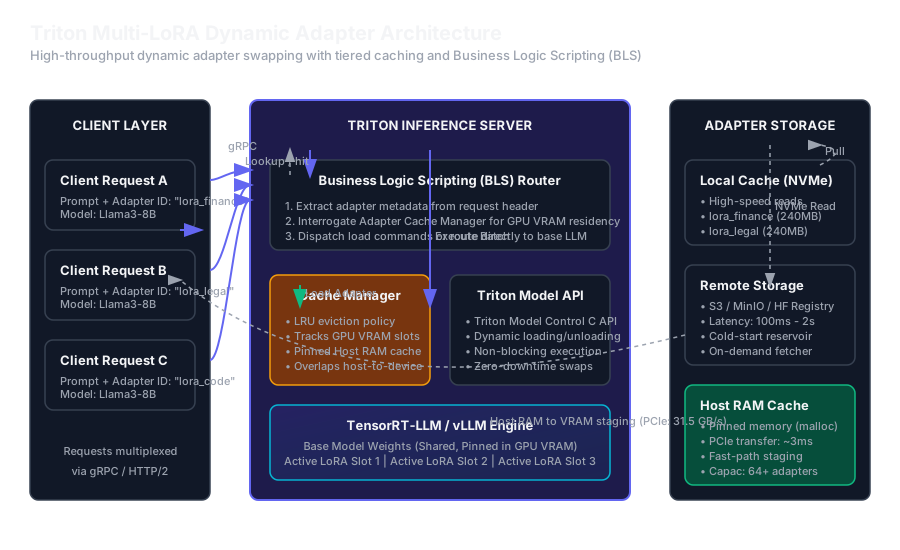
Serving fine-tuned Large Language Models (LLMs) at scale introduces a steep economic and engineering challenge. In multi-tenant enterprise applications, tenants require custom model behaviors, domain-specific vocabularies, and unique prompt alignments. Deploying dedicated, full-parameter model instances for hundreds of tenants—even for smaller open weights like Llama-3-8B—results in astronomical GPU memory requirements and cost structures. Low-Rank Adaptation (LoRA) solves the training bottleneck by isolating adapter parameters to 50–250MB per tenant. However, serving these adapters in production introduces critical bottlenecks: dynamic network fetches, disk I/O penalties, memory fragmentation, and GPU cache thrashing. To maintain sub-10ms adapter swapping overhead under concurrent high-throughput workloads, platform engineers must build a tiered caching layer and coordinate runtime scheduling. This post details how to implement a production-grade multi-LoRA serving system using Triton Inference Server, leveraging Business Logic Scripting (BLS) and vLLM’s dynamic LoRA backend.
The Multi-LoRA Serving Bottleneck: Memory vs. Latency
To understand why serving multi-LoRA is difficult, we must look at the hardware math. A base Llama-3-8B model running in FP16 consumes approximately 16GB of VRAM. In a production serving environment, we also have to allocate a significant portion of VRAM to the Key-Value (KV) cache to handle batching and long context lengths. A typical production setup might allocate 80-90% of GPU memory to the base model and its KV cache, leaving a tiny sliver of memory for runtime adapters.
If we host 100 separate model instances for 100 tenants, we require at least 2.4TB of VRAM, translating to a cluster of at least 30 NVIDIA A100 (80GB) GPUs. With a shared base model and dynamic LoRA, the base model is permanently pinned in memory, and the adapter weights are dynamically applied during the forward pass. A rank-16 LoRA adapter targeting the query, key, value, and projection layers (${W_q, W_k, W_v, W_o}$) represents only ~20-50M parameters, taking 40-100MB of VRAM in FP16. 100 adapters require just 4-10GB of storage.
However, naive dynamic loading introduces severe latency penalties. When a request requires an adapter that is not resident in GPU memory, the engine must fetch it.
- S3 Network Pulls: Fetching a 100MB adapter from an object store over a standard 10Gbps connection takes 80-150ms of raw network time, plus 100-200ms of TLS and HTTP connection overhead.
- NVMe Reads: Reading the adapter files from a high-speed local NVMe SSD (PCIe Gen3 x4) takes ~30-50ms due to kernel context switches, file system traversal, and serialization overhead.
- PCIe Bus Transfers: Staging the weights from Host RAM to GPU memory over PCIe Gen4 x16 takes ~3.1ms.
If these operations occur synchronously on Triton’s primary execution threads, they trigger head-of-line blocking. The dynamic batcher stalls, queuing up other requests and causing SLA breaches for all tenants. Mitigating this requires a tiered caching architecture that moves adapters asynchronously across three distinct memory boundaries: Remote Object Storage, Local NVMe Disk, and Host RAM, before they are mapped into GPU VRAM.
Architecture of a Dynamic Swap Engine on Triton
The most performant way to serve multi-LoRA is backend-level dynamic swapping. Instead of treating each adapter as a separate Triton model and calling Triton’s C++ Model Control API (which incurs significant overhead from graph rebuilds and memory allocations), we keep a single base model active using the vLLM backend. The backend manages its own internal GPU LoRA pool and exposes input tensors for the adapter’s metadata.
The Triton Business Logic Scripting (BLS) orchestrator acts as the front gateway. When a client request arrives:
- The BLS router intercepts the request and extracts the
adapter_id. - It queries a thread-safe cache manager to determine the status of the adapter weights on the host system.
- If the adapter is not present on the local NVMe disk, the router triggers a download from the remote S3 registry (a cold start).
- Once the adapter is verified on the local disk, the BLS router forwards the prompt, sampling parameters, and the local file system path of the adapter to the vLLM base model.
- The vLLM backend reads the adapter weights, dynamically maps them into its GPU memory pool using custom CUDA kernels (such as Punica or Grouped GEMM), and executes the forward pass.
Let’s implement the base model configuration.
The parameters max_loras and max_lora_rank statically reserve GPU memory for active adapters during initialization. This prevents runtime CUDA Out-of-Memory (OOM) failures. max_cpu_loras sets the upper bound for the backend’s Host RAM cache.
Next, we configure the Python-based BLS orchestrator model.
This BLS model runs on the CPU. We configure a instance group size of 8 to ensure the Python GIL (Global Interpreter Lock) does not bottleneck request routing and disk cache lookups under high concurrent loads.
Implementing the BLS Orchestrator and Cache Manager
The BLS model (model.py) intercepts the request, manages the caching state machine, and calls the base model using Triton’s internal execution APIs.
The orchestrator relies on the AdapterCacheManager to ensure the files are staged on disk. The cache manager must be thread-safe, prevent redundant downloads when multiple requests request the same cold adapter simultaneously, and evict the least recently used (LRU) adapters when disk space bounds are hit.
Client-Side Request Routing and Metadata Handling
Clients must target the gRPC interface of Triton to minimize network deserialization bottlenecks. Below is a production-ready client sending inference requests to the router.
Mitigating Production Failure Modes
Operating a dynamic Multi-LoRA system in production requires guarding against several critical edge cases.
1. Cache Thrashing under High Cardinality
If your application serves 1,000 distinct tenants but your active GPU cache pool size is restricted to max_loras = 32, and requests are uniformly distributed, the serving engine will spend all its time evicting and reloading adapters. This results in the PCIe bus becoming saturated and request latencies climbing from 15ms/token to >150ms/token.
Mitigations:
- Tenant-Aware Routing: Deploy a router at the ingress level (e.g., Envoy or a custom Go gateway). Route requests containing the same
adapter_idto the same physical Triton node. By partitioning the tenant space across nodes (consistent hashing onadapter_id), you maximize the local cache hit rate. - Dynamic Batch Grouping: Triton’s dynamic batcher can group requests by input parameters. Configure your routing layer to queue requests for up to 5-10ms to batch requests matching the same
adapter_idtogether. This executes multiple prompts against a single load cycle, amortizing the swapping overhead.
2. CUDA Out-of-Memory (OOM) Crashes
If you configure vLLM to utilize 90% of GPU memory for the KV Cache (gpu_memory_utilization = 0.90) and then attempt to dynamically load several large LoRA adapters, Triton will encounter a hardware allocation failure and crash.
Mitigations:
- Static Memory Reserving: Keep
gpu_memory_utilizationat0.80or0.82. The remaining 18% of VRAM is reserved for the OS, Triton backend overhead, and the static memory buffer required by the active LoRA pool. - Determine Safe Pool Size: Calculate the VRAM footprint of your maximum rank adapter:
\(\text{Memory Size} = 2 \times \text{Parameters} \times \text{Bytes per Parameter}\)
A rank-16 Llama-3-8B adapter requires ~48MB of VRAM. A pool of 32 adapters requires $32 \times 48\text{MB} = 1.536\text{GB}$. Set the
max_lorasparameters to match this allocated budget precisely.
3. Dynamic Load Latency Spikes (Cold Starts)
When a request hits a cold adapter, the client experiences a delay of several seconds while the file is pulled from S3.
Mitigations:
- Asynchronous Warm-up: Never download on the critical path if it can be avoided. Provide an administrative API
/warmthat tenants trigger immediately after training or during workspace activation. This API calls the Cache Manager to pull the files onto NVMe before live traffic is routed. - Pre-warming Scripts: Run a startup script to pull the most active adapters onto NVMe before Triton begins serving traffic.
Performance Metrics: Benchmarking the Overhead
Evaluating this dynamic multi-LoRA system under load reveals the performance characteristics of the various caching tiers:
- GPU Cache Hit (Resident): The adapter is already loaded in VRAM. The attention kernels map the inputs to the correct adapter parameters instantly. The latency overhead is < 0.5ms, making it indistinguishable from executing the base model alone.
- Host RAM Cache Hit (Staged): The adapter is in pinned Host RAM but must be copied to GPU. The transfer happens over PCIe Gen4 x16 at a rate of 31.5 GB/s. A 100MB adapter takes ~3.2ms to copy, resulting in a minor latency penalty that is imperceptible to the client.
- NVMe Disk Cache Hit: The adapter is on the NVMe disk and must be read into Host RAM, then copied to GPU. Reading from NVMe takes 30-50ms. The client will experience a slight delay on the first token (Time-to-First-Token, or TTFT), but subsequent tokens will stream at normal speeds.
- Cold Miss (S3 Download): The adapter must be downloaded from S3, written to NVMe, loaded to RAM, and pushed to GPU. This incurs a latency penalty of 400ms to 1.5 seconds depending on network congestion, connection pooling, and the size of the adapter.
By optimizing cache residency through client-side routing and pre-warming the NVMe disks with your hottest adapters, you can guarantee a cache hit rate of over 95%, ensuring sub-10ms adapter switching overhead for almost all client requests.