Optimizing LLM Context Reuse with vLLM Prefix Caching and Chunked Prefill
A production-focused guide to optimizing LLM serving using vLLM's automatic prefix caching and chunked prefill to maximize throughput and minimize latency.
Deploying large language models (LLMs) in high-throughput production environments—such as multi-turn conversational agents, complex retrieval-augmented generation (RAG) loops, or large-document summarization services—quickly exposes the massive economic and physical bottlenecks of standard transformer inference. When serving requests on multi-GPU nodes (like 8x H100 or A100 setups costing upwards of $15,000 per month), up to 70% of compute cycles are often wasted repeatedly processing identical system instructions, static prompt templates, or retrieved document contexts. This redundant computation spikes Time-to-First-Token (TTFT) and consumes valuable GPU memory through duplicate key-value (KV) cache allocations, causing concurrent requests to starve. To maximize hardware efficiency and prevent latency degradation under high concurrency, platforms must shift from naive static batching to state-of-the-art context optimization techniques. By combining vLLM’s Automatic Prefix Caching (APC) with Chunked Prefill, engineers can completely bypass prefill computations for recurrent prompt components while interleaving remaining prefill cycles with active token generation to maintain smooth, predictable inter-token latencies.
The Compute Disparity: Prefill Bottlenecks vs. Decode Memory Limits
To build a high-performance LLM serving layer, backend engineers must model LLM execution as two completely distinct runtime phases, each bounded by different hardware limits:
- The Prefill Phase (Compute-Bound): When a prompt is submitted, the model processes all input tokens in parallel. This phase is characterized by matrix-matrix multiplications (GEMMs) that map directly to GPU Tensor Cores. Because it evaluates all attention relationships simultaneously, its compute complexity scales quadratically ($O(N^2)$) with the prompt length $N$. A large RAG prompt containing 8,000 context tokens blocks GPU execution streams for hundreds of milliseconds, creating a scheduling bottleneck that halts all other concurrent operations.
- The Decode Phase (Memory-Bandwidth Bound): During token generation, the model generates exactly one token at a time. This requires loading the entire model’s weights and the KV cache of all previous tokens from high-bandwidth memory (HBM) to the GPU’s registers for every single step. This phase is memory-bandwidth bound, constrained by how fast parameters can be read rather than raw FLOP availability.
When a standard inference engine receives a large prompt while concurrently processing 32 active decoding streams, it prioritizes the new prompt’s prefill. This creates a "prefill bubble"—a period where the GPU Tensor Cores are fully saturated by the incoming request. Consequently, the active decode requests are stalled, causing a massive spike in Inter-Token Latency (ITL) and violating strict P99 latency SLAs.
vLLM Automatic Prefix Caching (APC): Mechanics and Memory Layout
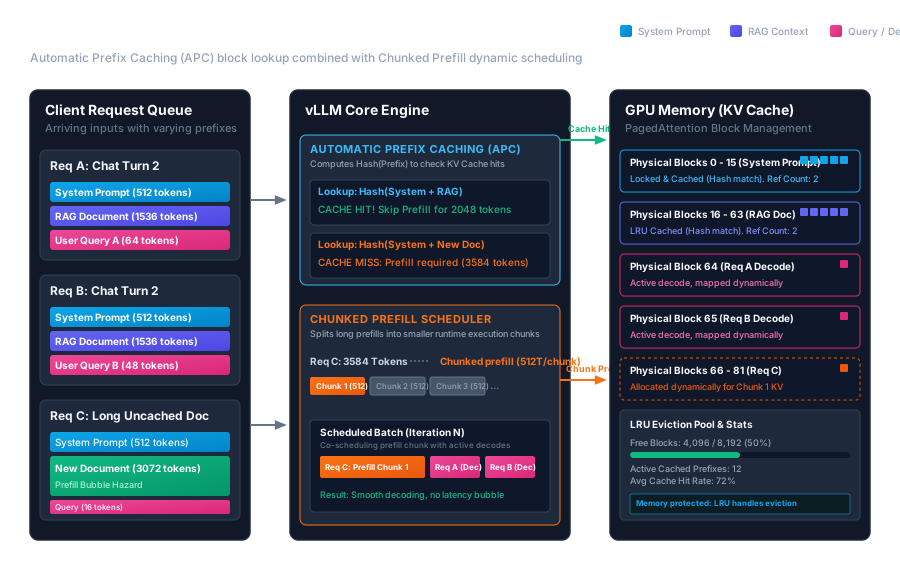
Automatic Prefix Caching (APC) in vLLM optimizes workloads that reuse prefix text by matching requests against previously computed KV cache blocks. Built on top of the PagedAttention memory manager—which treats GPU memory as page-allocated virtual memory similar to operating system paging—APC divides the KV cache into logical blocks, with a default size of 16 tokens per block.
The Radix Tree Cache
Instead of maintaining a flat key-value lookup, vLLM models cached prefixes as a Radix Tree. Each node in the tree corresponds to a sequence of tokens, and its child nodes represent subsequent extensions of that prefix.
- When a prompt arrives, vLLM tokenizes it and calculates the cryptographic hash of its token blocks.
- The engine traverses the Radix Tree from the root, matching block hashes against active nodes.
- If a match is found (a Cache Hit), vLLM retrieves the precomputed physical KV cache blocks directly from the GPU HBM, skipping the prefill computation for those tokens.
- If a partial match occurs, vLLM only runs the prefill phase for the missing suffix tokens, appending the resulting new blocks as children of the matched prefix node in the tree.
- Once a request finishes, its physical memory blocks are not freed back to the global pool immediately. Instead, they are moved to the Least Recently Used (LRU) eviction list, keeping them warm for subsequent hits.
The Physics of KV Cache Memory Savings
Sharing KV cache blocks directly increases the effective batch size of the GPU. To understand the scale of these savings, we can compute the precise memory footprint of the KV cache for a single token using the model’s structural parameters:
\[\text{Memory}_{\text{KV}} = 2 \times n_{\text{layers}} \times n_{\text{kv\_heads}} \times d_{\text{head}} \times b_{\text{bytes\_per\_elem}}\]Let’s calculate the memory required per token for Llama-3-8B-Instruct, which uses Grouped-Query Attention (GQA):
- $n_{\text{layers}} = 32$
- $n_{\text{kv_heads}} = 8$ (utilizing GQA, where query heads are grouped to share KV projections)
- $d_{\text{head}} = 128$
- $b_{\text{bytes_per_elem}} = 2$ (for FP16 precision)
For a prompt context containing 8,192 tokens:
\[\text{Memory}_{\text{KV\_total}} = 128 \text{ KB/token} \times 8,192 \text{ tokens} = 1.048 \text{ GB per request}\]In a naive system, serving 64 concurrent requests sharing a RAG context of 8,192 tokens requires allocating 67.07 GB of GPU memory just for the redundant prefill KV caches. Under APC, this context is stored exactly once in physical memory. The 64 concurrent clients merely maintain pointers to the shared blocks, reducing the total memory footprint to 1.048 GB (plus a minimal dynamic decode buffer of approximately 10MB per client), freeing up over 65 GB of high-speed GPU memory for additional throughput.
Production Failure Mode: Prompt Template Alignment and Cache Invalidation
The most common operational failure mode when deploying APC is cache invalidation due to dynamic prompt templates. Because the Radix Tree relies on sequential block hashing, any mutation in the prefix sequence invalidates the cache for that block and all subsequent child blocks.
Consider the following common template pattern:
[SYSTEM] You are a helpful assistant. Current Time: 2026-06-24 08:00:00 UTC.
[DOCUMENT CONTEXT]
Title: Q2 Financial Report
... (8000 tokens of static text) ...
[USER] What was the revenue growth?
In this structure, the dynamic time variable 2026-06-24 08:00:00 UTC is injected before the large static RAG context. When tokenized, the block representing the timestamp changes with every minute or request. Because vLLM computes hashes sequentially:
The dynamic block invalidates the hash for block $n$, which propagates down the chain, forcing the engine to re-prefill the entire 8,000-token document.
The Fix: Structural Optimization
To guarantee cache hits, restructure prompt templates to ensure all dynamic parameters (timestamps, unique user identifiers, conversation-specific variables) are located at the absolute end of the prompt, downstream of the heavy static data:
[SYSTEM] You are a helpful assistant.
[DOCUMENT CONTEXT]
Title: Q2 Financial Report
... (8000 tokens of static text) ...
[METADATA] Current Time: 2026-06-24 08:00:00 UTC.
[USER] What was the revenue growth?
With this ordering, the first 500 blocks containing the system prompt and document context retain identical tokens and hashes across requests. Only the final dynamic blocks miss the cache, saving 99% of prefill execution time and memory.
Chunked Prefill: Tackling the Latency Spikes of Uncached Prefills
While APC works exceptionally well for recurrent contexts, it cannot optimize the first-time prefill of a new document. If a client submits a new 16,000-token PDF, the engine is forced to execute a large, monolithic prefill. As explained earlier, this monolithic prefill blocks decoding execution streams, creating an ITL latency spike.
Chunked Prefill mitigates this by breaking down a monolithic prefill phase into smaller chunks (typically 512 or 1,024 tokens) and scheduling them incrementally across multiple inference iterations.
Co-Scheduling Mechanics
Rather than dedicating the GPU exclusively to processing a 4,096-token prefill, the scheduler breaks the prefill into 8 discrete chunks of 512 tokens. In each iteration, the scheduler constructs a co-scheduled batch:
\[\text{Batch}_{\text{iteration}} = \{ \text{Prefill Chunk (512 tokens)}, \text{Decode}_{1}, \text{Decode}_{2}, \dots, \text{Decode}_{m} \}\]By limiting the size of the prefill contribution to 512 tokens, the GEMM execution time is tightly bounded. The GPU Tensor Cores process the prefill chunk fast enough to keep execution within the time window allocated for decoding, maintaining a stable, low ITL for active streams.
The trade-off is a slight increase in the total prefill time (TTFT) for the incoming request, as its prefill is spread across several execution iterations. However, this is a highly acceptable trade-off in production, as it protects the system against P99 ITL violations.
Production Configuration and Tuning Guide
To deploy these optimizations in production, you must set the appropriate CLI arguments on the vLLM engine. Below is a production-hardened Docker Compose or Kubernetes deployment manifest setup for serving a Llama-3-8B model on a single NVIDIA A100 (80GB PCIe) GPU.
apiVersion: apps/v1
kind: Deployment
metadata:
  name: vllm-llama3-serving
  namespace: llm-serving
spec:
  replicas: 1
  selector:
    matchLabels:
      app: vllm-engine
  template:
    metadata:
      labels:
        app: vllm-engine
    spec:
      containers:
      - name: vllm-container
        image: vllm/vllm-openai:v0.4.3
        args:
        - "--model"
        - "meta-llama/Meta-Llama-3-8B-Instruct"
        - "--tensor-parallel-size"
        - "1"
        - "--gpu-memory-utilization"
        - "0.90"
        - "--max-model-len"
        - "8192"
        - "--enable-prefix-caching"
        - "--enable-chunked-prefill"
        - "--max-num-batched-tokens"
        - "512"
        - "--max-num-seqs"
        - "256"
        - "--block-size"
        - "16"
        - "--kv-cache-dtype"
        - "auto"
        resources:
          limits:
            nvidia.com/gpu: "1"
            memory: "64Gi"
            cpu: "16"
          requests:
            nvidia.com/gpu: "1"
            memory: "32Gi"
            cpu: "8"
        ports:
        - containerPort: 8000
          name: http
Explaining the Critical Flags
--enable-prefix-caching: Activates the internal Radix Tree block manager. This flag enables automatic prefix detection and mapping to PagedAttention blocks.--enable-chunked-prefill: Instructs the vLLM scheduler to split large prefill requests.--max-num-batched-tokens: Set to512in this config. This parameter controls the maximum number of tokens (prefill + decode) that can be processed in a single iteration. When chunked prefill is enabled, this acts as the upper bound for our prefill chunk size. Tuning this parameter requires balancing GPU utilization against latency constraints:- Higher values (e.g.,
1024or2048) increase GPU computation density and throughput, but can trigger latency spikes. - Lower values (e.g.,
512or256) minimize ITL variance but reduce overall throughput due to increased kernel launching overhead.
- Higher values (e.g.,
--gpu-memory-utilization: Allocated to0.90(90%). This reserves 10% of the GPU’s memory for activation states, PyTorch runtime buffers, and intermediate workspace variables, preventing Out-Of-Memory (OOM) crashes during large batch allocations.
Monitoring Prefix Caching and Scheduler Performance
You cannot optimize what you do not measure. A production deployment of vLLM must expose Prometheus metrics to track cache hit ratios, queue state, and memory pressure.
Key Prometheus Metrics to Dashboard
vllm:num_requests_waiting: The number of requests sitting in the queue waiting for prefill space. A sustained value above zero indicates the engine is saturated.vllm:num_requests_running: The number of active sequences running in the current batch.vllm:gpu_cache_usage_factor: The percentage of allocated GPU KV cache blocks currently in use. If this reaches1.0(100%), vLLM will begin evicting blocks from the LRU cache, or in extreme cases, preempt active requests.vllm:cpu_cache_usage_factor: The percentage of CPU swap space used for KV cache blocks. High CPU cache swap indicates memory pressure and results in high latency due to PCIe transfer times.- Prefix Cache Hit Ratio: vLLM exposes token-level cache statistics via the Prometheus metrics endpoint. We can extract the hit rate using the following PromQL query:
sum(rate(vllm_num_cached_tokens_total[5m]))
/
(sum(rate(vllm_num_cached_tokens_total[5m])) + sum(rate(vllm_num_prompt_tokens_total[5m])))
Grafana Dashboard Architecture
A production-ready Grafana dashboard for vLLM should display:
- KV Cache Allocation Panel: A gauge tracking
vllm:gpu_cache_usage_factor. Keep this below0.85for stable operational headrooms. - Latency Histogram: Tracking TTFT and ITL. If ITL spikes match incoming queue surges, it indicates that chunked prefill is disabled or
--max-num-batched-tokensis set too high. - Prefix Cache Hit Rate Panel: Tracking the PromQL query above. A drop in this rate indicates changes to downstream application templates (e.g., dynamic elements injected upstream) that are invalidating cached blocks.
Summary of Architectural Trade-offs
| Feature | Primary Advantage | Major Trade-off | Ideal Workloads |
|---|---|---|---|
| Automatic Prefix Caching | Eliminates prefill compute for reused contexts; saves massive GPU HBM memory. | Susceptible to cache invalidation from minor prompt formatting adjustments. | RAG pipelines with static documents, multi-turn chat applications, agentic tools with fixed prompts. |
| Chunked Prefill | Prevents ITL spikes and latency bubbles; ensures smooth scheduling of concurrent requests. | Slightly increases overall prefill execution times (TTFT). | Multi-tenant environments serving mixed prompt sizes; long document summarization. |
By aligning prompt template formats to preserve Radix Tree hash sequences and configuring vLLM’s scheduler to balance prefill and decode execution times, backend engineers can scale LLM platforms to handle thousands of concurrent queries without incurring exponential hardware costs or violating latency agreements.