Mitigating Replay Attacks in AWS IAM Roles Anywhere with Cryptographic Challenge-Response and SPIFFE
Mitigate SigV4 replay attacks in AWS IAM Roles Anywhere by combining SPIFFE/SPIRE memory-only certificates with a cryptographic challenge-response broker.
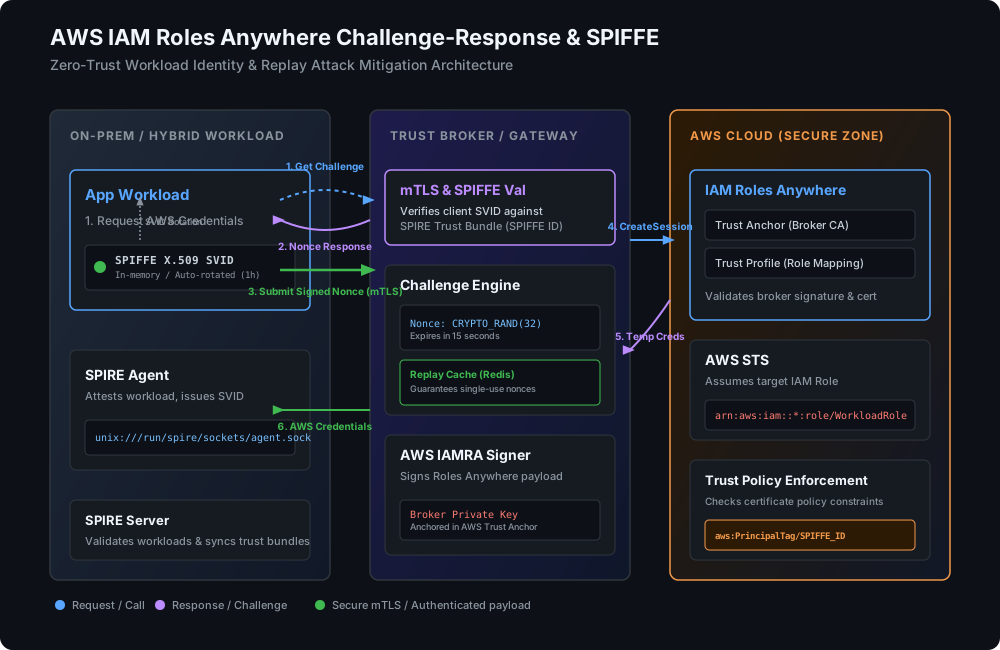
In modern cloud-native architectures, securing hybrid and multi-cloud workloads that require access to AWS resources is a persistent challenge. AWS IAM Roles Anywhere provides a mechanism to establish trust using public key infrastructure (PKI), enabling on-premises servers, containers, or edge devices to exchange X.509 certificates for temporary AWS credentials via AWS STS. However, a standard implementation introduces a critical vulnerability: Signature Version 4 (SigV4) request replay attacks. Because AWS IAM Roles Anywhere does not track signature state natively, an attacker who intercepts a signed CreateSession request (e.g., via compromised HTTP proxies, logging systems, or debug dumps) can replay that exact request within its 15-minute validity window to obtain unauthorized AWS credentials. Furthermore, storing long-lived private keys on server disks exposes them to direct compromise. This post details how to eliminate these risks by combining SPIFFE/SPIRE for in-memory, short-lived cryptographic identities with a custom trust broker implementing a stateful, cryptographic challenge-response exchange.
Anatomy of a SigV4 Replay Attack in Roles Anywhere
To understand the vulnerability, we must dissect the authentication handshake of AWS IAM Roles Anywhere. When a client workload wants to assume an IAM role, it uses the aws_signing_helper tool or custom SDK code to call the CreateSession API endpoint. The request is authenticated using AWS SigV4, but instead of using standard IAM user access keys, the signing process uses the private key of a local X.509 certificate.
AWS validates the certificate chain against a configured Trust Anchor, checks that the certificate satisfies the Trust Profile constraints, and validates the SigV4 signature. Upon success, AWS STS generates temporary credentials (Access Key ID, Secret Access Key, Session Token) and returns them to the caller.
While this flow eliminates the need for long-lived AWS IAM User credentials on disk, it introduces two major security vulnerabilities:
- Lack of Signature Idempotency Enforcement: The SigV4 protocol restricts the signature’s validity using the
X-Amz-Dateheader. By default, AWS allows a clock skew window of up to 15 minutes. Within this 15-minute window, AWS does not enforce one-time use of the signed request. If a signed request is intercepted by a malicious insider, captured in log aggregators (like FluentBit or Logstash capturing HTTP headers), or extracted from an APM tool, the attacker can replay the request directly to the AWS IAM Roles Anywhere endpoint. AWS will accept the signature, perform the cryptographic checks, and return a fresh set of STS credentials to the attacker. - Disk-Bound Private Keys: Workloads typically read their client certificates and private keys from the host filesystem. If an attacker gains root access, exploits a directory traversal vulnerability, or gains access to physical backups, the private key is permanently compromised.
To address these vulnerabilities, we must decouple the client workloads from direct AWS IAM Roles Anywhere communication and introduce short-lived, in-memory workload identities.
Eliminating Disk-Bound Private Keys with SPIFFE/SPIRE
The Secure Production Identity Framework for Everyone (SPIFFE) defines a standard for establishing trust and issuing cryptographic identities (SPIFFE Verifiable Identity Documents, or SVIDs) to workloads in dynamic environments. SPIRE (the SPIFFE Runtime Environment) is a production-ready implementation of the SPIFFE APIs.
In a SPIRE-controlled environment, a SPIRE Agent runs on each node and attests the local workloads based on platform-specific attributes (e.g., Kubernetes namespace, systemd service cgroup, or AWS EC2 instance ID). Once verified, the Agent delivers an X.509 SVID directly to the workload via a local UNIX domain socket (the Workload API).
This approach provides three key security advantages:
- No Disk Storage: The private key is generated in memory, transmitted over the UNIX socket, and held in the workload’s memory. It never touches physical disks.
- Short Lifetimes: SVIDs are highly ephemeral, typically expiring within 1 hour.
- Auto-Rotation: The SPIRE Agent automatically rotates the SVID and private key prior to expiration without causing workload downtime.
The following Go code snippet demonstrates how a workload connects to the SPIRE Workload API to load its ephemeral SVID directly into memory:
The Challenge-Response Architecture
While SPIFFE solves the disk compromise vector, it does not stop the replay of an intercepted request. To mitigate SigV4 replay attacks, we implement a custom, stateful Trust Broker Gateway.
In this architecture, client workloads do not interact directly with AWS IAM Roles Anywhere. Instead, the Trust Broker Gateway sits between the workload and AWS. The authorization handshake proceeds as follows:
- Mutual TLS (mTLS): The client workload establishes an mTLS connection to the Trust Broker Gateway, using its SPIFFE SVID to authenticate its identity. The gateway validates the client’s SVID against the SPIFFE trust bundle.
- Challenge Request: The client requests a cryptographic challenge (nonce) from the Gateway.
- Nonce Generation and Caching: The Gateway generates a cryptographically secure, random 32-byte nonce. It stores this nonce in a fast, centralized Redis cache with a short Time-To-Live (TTL) of 15 seconds.
- Signing the Challenge: The client receives the nonce, hashes it with SHA-256, and signs the digest using the private key associated with its SPIFFE SVID. The signature is sent back to the Gateway.
- Validation and Consumption: The Gateway retrieves the nonce from the client payload, checks for its existence in Redis, and immediately deletes it within a single atomic operation. If the nonce is valid and has not been used, the Gateway verifies the signature using the client’s public key (extracted from the mTLS certificate).
- AWS Session Exchange: Upon successful verification, the Gateway calls
rolesanywhere.CreateSessionon behalf of the client (using its own dedicated signing certificate) and returns the temporary STS credentials to the client over the secure mTLS channel.
The following client-side snippet shows how a Go workload hashes and signs the nonce received from the Trust Broker Gateway:
Implementing the Trust Broker
The Trust Broker Gateway runs inside a secure, restricted network zone. It must have access to a Redis cluster to track nonces and prevent replay. To avoid race conditions and double-spending of nonces under high concurrent loads, the broker uses an atomic Lua script to check and delete the nonce key in Redis.
The following snippet implements the core verification engine of the broker:
Once the broker has verified the client’s signature, it calls AWS IAM Roles Anywhere. The broker signs this second leg of the authentication using its own certificate and private key. To preserve the original client context and ensure traceability, the broker maps the client’s SPIFFE ID into the AWS session context by passing it as the SessionName parameter.
The following snippet demonstrates how the broker calls the AWS SDK to retrieve temporary STS credentials:
Securing AWS IAM Roles Anywhere Configurations
On the AWS side, security must be tightly configured. Because the Trust Broker is acting as an intermediary, only the Broker’s Intermediate CA (or its specific signing certificate) should be registered as a Trust Anchor in AWS. Client certificates issued by SPIRE must not be registered directly in AWS, preventing bypass of the Trust Broker.
We must also configure the IAM Role Trust Policy to restrict assuming the role. The policy must ensure that the principal assuming the role is AWS IAM Roles Anywhere, that the request originates from our designated Trust Anchor ARN, and that the session name matches the expected SPIFFE ID pattern.
The following JSON policy shows a secure Trust Policy configuration:
To automate the deployment of the AWS side of this architecture, we use Terraform. The configuration below defines the Trust Anchor (referencing the Broker’s root or intermediate CA) and a Trust Profile that restricts the maximum session duration to match the SPIFFE certificate renewal cycle (1 hour):
Production Failure Modes and Hardening
Operating this zero-trust authentication architecture at scale requires preparing for specific failure modes:
1. Clock Drift and NTP Synchronization
AWS SigV4 has a built-in 15-minute clock drift limit, but our cryptographic challenge-response protocol uses a much tighter window (15-second TTL on Redis nonces). If either the client workload system or the Trust Broker system drifts, authentications will fail.
- Mitigation: Implement
chronyon all systems. Monitor node clock offset continuously using the systemd node-exporter or Prometheus metricnode_timex_offset_seconds. Alert if the offset exceeds 1 second.// snippet-7 # Check chrony NTP synchronization status chronyc tracking chronyc sources -v
2. AWS API Throttling
AWS IAM Roles Anywhere enforces rate limits on CreateSession API calls (the default is 100 requests per second in most regions). If you have thousands of workloads initiating connections concurrently, you will hit rate limits.
- Mitigation: The client workloads must cache their credentials locally in memory. The client should check the expiration time of the cached credentials and only request a new session from the Trust Broker when the remaining lifetime falls below a threshold (e.g., 10 minutes). Do not call the broker on every API request.
3. Redis Outage
If the centralized Redis cluster becomes unavailable, the Trust Broker cannot validate nonces, leading to a complete outage.
- Mitigation: Use a highly available Redis setup (e.g., AWS ElastiCache with multi-AZ and auto-failover, or Redis Sentinel). Additionally, configure the broker with a fallback sliding-window bloom filter in local memory for emergency fail-closed operations, or configure a graceful fall-back to strict client-IP pinning when Redis is unreachable, depending on your risk tolerance.
4. SPIRE Socket Permissions
The SPIRE Workload API socket is a UNIX domain socket. If the client workload container or process lacks appropriate OS-level permissions (e.g., UID/GID mismatches on the mounting directory), it will fail to load its SVID.
- Mitigation: Configure the SPIRE Agent to create the socket with group-writable permissions (
chmod 770or0777if isolated within pod boundaries) and run the workload container with matching group IDs (fsGrouporrunAsGroupin Kubernetes security contexts).