Microservices Architecture Patterns Every Engineer Should Know
The essential microservices patterns — from service decomposition to inter-service communication and fault tolerance.
Microservices aren’t a silver bullet. They solve real problems while creating new ones. This post covers the patterns that make microservices work in practice — and the pitfalls that bring them down.
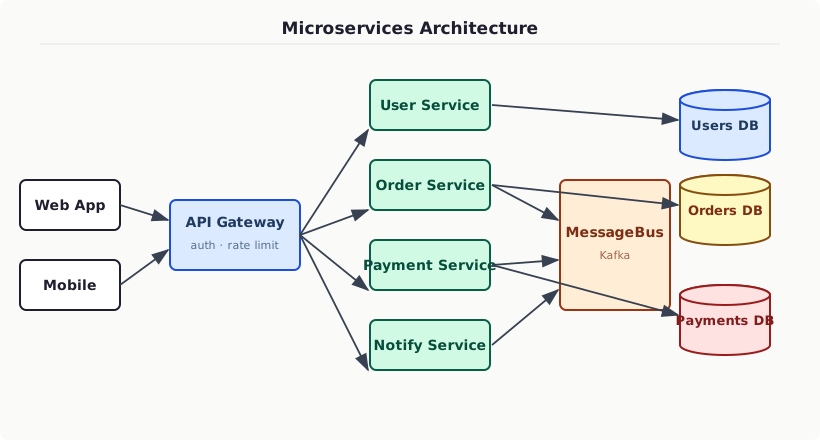
When to Go Microservices
Don’t start with microservices. Start with a monolith, then extract services when you feel the pain:
- Independent scaling — One service needs 10x more instances than others
- Independent deployment — Teams are blocked waiting for release coordination
- Technology diversity — One component genuinely needs a different language/database
- Organizational boundaries — Conway’s Law: structure follows org chart
The “microservices first” approach almost always leads to distributed monolith hell.
Decomposition Patterns
Decompose by Business Capability
Organize around business functions, not technical layers:
Decompose by Subdomain (DDD)
Use Domain-Driven Design to find service boundaries. Each bounded context becomes a service candidate.
Communication Patterns
Synchronous (REST/gRPC)
Use for operations requiring an immediate response:
Problem: Coupling. If payment service is down, the whole chain fails.
Asynchronous (Message Queue)
Use for operations that don’t require immediate response:
Benefits: Decoupling, resilience, natural retry mechanism.
The API Gateway Pattern
Never expose your internal services directly. Use an API Gateway as the single entry point:
The gateway handles:
- Authentication/Authorization
- Rate limiting
- Request routing
- SSL termination
- Response aggregation
The Saga Pattern for Distributed Transactions
ACID transactions don’t work across services. Use sagas — a sequence of local transactions with compensating transactions for rollback.
Choreography-based Saga
Services react to events:
Orchestration-based Saga
A central coordinator drives the steps:
Circuit Breaker Pattern
Prevent cascading failures when a downstream service is struggling:
Use libraries like gobreaker (Go) or resilience4j (Java) in production.
Service Mesh
For complex microservices deployments, consider a service mesh (Istio, Linkerd):
- mTLS between all services
- Distributed tracing without code changes
- Traffic management (canary, weighted routing)
- Circuit breaking and retries at the infrastructure level
The Most Important Rule
Don’t build microservices you don’t need yet. The architecture cost is real. Embrace the monolith, identify the seams, and extract thoughtfully when the business justifies it.