Implementing Structured JSON Outputs in LLM Inference Engines via Compiler-Aided CFG State Machines
Eliminate JSON parsing failures in LLM pipelines by implementing compiler-aided CFG state machines directly into inference engine logit processors.
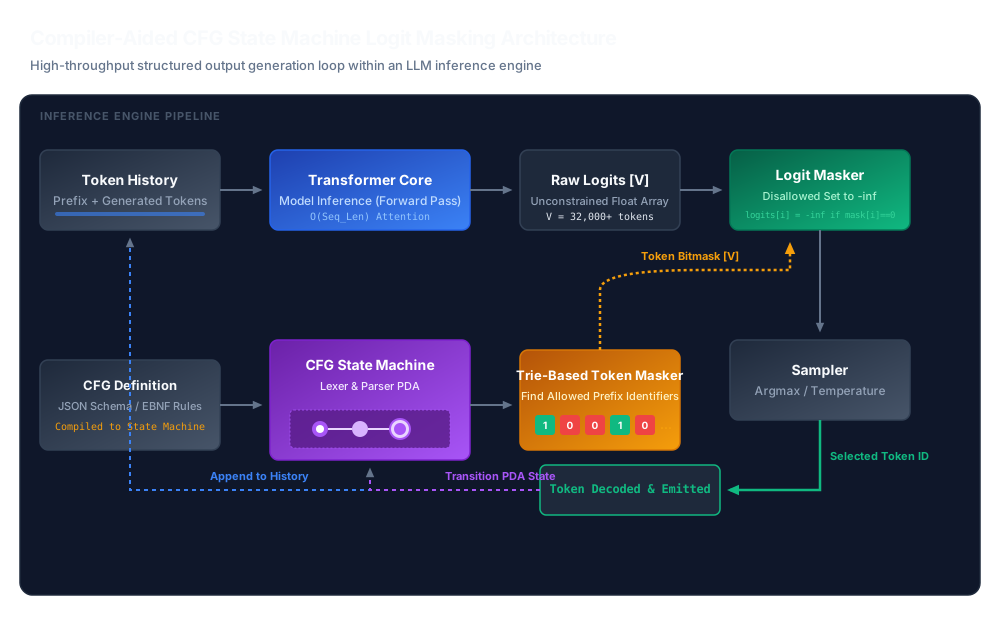
At a production scale of 50 million tokens per day, relying on raw LLM prompt engineering or post-hoc validation to guarantee structured JSON outputs is a high-latency, high-cost anti-pattern. When an LLM randomly drops a closing bracket, escapes a double quote incorrectly, or spits out conversational fluff like “Sure, here is your JSON:”, it breaks downstream ingestion services and triggers cascade failures. Traditional retry loops double or triple your average latency and API bill, while post-generation parsing repair libraries (like json-repair) are brittle heuristics that fail on truncated streams or deep structural mutations. The only robust solution is grammar-constrained decoding enforced directly inside the inference engine. By compiling Context-Free Grammars (CFGs) or JSON schemas into state machines, the inference engine can compute the exact set of valid next tokens at each step of generation. This set forms a bitmask that is applied to the raw model logits before sampling, guaranteeing that the model cannot emit syntactically invalid output.
The Core Bottleneck: Tokenizer vs. Parser Vocabularies
The fundamental challenge of implementing grammar-constrained decoding lies in the “Lexer Gap” between characters and tokens. Context-Free Grammars (CFGs) and JSON schemas operate at the character level (e.g., “a colon must follow a string key”). However, modern Autoregressive Large Language Models (LLMs) do not generate text character-by-character. Instead, they process and emit tokens—sub-word sequences defined by vocabularies using Byte-Pair Encoding (BPE) or WordPiece.
For instance, the Llama 3 tokenizer features a vocabulary size ($V$) of 128,256 tokens. A single token in this vocabulary can contain both structural JSON delimiters and partial user strings. Consider the token ,"email":. This single unit contains a comma (delimiter), a double quote (structural boundary), the word “email”, another double quote, and a colon. If your state machine only tracks character-level transitions, it must evaluate seven distinct states to consume this single token.
Checking every token in a 128k vocabulary against a character-level grammar at every single step of generation is an $O(V \times L)$ operation (where $L$ is the maximum token length in bytes). Doing this naively inside the hot path of an inference engine’s forward pass adds 150ms to 300ms of CPU latency per token, completely neutralizing the benefits of GPU acceleration. To build a high-performance engine, we must compile our grammar rules and index our vocabulary to allow fast, constant-time ($O(1)$) lookups during logit masking.
Compiling Context-Free Grammars to Pushdown Automata
Regular expressions are suitable for simple pattern matching, but they compile to Finite State Automata (FSA) which cannot parse recursive structures like nested JSON objects or balanced brackets. JSON is a context-free language that requires a Pushdown Automaton (PDA)—a state machine equipped with an internal stack to push and pop expected terminal symbols.
To make this computationally efficient during inference, we compile our EBNF (Extended Backus-Naur Form) representation of the target JSON schema into a state transition table. The PDA tracks the syntactic structure of the output. When the model generates a character, the PDA transitions its internal state and alters its stack.
To bridge this character-level PDA with the model’s token-level vocabulary, we construct a static Vocabulary Trie at engine initialization. This Trie stores the character sequences of all tokens in the model’s vocabulary. At each generation step, we perform a Depth-First Search (DFS) on the Trie, guided by the PDA’s transition rules, to gather the set of valid token IDs.
Building the Vocabulary Trie
The Vocabulary Trie indexes the decoded byte representations of the tokenizer’s vocabulary. Each node in the Trie represents a prefix string and stores the set of token IDs that match this prefix. When compiled, a one-time indexing of Llama 3’s 128,256-token vocabulary takes approximately 1.2 seconds on a single CPU thread and consumes around 35MB of memory.
Below is the Python implementation of a TokenTrie structured to support quick prefix-based state transitions.
The Traversal Algorithm: Mapping Characters to Tokens
At each decoding step, we use the active PDA state to prune paths in the Trie. We traverse the Trie recursively: if a path represents a sequence of characters that violates the PDA transition rules, we prune the entire branch, eliminating thousands of invalid token IDs immediately.
Below is the implementation of the JSON PDA state machine and the DFS bridge that collects valid token IDs for the next generation step.
With the PDA and the Trie in place, we implement the recursive search algorithm. This DFS queries the Trie from the root, testing character transitions against a cloned instance of the PDA.
Logit Masking Integration and PyTorch Hot Paths
The list of allowed token IDs must be integrated into the inference loop. In engines like vLLM or standard Hugging Face pipelines, this is achieved by implementing a custom LogitsProcessor. The logit processor modifies the model’s raw output logits before the sampling step, setting the logits of disallowed tokens to negative infinity (-inf), which guarantees their probability is zero.
Eliminating PCIe Stalls: Bit-Packing and CUDA Kernels
In the naive PyTorch implementation above, creating allowed_idx on the host CPU and transferring it to the GPU via torch.tensor at every token step introduces a major systems bottleneck: a CPU-GPU synchronization barrier. Copying uncompressed arrays across the PCIe bus stalls the GPU pipeline, adding 1ms to 3ms of latency per token step.
To eliminate this overhead in production engines, we pack our allowed token masks into a compressed bitset (where 1 bit represents an allowed/disallowed token). For a 128,000 token vocabulary, a boolean float mask consumes 512 KB, whereas a packed bitmask requires only 16 KB. We write the bitset into pinned host memory (cudaHostAlloc) and upload it asynchronously via non-blocking CUDA streams.
Multi-Tenant Architecture in Production Engines
When deploying this in a multi-tenant backend environment (such as a Rust or Go API service wrapped around TensorRT-LLM or vLLM), we must handle concurrent request streams. Each stream maintains its own isolated grammar state. As the inference engine performs continuous batching—adding and removing sequences from the execution queue dynamically—we require a thread-safe manager to track individual parser states and generate the corresponding logits masks.
Here is a backend orchestration pattern implemented in Go, designed to manage concurrent grammar states across multiple active model inference streams.
Production Failure Modes and Mitigation Strategies
Deploying compiler-aided CFG state machines in high-throughput production environments exposes edge cases that do not occur in local testing. As an AI systems engineer, you must architect your code to handle the following structural failure modes.
1. Tokenizer Skew (Constraint Forcing)
When you apply a strict logit mask, you restrict the options available to the model. Sometimes, the token needed to satisfy the grammar does not align with the model’s high-probability tokens. If the grammar forces the selection of a token that has an extremely low raw probability (e.g., a probability of $10^{-6}$), the model will continue generating, but its subsequent internal activations may drift. This can cause the model to output lower-quality text or repeat words within string fields.
Mitigation: Monitor the average entropy of the allowed tokens. If the cumulative probability of the allowed tokens falls below a set threshold (such as $0.01$), fall back to a less restrictive rule or adjust the temperature scale dynamically to flatten the logit distribution.
2. Invalid UTF-8 Boundaries
Multi-byte UTF-8 characters (like emojis or non-English characters) are split across multiple tokens. A token can end in the middle of a multi-byte sequence. If the PDA evaluates character-by-character using standard string decoding, it will throw a decoding error on these partial bytes.
Mitigation: Run the state machine and the Vocabulary Trie at the byte level (uint8) instead of the character level. The Trie must index the raw bytes of the tokens, and the PDA must transition based on byte-level rules.
3. Infinite Generation Loops
If a grammar defines a required element (like a closing bracket }) but the model fails to generate it naturally, the constraint engine will block the End-of-Sequence (EOS) token. Because EOS is disallowed by the mask, the inference engine is forced to continue sampling other valid tokens indefinitely, leading to infinite generation loops that consume GPU cycles.
Mitigation: Set a hard token limit specifically for structural states. Additionally, track the repetition count of structural patterns. If the generation step count exceeds the maximum limit or starts repeating patterns, force-append the terminal punctuation tokens (such as } or ]) and manually terminate the generation loop.