Implementing Offline LLM Guardrails at Scale with LlamaGuard and vLLM
Learn how to build a high-performance, low-latency LLM guardrail pipeline using LlamaGuard, vLLM, and Go to secure production AI applications offline.
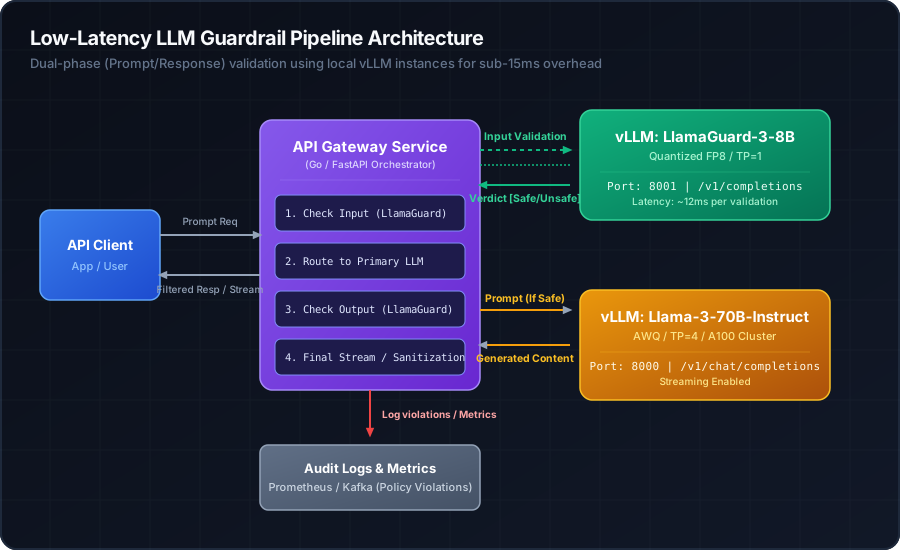
Imagine your production LLM gateway, handling thousands of user requests per minute, suddenly gets hit by a targeted jailbreak attack. An attacker inputs a carefully crafted adversarial prompt, tricking your agent into leaking internal system configurations, dumping customer PII, or generating toxic content. If you rely on external cloud moderation APIs like OpenAI’s moderation endpoint to defend your endpoints, you are facing a painful trade-off: adding 200ms to 400ms of latency to every single interaction, dealing with external API rate limits, and shipping sensitive user prompts to third-party endpoints. In high-throughput, enterprise-scale backend environments, this latency budget is unacceptable. The solution is to build a self-hosted, offline guardrail pipeline running locally in your cluster. By deploying Meta’s LlamaGuard model on a vLLM serving engine, you can validate inputs and outputs with sub-15ms overhead, maintain absolute data sovereignty, and secure your systems at scale.
The High-Throughput Latency Budget: Why Offline Guardrails?
In backend engineering, performance and security are often in direct opposition. Guardrails represent a critical security check, but when placed inline with client requests, they directly degrade the user experience. If your primary LLM takes 500ms to produce a response, adding a pre-generation moderation check and a post-generation validation check using SaaS providers can easily double that latency.
To illustrate the latency impact, consider the following metrics comparing different LLM guardrail architectures:
- Cloud SaaS Moderation APIs (e.g., OpenAI Moderation): 150ms to 350ms round-trip latency. Subject to internet routing variance, API rate limits (HTTP 429), and outbound payload inspection.
- Local Python-based Guardrail Libraries (e.g., Guardrails AI, NeMo Guardrails running locally): 50ms to 120ms latency. Often runs inline within the same application process, creating CPU bottlenecks and scaling issues in core service pods.
- Local vLLM-served LlamaGuard Engine (Quantized FP8): 10ms to 15ms latency. Hosted on dedicated GPU nodes in the same local Kubernetes cluster, communicating over low-latency HTTP/JSON APIs.
By decoupling the moderation engine from SaaS networks and running LlamaGuard 3-8B inside a high-performance vLLM cluster, we transform security checks from a major performance bottleneck into a minor infrastructure expense. vLLM accelerates LlamaGuard through PagedAttention, which minimizes memory fragmentation from keys and values, and continuous batching, which schedules incoming requests dynamically to maximize GPU throughput. Using FP8 quantization, the VRAM footprint is small enough to run LlamaGuard on cheap, readily available hardware, such as an NVIDIA L4 or A10G, keeping your H100s free for primary completion workloads.
Deploying LlamaGuard at Scale with vLLM
To implement this architecture in production, we serve LlamaGuard 3-8B via vLLM. The model is trained to act as a classifier. Given a prompt containing a safety taxonomy and a conversation history, LlamaGuard determines if the prompt is safe or unsafe, and outputs the violated category code.
To deploy this efficiently, we run vLLM as a separate service using Docker or Kubernetes. The configuration must be tuned to minimize memory usage while keeping throughput high. Below is a production-grade Docker Compose manifest for deploying LlamaGuard 3-8B on an NVIDIA GPU with FP8 quantization and eager execution mode.
In this configuration, we set --max-model-len 4096 to support large prompts while capping memory consumption. We enforce --enforce-eager to bypass the CUDA graph compilation step. While CUDA graphs improve throughput for static batch shapes, they can add several minutes to the container startup time. For guardrail services that need to scale out quickly in response to traffic spikes, quick container startup is critical. We limit --gpu-memory-utilization to 0.30 because an 8B model quantized to FP8 occupies less than 8GB of VRAM. This leaves ample memory on a 24GB L4 GPU for scaling up concurrency or running alongside other small helper models.
Structuring the Guardrail API Payloads in Go
With the vLLM container running, the next step is building the Go client to interface with its completions API. LlamaGuard is designed to be used with the raw completion endpoint /v1/completions rather than the chat completion endpoint, as we need strict control over the input format and prompt tokens.
First, we define the Go structs matching the OpenAI-compatible request and response schemas exposed by vLLM.
The LlamaGuard Prompt Template
The core mechanism of LlamaGuard is its input formatting. The model behaves as a zero-shot classifier only when it receives its expected instruction wrapper. The prompt must outline the safety guidelines (the taxonomy) and specify the role format.
Here is the Go implementation of the LlamaGuard 3 prompt template compiler. The taxonomy details eleven default safety categories defined by Meta, covering violations like cyberattacks, child exploitation, and intellectual property theft.
This function constructs a prompt using Llama 3’s special tokens (<|begin_of_text|>, <|start_header_id|>, etc.) to instruct LlamaGuard to analyze only the user’s message. Notice the strict structural instruction Allowed Responses: safe\nunsafe. This constraints the model to output exactly one of these two tokens, preventing open-ended dialogue and drastically reducing the token generation cost to a single token in the safe case.
Implementing the Core Safety Validation Client
With the request schemas and prompt formatter in place, we write the client client code to execute the HTTP post against the vLLM container. The client parses the response and extracts the safety verdict.
If the response contains unsafe, LlamaGuard also outputs the matching category codes (e.g., unsafe\nS6), which we parse to understand which policy was violated.
This client enforces strict timeouts using context.Context to guarantee that safety checks do not hang the main application thread. The parseVerdict helper handles the custom output format of LlamaGuard. If LlamaGuard detects a violation, it outputs unsafe on the first line, followed by comma-separated violation codes on the next line. If it is safe, it outputs only safe. Any other response is considered a validation failure, prompting an error which the calling application should handle.
Orchestrating the Dual-Phase Validation Lifecycle
A robust LLM safety pipeline requires validation at two distinct phases of the request lifecycle:
- Pre-generation Validation: Inspects the user’s input prompt. This protects the backend from prompt injection (e.g., instructions attempting to bypass system rules) and prevents toxic inputs from wasting expensive generator GPU resources.
- Post-generation Validation: Inspects the output generated by the primary LLM before returning it to the user. This ensures that the primary LLM did not hallucinate sensitive data, leak its system prompt, or generate prohibited content.
Here is a production-grade Go HTTP handler showcasing how to orchestrate these checks sequentially around a generation call.
This orchestration highlights a key architectural pattern:
- Pre-generation checks validate the raw user input prompt against the default taxonomy.
- Post-generation checks validate the concatenated user prompt and generator response. This provides LlamaGuard with the conversational context needed to identify cases where the generator’s response is inappropriate relative to the prompt.
- Handlers return clear, distinct HTTP status codes (e.g.,
400 Bad Requestfor invalid user inputs, and424 Failed Dependencyfor generated outputs that fail safety validation) allowing client applications to handle errors appropriately.
Speculative Streaming Validation for Real-Time UX
The sequential validation pattern works well for standard REST payloads, but it introduces a major bottleneck when building interactive chat applications that stream tokens to the user using Server-Sent Events (SSE). Waiting for the primary LLM to complete its entire response, running the output guardrail, and only then releasing the text kills the streaming user experience.
To solve this, we implement Speculative Streaming with Async Sentence Validation:
- We stream tokens from the primary LLM and forward them directly to the client to keep latency minimal.
- Simultaneously, we buffer the tokens in memory.
- As soon as we detect a sentence boundary (e.g., a period, exclamation mark, or line break), we extract that sentence and send it asynchronously to the LlamaGuard vLLM instance.
- If any asynchronous check returns an
unsafeverdict, we immediately abort the request context. This terminates the active HTTP stream, preventing further tokens from reaching the client, and logs the security violation.
Here is the Go implementation of this high-performance pipeline using goroutines, channels, and context cancellation.
This implementation relies on a shared cancelFunc to force-close the parent context. When a safety violation is detected by any concurrent goroutine, it calls cancelFunc with a safety error. This immediately stops the token processing loop, halts the SSE stream, and allows the API gateway to log the offending request. While speculative streaming means the user might see the first few words of an unsafe response before it is severed, it prevents the delivery of complete unsafe payloads while keeping the perceived latency at zero.
Production Failure Modes and Mitigation Strategies
When running LlamaGuard at scale, several real-world failure modes must be accounted for:
1. Hard Prompt Truncation and Security Bypasses
If a user submits an extremely long prompt (e.g., 20,000 tokens of gibberish) and your vLLM LlamaGuard instance is configured with a shorter max model length (e.g., --max-model-len 4096), vLLM will either reject the request with an HTTP 400 or truncate the input.
If your gateway client handles this error by failing open (allowing the request), an attacker can easily bypass guardrails by prefixing their injection attack with 5,000 tokens of white space.
- Mitigation: Enforce strict input size limits at the gateway layer before calling the guardrail service. Reject any prompt that exceeds a reasonable token limit (e.g., 2,048 tokens for standard chat applications). Never fail open on client truncation errors.
2. False Positives on Code Payloads (Category S6/Cyberattacks)
LlamaGuard is highly sensitive to technical scripts. If you build developer tools, standard programming questions containing SQL queries, Bash commands, or Python code will frequently trigger false positives under Category S6 (Cyberattacks) or S2 (Non-Violent Crimes).
- Mitigation: You must customize the LlamaGuard taxonomy template. Instead of using the generic
DefaultLlamaGuard3Taxonomy, modify Category S6 to explicitly allow benign code snippets, or fine-tune LlamaGuard on a labeled dataset of safe programming prompts.
3. GPU Memory Over-Commitment and Head-of-Line Blocking
Under high traffic spikes, the LlamaGuard vLLM queue can fill up, leading to request queuing. Because vLLM uses continuous batching, it will attempt to process as many sequences as possible, but if VRAM is exhausted, throughput will collapse, causing safety validation latency to climb from 15ms to over 500ms.
- Mitigation: Use an ingress gateway (like Envoy or Traefik) to rate limit requests to vLLM. Configure vLLM’s max sequence settings (e.g.,
--max-num-seqs 128and--max-num-batched-tokens 4096) to match your hardware capacity, ensuring predictable latency bounds under load.
4. Cold Starts and Auto-scaling Latency
In Kubernetes environments, auto-scaling LlamaGuard pods based on CPU/GPU utilization can introduce massive latency spikes during scale-up events. If a new replica is spawned, vLLM must load the 8B parameter model into GPU memory, which takes 20 to 60 seconds.
- Mitigation: Implement a warmup probe in your Kubernetes manifest. Do not route traffic to a newly spawned vLLM pod until it passes its readiness health check (e.g., querying
/healthor sending a dummy completion request).
By anticipating these production failure modes and implementing dual-phase validation, developer teams can confidently roll out LLM-powered features knowing they are protected by a localized, high-throughput security boundary.