Implementing a Lock-Free Consistent Hashing Ring with Bounded Loads in Go
Build a lock-free, bounded-load consistent hashing ring in Go to eliminate cache hot spots and lock contention under extreme traffic.
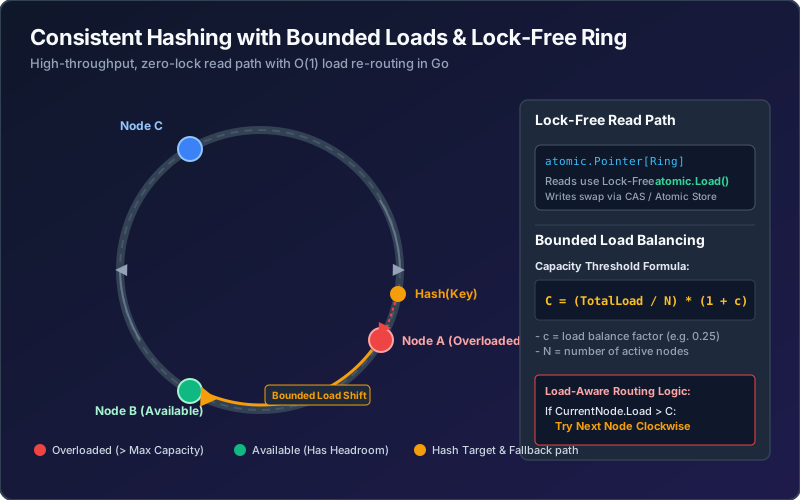
In high-throughput distributed systems, a standard consistent hashing ring is the default tool for routing requests to partition key-spaces across cache pools or microservices. However, under production loads of 100,000+ requests per second (RPS), the combination of Zipfian key distributions (where 1% of keys receive 90% of the traffic) and global read-write locks (sync.RWMutex) turns these rings into performance bottlenecks and cascading failure triggers. When an ultra-popular key hits the cluster, standard consistent hashing routes all corresponding traffic to a single node. This node quickly runs out of CPU or memory, suffers a latency spike, and ultimately falls over. The traffic then immediately cascades to the next node on the ring, taking it down in a domino effect. To survive such traffic spikes without over-provisioning infrastructure by 3x, we must implement a load-aware routing strategy that is completely lock-free.
The Cascading Failures of Standard Consistent Hashing
Standard consistent hashing, originally proposed by Karger et al. in 1997, maps both physical node identifiers and request keys to a shared integer space (usually a 32-bit circle). The request is routed to the first node whose position is greater than or equal to the key’s hash. While this ensures that adding or removing a node only redistributes $1/N$ of the keys, it relies on the critical assumption that hash values are uniformly distributed and that each key receives a similar rate of traffic.
In real-world production, this assumption falls apart. Skewed traffic distributions, such as cache stampedes or flash sale events, place disproportionate loads on specific keys. Furthermore, because nodes are mapped randomly, standard consistent hashing ring load distribution can vary by up to 20–30% even with virtual nodes. Under a heavy traffic spike, this variance triggers the “hotspot” problem.
If Node A receives a disproportionate load, its local queue overflows, response times spike, and upstream routers might mark it as unhealthy. Once Node A is removed from the ring, its load immediately shifts to Node B, its clockwise neighbor. Node B, already running at normal capacity, is instantly crushed by the shifted load, causing it to fail. This cascading failure sweeps clockwise through the ring, taking down the entire cluster.
To mitigate this, Google researchers published “Consistent Hashing with Bounded Loads” in 2016. The core idea is simple: define a maximum capacity limit for each node based on the average load of the cluster. If routing a request to the primary node would push it over its capacity limit, the router “walks” clockwise along the ring until it finds a node with available headroom. By bounding the maximum load of any node to $(1 + \epsilon)$ times the average cluster load, we eliminate hotspots and cascading failures.
The Bottleneck: sync.RWMutex Under Core Contention
Many Go developers default to wrapping a shared consistent hashing ring in a sync.RWMutex. While this works fine under light workloads, it introduces severe bottlenecks on modern multi-core machines (e.g., AWS c6i.32xlarge instances with 128 vCPUs) running at high concurrency.
In Go, a sync.RWMutex is not free. Even if 99.9% of operations are read locks (RLock), every goroutine calling RLock must atomically update the reader count inside the mutex structure. This write operation requires the CPU core to acquire exclusive ownership of the cache line containing the mutex. In a highly parallelized environment, the cache line containing the mutex bounces constantly between CPU L1/L2 caches. This “cache line bouncing” invalidates local caches, stalls CPU pipelines, and leads to massive throughput degradation. Under a write lock (e.g., when adding a node or updating health status), all read operations are completely blocked, causing latency to spike from sub-millisecond to hundreds of milliseconds.
To achieve maximum throughput and predictable latency, the lookup path (the read path) must be completely lock-free. We can achieve this by treating the consistent hashing ring as an immutable structure. When membership changes occur, we build a new ring structure off-line and swap it atomically using sync/atomic.Pointer. The read path loads the active ring pointer atomically, performs its binary search and clockwise walk, and decrements or increments dynamic node loads using atomics.
Snippet 1: Modeling the Immutable Ring and Nodes
First, we define our structures. A physical node contains a dynamic load tracker (Load). The ring itself is an immutable snapshot (Ring) containing sorted virtual nodes (vNodes) and the target load balance factor (epsilon).
By separating the dynamic state (Load) from the static topology (vNodes and nodes slices), we ensure that the structure of the ring remains read-only. Multiple goroutines can search the ring slices concurrently without locks.
Snippet 2: Hashing and Virtual Node Distribution
We construct the ring by generating deterministic virtual node identifiers and sorting them in ascending order. We use the FNV-1a algorithm for hashing, which is fast and native to Go’s standard library.
Sorting the slice allows us to use binary search (sort.Search) to find the nearest virtual node clockwise in $O(\log(N \times V))$ time.
Snippet 3: The Atomic Swapping Mechanism
To manage membership updates (nodes joining, leaving, or failing health checks), we create a thread-safe wrapper ConsistentHashRing. This structure uses a sync.Mutex to serialize updates (writes are rare) and an atomic.Pointer to provide zero-lock lookups (reads are hot).
Since the lookup path only calls chr.active.Load(), readers are completely unblocked during ring updates. The allocations associated with rebuilding the ring are isolated to the write thread, preserving the hot read path.
Snippet 4: The Core Bounded-Load Lookup Algorithm
The lookup algorithm determines the dynamic capacity limit based on the total load of all nodes in the active ring. It then performs a binary search to find the starting virtual node and walks clockwise until a node under the capacity threshold is found.
This dynamic approach prevents lockups. If the entire cluster is running at maximum capacity, step 4 triggers a fallback that routes the request to the node with the lowest load, rather than blocking the request or dropping it outright.
Snippet 5: Dynamic Load Tracking in Network Client
In production, routing key-space queries must be integrated directly into our client routers or HTTP/gRPC handlers. Here is how you wrap a network call to ensure the load is incremented on lookup and decremented using a defer block once the request finishes.
By encapsulating the decrement logic within the return value of Get, the HTTP router ensures that the load state remains accurate, even if the target server times out or returns a 502 Bad Gateway.
Snippet 6: Contention Benchmarks: Mutex vs. Lock-Free
To quantify the scalability of this lock-free design, we write Go benchmarks comparing a standard mutex-protected implementation against our lock-free active ring pointer swap.
Running these benchmarks on a multi-core machine demonstrates why lock-free patterns are essential for high-throughput Go services:
- Mutex-based ring: Throughput caps early and declines as the number of parallel workers exceeds the number of physical CPU cores due to kernel context switching and reader-lock contention on the shared cache line.
- Lock-free atomic pointer ring: Scales almost linearly with the number of CPU cores. Because the read path reads from an immutable snapshot, CPU cores can cache the ring’s virtual node array locally in L1/L2 caches without triggering cache invalidation cycles.
Operational Considerations and Edge Cases in Production
Tuning Epsilon ($\epsilon$)
The parameter epsilon ($\epsilon$) controls the balance between load distribution and network hops:
- Low $\epsilon$ (e.g., $0.05$): The ring acts as a strict load balancer. No node can exceed the average load by more than 5%. However, under skewed traffic, requests will frequently fail to match their primary hash node, walking clockwise to other nodes. This increases lookup hops and degrades cache locality, turning cache lookups into random distributions.
- High $\epsilon$ (e.g., $0.50$): The ring prioritizes cache locality, allowing hot keys to remain on their primary node up to a 150% overload threshold. This reduces routing hops but increases the risk of hotspotting.
In practice, $\epsilon$ values between $0.15$ and $0.25$ represent the sweet spot for caching tiers, bounding maximum load while preserving 80%+ cache hit ratios under heavy load.
Choosing the Virtual Node Factor
To ensure uniform hash distribution, use at least 100 to 200 virtual nodes per physical node. While more virtual nodes improve the hash distribution curve, they increase the memory footprint of the ring structure and slightly slow down the binary search ($O(\log(N \times V))$). For a 100-node cluster, 150 virtual nodes per node yields an array of 15,000 elements, which fits comfortably inside L3 CPU caches and can be binary searched in less than a microsecond.
The Herd Effect in Dynamic Environments
When using decentralized routers, each router instance maintains its own local view of each backend’s current load. If a backend node starts approaching its capacity threshold, multiple independent router instances might desynchronize. In severe cases, they may simultaneously decide that Node A is full and shift their traffic to Node B, causing Node B to overload.
To prevent this “herd effect” in production, you must:
- Smooth dynamic load tracking using exponential moving averages (EMA) or sliding window counters.
- Introduce a jitter factor in the capacity threshold calculation or random skips in the clockwise walk.
- Propagate load feedback from backend nodes using HTTP response headers (e.g.,
X-Backend-Load) to continuously adjust router metrics.
By coupling lock-free atomic pointer swaps with consistent hashing with bounded loads, Go services can maintain high-throughput request routing with stable p99 latencies, even under extreme Zipfian traffic skew.