Implementing Kernel Bypass with DPDK for Low-Latency Packet Processing in C++
Bypass the Linux network stack using C++ and DPDK to achieve sub-microsecond packet processing latency at wire-speed.
At 10 Gbps, a single 64-byte Ethernet packet arrives every 67.2 nanoseconds. If your high-throughput or low-latency C++ backend application processes network traffic via standard Linux sockets, it is dead on arrival at line rate. Between the physical NIC receiving the frame and your application reading it, the packet must trigger a hardware interrupt, schedule a SoftIRQ, allocate a socket buffer (sk_buff), traverse the complex netfilter/routing layers of the TCP/IP stack, copy the data from kernel memory to user space, and trigger a context switch to wake up your application thread. This entire sequence wastes between 1.5 to 3 microseconds of CPU time per packet. In high-frequency trading (HFT), real-time packet inspection, or high-throughput load balancers, this latency budget is unacceptable. Bypassing the kernel and handling packets directly in user space using the Data Plane Development Kit (DPDK) is the only viable path to achieve predictable sub-microsecond processing latencies.
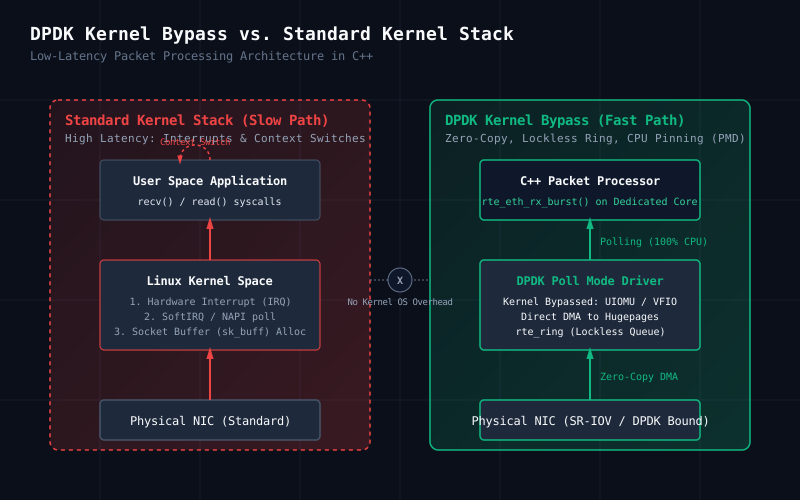
The Anatomy of Kernel Network Stack Overhead
To understand why kernel bypass is necessary, we must examine the physical and logical friction points of the Linux kernel network path.
The first bottleneck is interrupt handling. When a packet arrives, the network interface card (NIC) triggers a hardware interrupt (IRQ) to notify the CPU. The CPU suspends its current task, saves its registers, executes the Interrupt Service Routine (ISR), and schedules a SoftIRQ (software interrupt) to process the packet queue via the NAPI (New API) framework. Each interrupt invalidates CPU caches and forces context switches. While NAPI switches to polling mode under high loads, the transition and scheduling jitter remain highly variable.
The second bottleneck is memory allocation and copying. The kernel represents every packet using a complex socket buffer structure called sk_buff. This structure is dynamically allocated and freed in kernel space, introducing malloc/free overhead for every frame. Once the kernel stack processes the headers, a recv() or read() system call triggers a transition from user space to kernel space, copies the payload from the kernel-space sk_buff to the user-space buffer, and triggers a transition back to user space.
The third bottleneck is global state locking. The Linux kernel network stack is generic and must handle concurrency safely across multiple sockets, routes, and iptables rules. This safety is achieved through spinlocks and mutexes. When scaling to multi-core architectures, lock contention on network structures degrades throughput and spikes tail latency (p99.9 and p99.99).
Enter Kernel Bypass: The DPDK Architecture
Kernel bypass shifts control of the network interface card from the operating system kernel directly to the user-space application. DPDK achieves this through several foundational concepts:
- User Space Drivers (PMD): Poll Mode Drivers run in user space. Instead of waiting for interrupts, PMD threads pin themselves to dedicated CPU cores and continuously poll the NIC’s RX/TX ring buffers. This eliminates interrupt handling, context switches, and scheduler latency entirely.
- Zero-Copy Memory Layout via Hugepages: DPDK maps the NIC’s memory-mapped I/O (MMIO) space directly into user-space memory using standard UIO (Userspace I/O) or VFIO (Virtual Function I/O) interfaces. Packet buffers are pre-allocated in massive, contiguous blocks of physical memory called Hugepages (typically 1GB or 2MB in size). The NIC uses Direct Memory Access (DMA) to write packet payloads directly into these hugepages, allowing the C++ application to read packet headers and payloads with zero copy operations.
- Lockless Ring Buffers: DPDK provides lockless multi-producer, multi-consumer (MPMC) or single-producer, single-consumer (SPSC) ring buffers (
rte_ring). This allows high-speed communication between polling threads and worker threads without kernel-level synchronization primitives.
System Setup and Kernel Boot Parameters
Before writing a single line of C++ code, the underlying Linux kernel must be configured to isolate CPU cores and allocate hugepages. This ensures the operating system’s scheduler does not interrupt the polling threads.
Modify the system’s GRUB configuration (typically located in /etc/default/grub) to include the parameters shown in the snippet below.
default_hugepagesz=1G hugepagesz=1G hugepages=16allocates 16 GB of physically contiguous memory in 1GB pages, preventing Translation Lookaside Buffer (TLB) misses.isolcpus=2-7prevents the Linux scheduler from running normal user tasks or OS threads on cores 2 through 7.nohz_full=2-7andrcu_nocbs=2-7disable the kernel timer tick and RCU callbacks on the isolated cores, turning them into pure jitter-free execution environments.intel_idle.max_cstate=0andprocessor.max_cstate=0disable power-saving C-states, preventing latency spikes when waking up a core from low-power modes.
DPDK Environment Abstraction Layer (EAL) Initialization
The C++ entry point must initialize the DPDK Environment Abstraction Layer (EAL). The EAL parses command-line arguments to claim isolated CPU cores (lcores), map hugepages, and initialize virtual and physical devices.
The main thread executes the EAL initialization before allocating any custom resources. The function rte_eal_init processes DPDK-specific arguments and leaves standard application arguments to be processed by your application.
Port Configuration and Mempool Allocation
DPDK uses packet memory pools (rte_mempool) to hold structures of type rte_mbuf (message buffers). The rte_mbuf is DPDK’s equivalent to sk_buff, but it is designed with a fixed footprint, cache-line aligned, and allocated in contiguous hugepages.
Below is the C++ code to create an optimal mempool and configure a physical Ethernet port with hardware offloads, queue structures, and rings.
- The pool size
NUM_MBUFSis set to8191. DPDK rings perform division using bitmask operations, which requires size configurations of $2^N - 1$. - Memory pools must be allocated on the same NUMA socket as the physical PCIe device. Cross-socket memory traffic adds up to 60 nanoseconds of latency due to CPU interconnect hops (UPI or Infinity Fabric).
The Low-Latency Packet Processing Loop
Once the ports are initialized, the polling mode driver takes over. The CPU core running the processing loop spins in an infinite loop, pulling batches of packets from the NIC ring.
To achieve sub-microsecond processing, we must prevent pipeline stalls inside the CPU. DPDK handles this via prefetching. When rte_eth_rx_burst fetches a batch of rte_mbuf pointers, only the pointers themselves are loaded into L1 cache. The actual packet structures and payloads remain in system RAM. We must invoke rte_prefetch0 to asynchronously pull the packet headers into the CPU cache before accessing their fields.
unlikely(nb_rx == 0)is a compiler optimization hint (__builtin_expect). It tells the compiler to generate assembly that assumes the branch is not taken, optimizing the instruction pipeline for the case where packets are present.rte_pktmbuf_free(mbuf)returns the buffer back to the core’s local memory pool cache. This avoids locking the global memory pool ring.
Zero-Copy Packet Manipulation and Header Offloading
When dealing with low-latency requirements, parsing and modifying packets must avoid intermediate copy buffers. DPDK’s rte_pktmbuf_mtod macro returns a direct pointer to the packet’s payload.
The snippet below demonstrates zero-copy extraction and modification of Ethernet, IPv4, and UDP headers in place, swapping UDP ports to route traffic back.
rte_pktmbuf_mtod_offsetuses static casting and pointer arithmetic to compute offsets instantly.RTE_MBUF_F_TX_IP_CKSUMtriggers physical NIC offloading. The network processor computes the checksum during DMA transfer, freeing CPU cycles on the host lcore.
Lockless Multicore Dispatching
To scale a DPDK application, you must separate packet ingestion from packet processing. Polling cores (I/O threads) should do nothing but pull packets from the NIC and dispatch them to worker cores. Lockless queues (rte_ring) are used for this.
rte_ring_enqueue_burstuses atomic CAS (Compare-And-Swap) loops to update the ring queue headers without system calls or kernel locks.- If the consumer cores fall behind and the ring fills up, the dispatcher drops packets instantly by freeing them back to the mempool, protecting system stability from memory exhaustion.
Critical Production Failure Modes & How to Fix Them
Deploying DPDK to production exposes performance issues that are non-existent in traditional socket programming. Below are the most critical issues and how to resolve them.
NUMA Misalignment
A single NUMA socket consists of a physical CPU chip, its local RAM channels, and its PCIe lanes. If your network interface card is plugged into a PCIe slot connected to Socket 0, but your C++ worker thread runs on Socket 1, every packet access must traverse the CPU interconnect (UPI/QPI). This traversal adds ~60-80ns per cache line request, causing packet processing capacity to collapse under load.
- Diagnosis: Check core-to-socket maps with
lscpuand look for drop counters on your NIC while CPU utilization remains below 80%. - Remediation: Always pin DPDK threads using the correct EAL
-lcore mask matching the NIC socket. Programmatically query socket alignment using:unsigned int socket_id = rte_eth_dev_socket_id(port_id);Ensure all
rte_mempoolandrte_ringallocations target this exactsocket_id.
Cache Line False Sharing
If two threads write to different variables that reside in the same 64-byte chunk of memory (a cache line), the hardware cache coherency protocol (MESI) forces the cache line to bounce between the CPU cores. This causes massive latency spikes.
- Diagnosis: Profile the application using
perf c2cto locate cache lines experiencing high levels of cross-core modification. - Remediation: Ensure all statistics structures, worker variables, and ring buffers are aligned to 64-byte boundaries. Use
__rte_cache_alignedoralignas(64)for all shared structures:struct alignas(64) CoreStats { uint64_t tx_packets; // Padded to 64 bytes automatically to prevent sharing issues };
Linux Scheduler Interrupts
If a CPU core pinned for a PMD thread executes even a single OS context switch, the core stops polling the NIC ring for several microseconds. At 10Gbps, a 10-microsecond pause will overflow the NIC’s physical RX ring, causing hardware packet drops.
- Diagnosis: Check
/proc/interruptsto see if interrupts are incrementing on isolated cores, or monitor/proc/parent_pid/tasks/usinghtopto identify kernel threads running on pinned cores. - Remediation: Ensure
isolcpusis configured correctly in GRUB. Disable local timers by applying the kernel boot flagnohz_fulland delegate RCU callbacks to non-isolated cores usingrcu_nocbs.
CPU Governor Latency
If the CPU governor scales the clock frequency of your polling core down because it misinterprets polling as an idle state, the application’s processing speed will drop, resulting in massive packet losses.
- Diagnosis: Run
cpupower monitorto check the current frequency of the isolated cores. - Remediation: Disable Intel SpeedStep or AMD Cool’n’Quiet in the system BIOS. In Linux, set the scaling governor to performance:
for cpu in /sys/devices/system/cpu/cpu*/cpufreq/scaling_governor; do
    echo performance > $cpu;
done