Implementing Cryptographic Attestation for Ephemeral Microservice Identities using AWS Nitro Enclaves and KMS
Secure ephemeral microservice workloads by binding credentials to hardware-verified cryptographic attestation documents via AWS Nitro Enclaves and KMS.
In cloud-native architectures, we routinely trust software-defined identities like IAM Roles for Service Accounts (IRSA), instance profiles, and short-lived OIDC tokens. However, in the event of a host-level compromise—such as a container breakout, a kernel exploit, or a malicious Kubernetes cluster administrator—these credentials become trivial to exfiltrate. An attacker gaining root access on an EC2 host can intercept memory buffers, query the Instance Metadata Service (IMDSv2), or hijack service account tokens from the local filesystem to impersonate the microservice across your entire infrastructure. To achieve true zero-trust at the compute boundary, we must transition from credentials bound to transient files or network metadata to hardware-attested identities. Cryptographic attestation using AWS Nitro Enclaves and AWS Key Management Service (KMS) eliminates host-level trust, ensuring that sensitive data is only decrypted when the requesting process is running in a cryptographically verified CPU and memory partition, completely isolated from the host operating system.
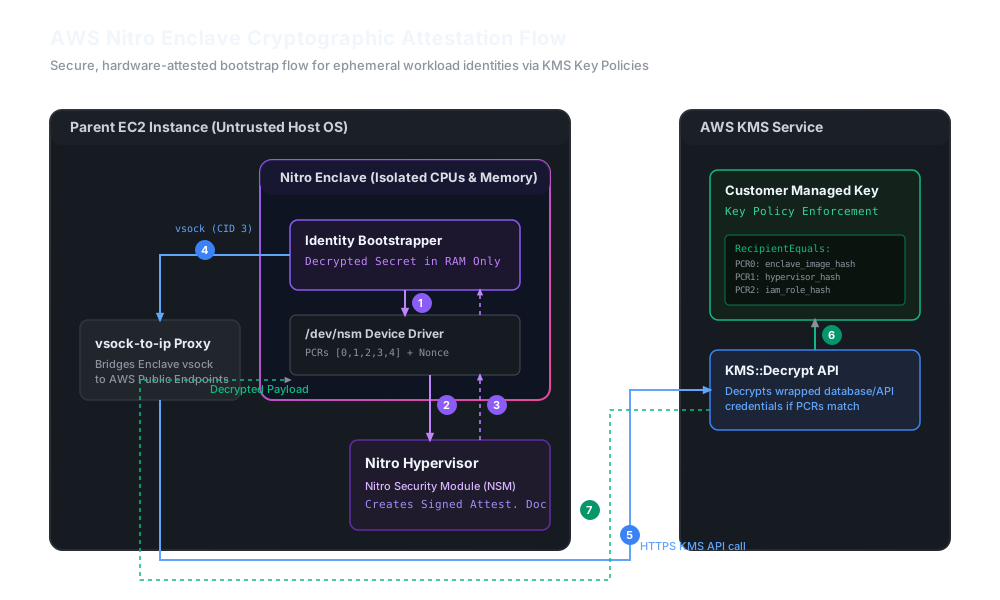
The Core Architecture: Enclave Isolation & Cryptographic Anchors
AWS Nitro Enclaves are isolated, virtual machines running alongside your parent EC2 instance. They do not possess persistent storage, an interactive shell, or an external network interface. The only channel for input/output is a virtual socket interface (vsock) connected directly to the parent EC2 host. The parent host handles the network routing and system-level scheduling, while the enclave runs in a dedicated CPU and memory pool pinned via the Nitro Hypervisor.
At the heart of the Nitro Enclave’s security model is the Nitro Security Module (NSM). The NSM is a virtual device exposed inside the enclave at /dev/nsm. It acts as a hardware-bound security module capable of generating a cryptographic attestation document. This document is a CBOR (Concise Binary Object Representation) structure wrapped in a COSE (CBOR Object Signing and Encryption) envelope. It is signed directly by the AWS Nitro Root of Trust using an asymmetric key pair generated and managed by the Nitro Hypervisor.
The attestation document contains a series of Platform Configuration Registers (PCRs) that reflect the exact cryptographic state of the enclave at boot:
- PCR0: A SHA-384 hash of the entire Enclave Image File (EIF). This measures the kernel version, the initramfs, the boot command line, and every single byte of your compiled application binary. If a developer modifies a single log line in the application, the PCR0 hash changes entirely.
- PCR1: Measures the Nitro Hypervisor and Enclave OS version, ensuring the host hasn’t altered the underlying hypervisor.
- PCR2: A hash of the IAM role assigned to the parent instance, ensuring the enclave is executing on an authorized host.
- PCR3: A hash of the parent instance ID.
- PCR4: A hash of the X.509 signing certificate used to sign the EIF (useful for decoupling key policies from minor code changes).
- PCR8: Measures the metadata associated with the enclave (e.g., number of vCPUs, memory size).
By constructing an AWS KMS Key Policy that restricts decrypt actions based on these PCR values, you guarantee that even if an attacker root-compromises the parent host, they cannot access the decrypted secrets. If they copy the ciphertext, they cannot decrypt it on the host because the host cannot produce a valid attestation document containing the target PCR values. If they attempt to run a modified version of your enclave to print the secrets, the EIF hash changes, altering PCR0, and KMS will reject the decryption request.
Step-by-Step Implementation
Step 1: Building and Packaging the Enclave Image File (EIF)
To package your application into an EIF, you must first compile a statically linked binary and package it inside a minimal Docker image. The Nitro CLI utility then converts this Docker image into the final EIF file, measuring the container contents and outputting the initial PCR values.
Below is the shell script and Docker definition to build a production-ready EIF:
Step 2: Generating the Ephemeral Key Pair and Requesting Attestation
Because the parent host coordinates network communication between the enclave and AWS KMS via a vsock proxy, you cannot allow AWS KMS to return the decrypted secret in plaintext. If KMS returned the plaintext secret directly, the user-space proxy running on the compromised parent host could easily sniff the TCP packets.
To solve this, the enclave application must generate an ephemeral asymmetric key pair (typically RSA-2048 or RSA-4096) in memory. The enclave includes the public key of this ephemeral pair in the attestation request to /dev/nsm. The NSM embeds a hash of this public key directly inside the signed attestation document.
Here is the Go code to interface with /dev/nsm and request the signed document:
Step 3: Establishing the Vsock Proxy on the Parent Host
Because the enclave is completely isolated from the physical network, it cannot directly initiate connections to the AWS KMS endpoints. We resolve this by running a small user-space TCP-to-Vsock proxy daemon on the parent EC2 instance. This daemon listens on a pre-configured virtual socket port and forwards incoming traffic to the standard AWS KMS public API endpoint.
The standard configuration file for the AWS Nitro Enclave vsock proxy is located at /etc/nitro_enclaves/vsock-proxy.yaml:
# snippet-3
# /etc/nitro_enclaves/vsock-proxy.yaml
# Managed by systemd service: aws-nitro-enclaves-vsock-proxy

- name: kms-proxy
  vsock_port: 8000
  domain: kms.us-east-1.amazonaws.com
  port: 443

- name: secretsmanager-proxy
  vsock_port: 8001
  domain: secretsmanager.us-east-1.amazonaws.com
  port: 443
Within the enclave, the AWS SDK client is configured to override its endpoint resolver, routing all KMS-destined HTTP traffic to http://127.0.0.1:8000 (which is mapped to vsock port 8000 via a local-loopback redirection script or a custom dialer in the application code).
Step 4: Structuring the AWS KMS Key Policy
We restrict access to the KMS Customer Managed Key (CMK) by using the kms:RecipientEquals condition block inside the Key Policy. When KMS receives a decryption request that contains an attestation document in the Recipient field, it extracts the document, validates its cryptographic signature against the AWS Nitro root certificate, and compares the PCR hashes within the document against the conditions defined in your policy.
Step 5: KMS Decrypt and Envelope Unwrapping inside the Enclave
The actual cryptographic decryption request is executed using the AWS SDK. We supply the binary attestation document directly inside the Recipient parameter.
When AWS KMS verifies the attestation document and confirms the PCR hashes match the key policy, it decrypts the ciphertext using the KMS CMK. Instead of returning this plaintext to the caller, KMS takes the decrypted payload, encrypts it using the ephemeral public key we provided inside the attestation document (using RSAES_OAEP_SHA_256), and returns this re-encrypted payload to the enclave client.
This ensures that the plaintext never crosses the vsock boundary or the parent host’s memory space.
Production Failure Modes & Operational Runbooks
Failure Mode 1: PCR0 Drift in CI/CD Pipelines
The most frequent production failure mode when utilizing Nitro Enclaves is PCR0 drift. Because PCR0 is a strict hash of the entire EIF, any compilation variance—such as compiler optimization updates, Go version patches, or dynamically generated timestamps during build—will produce a completely different PCR0 hash. When the CI/CD pipeline deploys the new EIF image, the running microservice will fail to authenticate with AWS KMS because the new PCR0 value does not match the hardcoded values in the KMS key policy.
Mitigating with Signed Enclaves (PCR4)
To prevent breaking deployments on every code change, you must switch from validation of raw image hashes (PCR0) to signed enclaves.
When building an EIF, you can optionally sign it using a private code-signing key. The SHA-384 hash of the corresponding X.509 certificate’s public key is written to PCR4. The PCR4 measurement will remain identical across multiple builds, provided they are all signed by the same signing certificate.
This enables you to lock down the KMS Key Policy to PCR4, shifting the identity trust from a static code hash to a cryptographic signature from your deployment pipeline.
Failure Mode 2: Vsock Buffer Exhaustion & Deadlocks
In high-throughput microservices, the default vsock connection limits can easily be exceeded. Vsock operates over a limited ring buffer. If your application attempts to stream telemetry, handle standard API traffic, and perform frequent KMS calls concurrently over the vsock proxy, you will run into buffer exhaustion. This manifests as silent timeouts, packet drops, and deadlocks inside the HTTP client.
To debug and prevent vsock starvation:
- Enforce HTTP Client Keep-Alives: Do not establish a new vsock connection for every single KMS request. Configure the custom http transport inside the enclave to keep connections open (
MaxIdleConnsPerHost: 100). - Increase Host-Side Vsock Queue Length: Set the parent host kernel parameters via sysctl:
sysctl -w net.core.somaxconn=1024 - Implement Enclave Memory Caching: The enclave must not query KMS for every operational request. Use the attestation flow exactly once at boot to fetch a transient symmetric Key Encryption Key (KEK) or database credential. Store this credential exclusively in the enclave’s memory pool, cache it, and decrypt operational data locally.
Failure Mode 3: Local Dev and Integration Testing
Because developer workstations and generic CI/CD execution environments do not run on AWS Nitro hardware, the /dev/nsm device is missing. If you write code directly referencing /dev/nsm, your application will crash during local testing, blocking integration pipelines and unit tests.
To support local engineering workflows, you should design a decoupled NSM provider interface that can automatically fallback to a mock driver in non-enclave execution contexts:
Performance and Latency Trade-offs
Moving to cryptographic attestation introduces measurable latency overhead. A typical execution path for an identity bootstrap request looks as follows:
- Ephemeral Key Generation (Enclave): Generating a new 2048-bit RSA key pair on a limited enclave core takes 20–60ms.
- Attestation Document Signing (NSM/Hypervisor): The ioctl call to
/dev/nsmforces a hypervisor trap where the hypervisor measures the registers, formats the CBOR document, and signs it using the Nitro CA. This hardware-level context switch takes 50–120ms. - Vsock Translation and Roundtrip (Proxy + KMS API): Routing the payload over the vsock proxy, connecting to the AWS KMS service over HTTPS, verifying the COSE signature, and returning the re-encrypted payload adds another 80–150ms.
In total, expect a 150ms to 330ms latency penalty for the initial credential exchange. Consequently, cryptographic attestation is completely unsuitable for inline, request-by-request authorization.
Instead, construct your microservice to treat cryptographic attestation as a bootstrapping event. Perform the handshake once when the container initialized, establish a long-lived, local-in-memory database session, or acquire a JWT token, and reuse that session for downstream traffic. The parent host has no way to steal the credentials since the keys required to decode the credentials exist exclusively within the non-swappable, isolated memory pages of the Nitro Enclave.