Implementing Consistent Hashing with Bounded Loads for Distributed Caching
Learn how Consistent Hashing with Bounded Loads prevents cache node overloading under skewed Zipfian traffic patterns using a production-ready Go implementation.
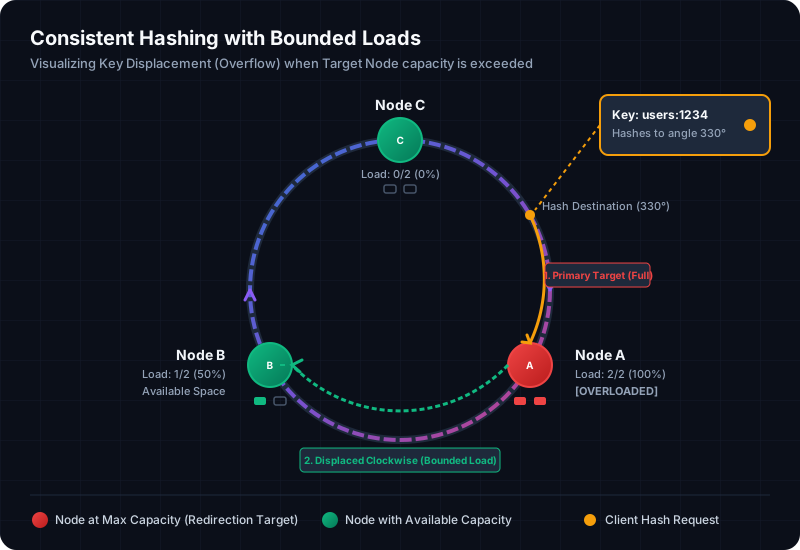
You have built a distributed cache cluster of 16 Redis nodes, using standard consistent hashing with 256 virtual nodes per node to guarantee a uniform key distribution. CPU utilization sits at a comfortable 15% across the cluster. Suddenly, a flash sale begins, or a celebrity mentions a specific item ID. Within seconds, a single cache node spikes to 100% CPU, drops connections, and crashes. Your caching proxy triggers failovers, but the next node in the ring receives the same hot key and immediately melts under the load, followed by the next. Standard consistent hashing is excellent at distributing keys, but it is fundamentally blind to the request rate (load) of those keys. When key popularity follows a power-law (Zipfian) distribution, standard consistent hashing cannot prevent a single cache shard from becoming a bottleneck and triggering a cascading cluster collapse. To solve this, we must implement Consistent Hashing with Bounded Loads—an algorithm that caps the maximum request load on any single node to a defined threshold and gracefully spills overflow traffic clockwise to adjacent nodes.
The Standard Hashing Blind Spot: Virtual Nodes Aren’t Enough
Standard consistent hashing (originally described by Karger et al.) maps both cache nodes and keys to a shared integer space, typically represented as a ring. By using multiple virtual nodes (vnodes) per physical node, standard libraries achieve a highly uniform distribution of keys across physical servers. If you have $N$ nodes and $M$ keys, each node gets roughly $M/N$ keys.
However, in production backend architectures, key distribution is only half the battle. The true culprit of cache failure is load distribution. In real-world applications, user requests are heavily skewed. According to Zipf’s law, the frequency of any key is inversely proportional to its rank in the frequency table. For instance, the most popular key might receive 10x the traffic of the second most popular key, and 10,000x the traffic of average keys.
When a single key receives 20,000 requests per second (RPS), it does not matter if you have 10,000 virtual nodes. Standard consistent hashing will always route that specific key to the exact same physical node. If that node can only handle 15,000 RPS before saturating its network interface or event loop, it will collapse.
In a standard system, when a node goes down, its keys are redistributed to the next node on the ring. In the case of a hot key, this is disastrous. The hot key is simply routed to the next node, which immediately crashes as well. This is a classic cascading cache failure (or cascading thundering herd).
Traditional mitigation strategies are often clunky:
- Cache Replication: Duplicating keys across multiple nodes using prefix salts (e.g. hashing
key_1,key_2,key_3to represent the same object). This wastes RAM and complicates cache invalidation. - Local Proxy Caching: Storing hot keys in the memory of the routing proxy itself. This adds memory overhead to the proxy layer and risks consistency issues.
Instead, we want a native hashing solution that dynamically balances the load across the cluster while preserving cache locality as much as possible.
Enter Bounded Loads: The Math and the Algorithm
In 2016, researchers at Google published a paper titled Consistent Hashing with Bounded Loads (Mirrokni et al.). The core idea is simple: we define a maximum capacity for each node that is dynamically tied to the current average load of the entire cluster.
Let $L$ be the current total load on the cluster (measured in active concurrent requests or QPS), and $N$ be the number of active nodes. The average load per node is $L/N$. We introduce a balancing parameter, $\epsilon$ (epsilon), which defines the maximum allowable overhead. The capacity $C$ of any single node is defined as:
\[C = \lceil (1 + \epsilon) \cdot \frac{L}{N} \rceil\]For example, if the entire cluster is handling 10,000 concurrent requests across 10 nodes, the average load is 1,000 requests per node. If we set $\epsilon = 0.2$ (a 20% allowance), the capacity of any single node is capped at:
\[C = \lceil 1.2 \cdot 1,000 \rceil = 1,200 \text{ requests}\]When a request for key $K$ arrives:
- We hash the key $K$ and locate the closest node $N_{primary}$ clockwise on the ring, just as we would in standard consistent hashing.
- We check the current load of $N_{primary}$.
- If $Load(N_{primary}) < C$, we assign the request to $N_{primary}$ and increment its load counter.
- If $Load(N_{primary}) \ge C$, we say the node is “bounded.” We then traverse the ring clockwise, checking subsequent nodes $N_{next}$ until we find one whose load is below the capacity threshold ($Load(N_{next}) < C$).
- We assign the request to that node and increment its load counter.
- When the request completes, we decrement the assigned node’s load counter.
By doing this, no node can ever exceed the capacity threshold. The maximum load on any single node is strictly bounded to $(1 + \epsilon)$ times the average load. The overflow traffic from the hot node is distributed to the nearest nodes clockwise that have spare capacity, protecting the hot node from crash-inducing spikes.
Tuning the Epsilon Parameter
Selecting the right value for $\epsilon$ is a critical trade-off between load balance and cache hit rate:
- Small $\epsilon$ (e.g., $\epsilon = 0.05$): The system acts like a round-robin load balancer. The load is extremely balanced across all nodes. However, cache locality suffers. In the event of a single hot key, requests will spill over to almost every node in the ring. This causes the hot item to be fetched and cached on multiple shards, reducing the overall effective storage capacity of your cache.
- Large $\epsilon$ (e.g., $\epsilon = 1.0$): Nodes can handle up to 2x the average load before spilling over. Cache locality is highly preserved, but you risk overloading individual nodes if traffic skews heavily.
- Production Sweet Spot: For most high-throughput systems, an $\epsilon$ between
0.15and0.25is ideal. This bounds maximum node overhead to 15-25% while minimizing key displacement to only when a shard is truly under threat.
Implementing the Bounded Loads Ring in Go
Let’s implement this ring from scratch. We will write a clean, thread-safe Go implementation that uses FNV-1a hashing, virtual nodes, and atomic counters for load tracking.
First, we define our structures: Node, Ring, and the initialization function.
// snippet-1
package consistent

import (
	"crypto/fnv"
	"errors"
	"fmt"
	"math"
	"sort"
	"sync"
	"sync/atomic"
)

// Node represents a physical cache server.
type Node struct {
	ID       string
	Address  string
	Active   int64 // Atomic counter for current active load (QPS or connections)
	Capacity int64 // Maximum load this node is allowed to handle
}

// Ring represents the consistent hash ring.
type Ring struct {
	mu       sync.RWMutex
	vnodes   []uint32          // Sorted list of virtual node hashes
	nodeMap  map[uint32]*Node  // Map from vnode hash to actual Node
	nodes    map[string]*Node  // Map from Node ID to Node struct
	replicas int               // Number of virtual nodes per physical node
}

// NewRing creates a new Ring instance.
func NewRing(replicas int) *Ring {
	return &Ring{
		nodeMap:  make(map[uint32]*Node),
		nodes:    make(map[string]*Node),
		replicas: replicas,
	}
}
Next, we implement the ring initialization, node addition, and virtual node distribution logic. We use FNV-1a from Go’s standard library to hash node IDs and create a deterministic ring layout.
// snippet-2
// AddNode registers a physical node on the ring with a specific capacity.
func (r *Ring) AddNode(nodeID string, address string, capacity int64) {
	r.mu.Lock()
	defer r.mu.Unlock()

	node := &Node{
		ID:       nodeID,
		Address:  address,
		Capacity: capacity,
	}
	r.nodes[nodeID] = node

	for i := 0; i < r.replicas; i++ {
		hash := r.hash(fmt.Sprintf("%s#%d", nodeID, i))
		r.vnodes = append(r.vnodes, hash)
		r.nodeMap[hash] = node
	}
	sort.Slice(r.vnodes, func(i, j int) bool {
		return r.vnodes[i] < r.vnodes[j]
	})
}

// hash generates an FNV-1a 32-bit hash.
func (r *Ring) hash(key string) uint32 {
	h := fnv.New32a()
	_, _ = h.Write([]byte(key))
	return h.Sum32()
}
Now, we implement the core routing algorithm. The Get function finds the primary node, computes the dynamic capacity bound, and traverses the ring clockwise if the node is at capacity. We also track the node with the absolute lowest load as a fallback in case the cluster is completely saturated.
// snippet-3
// Get routes a key to a node on the ring while respecting the bounded load constraint.
// epsilon is the balance factor (e.g., 0.25 for 25% max load overhead).
func (r *Ring) Get(key string, epsilon float64) (*Node, error) {
	r.mu.RLock()
	defer r.mu.RUnlock()

	if len(r.nodes) == 0 {
		return nil, errors.New("empty ring")
	}

	hash := r.hash(key)
	idx := sort.Search(len(r.vnodes), func(i int) bool {
		return r.vnodes[i] >= hash
	})
	if idx == len(r.vnodes) {
		idx = 0
	}

	// Calculate total and average load to compute the capacity bound dynamically
	var totalLoad int64
	for _, node := range r.nodes {
		totalLoad += atomic.LoadInt64(&node.Active)
	}

	numNodes := int64(len(r.nodes))
	avgLoad := float64(totalLoad) / float64(numNodes)

	// Bounded capacity formula: Max(1, ceil((1 + epsilon) * avgLoad))
	maxCapacity := int64(1)
	if avgLoad > 0 {
		maxCapacity = int64(math.Ceil((1.0 + epsilon) * avgLoad))
	}

	// Traverse the ring clockwise starting from idx
	var bestNode *Node
	minLoad := int64(^uint64(0) >> 1) // Max int64

	for i := 0; i < len(r.vnodes); i++ {
		currIdx := (idx + i) % len(r.vnodes)
		node := r.nodeMap[r.vnodes[currIdx]]

		load := atomic.LoadInt64(&node.Active)
		if load < maxCapacity {
			// Found a node under capacity. Increment active load atomically and return.
			atomic.AddInt64(&node.Active, 1)
			return node, nil
		}

		// Keep track of the node with the lowest load as a fallback if all nodes are full
		if load < minLoad {
			minLoad = load
			bestNode = node
		}
	}

	// Fallback: if all nodes are over their capacity bound, route to the node with the least load
	atomic.AddInt64(&bestNode.Active, 1)
	return bestNode, nil
}

// Release decrements the active load count on a node.
func (n *Node) Release() {
	atomic.AddInt64(&n.Active, -1)
}
Building a Production-Grade Caching Proxy with Singleflight
To see how this works in a real backend service, let’s build an HTTP caching proxy middleware. The proxy intercepts incoming cache requests, determines the target cache node via our bounded ring, forwards the request, and handles active load accounting.
We will also integrate Go’s golang.org/x/sync/singleflight package. If a cache node fails, or if a key is displaced and causes a cache miss, we want to ensure only a single upstream query is made to the database, preventing a thundering herd on our database layer.
// snippet-4
package proxy

import (
	"context"
	"io"
	"net/http"
	"time"

	"golang.org/x/sync/singleflight"
)

type CacheProxy struct {
	ring *Ring
	sf   *singleflight.Group
}

func NewCacheProxy(ring *Ring) *CacheProxy {
	return &CacheProxy{
		ring: ring,
		sf:   &singleflight.Group{},
	}
}

func (p *CacheProxy) ServeHTTP(w http.ResponseWriter, r *http.Request) {
	key := r.URL.Query().Get("key")
	if key == "" {
		http.Error(w, "missing key parameter", http.StatusBadRequest)
		return
	}

	// Route the request using Bounded Loads Hashing (epsilon = 0.2)
	node, err := p.ring.Get(key, 0.2)
	if err != nil {
		http.Error(w, err.Error(), http.StatusInternalServerError)
		return
	}
	defer node.Release() // Release load slot when request finishes

	// Forward request to the cache node
	ctx, cancel := context.WithTimeout(r.Context(), 500*time.Millisecond)
	defer cancel()

	resp, err := p.forwardRequest(ctx, node.Address, key)
	if err != nil {
		// Fallback: If cache node is dead, fetch from origin directly using singleflight
		val, err, _ := p.sf.Do(key, func() (interface{}, error) {
			return p.fetchFromDB(key)
		})
		if err != nil {
			http.Error(w, "internal server error", http.StatusInternalServerError)
			return
		}
		w.Write(val.([]byte))
		return
	}
	defer resp.Body.Close()

	w.WriteHeader(resp.StatusCode)
	io.Copy(w, resp.Body)
}
Telemetry and Metrics Instrumentation
In a production environment, you cannot fly blind. You must monitor:
- Spillover Rate: The percentage of requests routed to a secondary node instead of their primary hash destination. A high spillover rate indicates either a massive hotkey skew or a cluster running close to absolute capacity.
- Per-Node Load: The current active request count on each node to verify that no node exceeds the $(1 + \epsilon)$ bound.
Let’s implement a Prometheus metric tracking wrapper for our ring.
// snippet-5
package metrics

import (
	"github.com/prometheus/client_golang/prometheus"
	"github.com/prometheus/client_golang/prometheus/promauto"
)

var (
	CacheRoutingRequests = promauto.NewCounterVec(
		prometheus.CounterOpts{
			Name: "cache_routing_requests_total",
			Help: "Total cache routing requests tracked by status",
		},
		[]string{"node_id", "status"}, // status: "primary" or "displaced"
	)

	NodeActiveLoad = promauto.NewGaugeVec(
		prometheus.GaugeOpts{
			Name: "cache_node_active_load",
			Help: "Current active load concurrent requests per node",
		},
		[]string{"node_id"},
	)
)

// TrackRouting logs telemetry data to monitor spillover rates.
func TrackRouting(primaryID, routedID string) {
	if primaryID == routedID {
		CacheRoutingRequests.WithLabelValues(routedID, "primary").Inc()
	} else {
		CacheRoutingRequests.WithLabelValues(routedID, "displaced").Inc()
	}
}
Deep Dive: Real-World Failure Modes & Mitigation
While Bounded Loads Consistent Hashing is a silver bullet for hotspot mitigation, it introduces new failure modes that you must design around:
1. Cache Pollution and Duplicate Fetching
When a hot key spills over from Node A to Node B, Node B will experience a cache miss for that key and fetch it from the database. Now, both Node A and Node B contain the same key. If the key continues to spill over to Node C, Node C will fetch it too.
- Impact: Cache capacity is reduced due to duplication, and database read queries increase during the spillover event.
- Mitigation: Use
singleflight(as shown in Snippet 4) to merge concurrent database fetches. Additionally, you can implement a read-through cache architecture where displaced requests fetch the data from the primary node instead of the database. If Node B gets a request for a key that hashes primary to Node A, Node B can query Node A directly before falling back to the database.
2. Load Metric Smoothing (Hysteresis and Oscillation)
If you track load as instantaneous QPS or active requests, the metric can fluctuate wildly. A node might be at capacity at millisecond 0, spill requests to Node B, drop below capacity at millisecond 1, reclaim requests, and repeat. This causes massive routing oscillations and destroys cache hit rates.
- Impact: Routing instability, lower cache hit rate.
- Mitigation: Smooth the load metric. Instead of using instantaneous active request counts, use an Exponentially Weighted Moving Average (EWMA) of the request rate, or windowed rolling counters.
3. Distributed vs. Local Load Counters
In a multi-proxy architecture (e.g. 5 Envoy instances or 5 custom Go proxies in front of a Redis cluster), how do the proxies agree on a node’s load?
- Option A: Centralized Counter (Redis/Memcached/Gossip): Proxies sync load metrics out-of-band. This introduces network overhead and latency (1-2ms RTT), which is unacceptable for routing microsecond-level cache requests.
- Option B: Local Approximation (Recommended): Each proxy tracks its own outbound requests to each backend shard. Under uniform round-robin distribution of traffic across proxies, local load is an excellent proxy for global load. This requires zero inter-proxy communication and zero overhead.
Capacity and Hit-Rate Tradeoffs: A Concrete Simulation
To illustrate the difference, consider a cluster of 10 Redis nodes handling a total of 10,000 QPS. The request volume is heavily Zipfian ($s = 0.95$).
| Metric | Standard Consistent Hashing | Bounded Loads Hashing ($\epsilon = 0.15$) |
|---|---|---|
| Average Node Load | 1,000 QPS | 1,000 QPS |
| Peak Node Load | 4,200 QPS (Shard 3) | 1,150 QPS (Cap reached) |
| Cluster CPU Variance | Extreme (10% to 100%) | Flat (10% to 25%) |
| Database Load (Spike) | High (due to Shard 3 crash) | Zero (spillover to Shards 4 & 5) |
| Cache Hit Rate | 94% (before Shard 3 crash) | 91.5% (slight pollution drop) |
With standard consistent hashing, Node 3 is overloaded at 4,200 QPS and crashes. The traffic cascades to Node 4, which now gets 5,200 QPS and crashes. With Bounded Loads ($\epsilon = 0.15$), Node 3 is capped at 1,150 QPS. The remaining 3,050 QPS of the hotspot is distributed to Node 4 (which takes 1,150 QPS), Node 5 (which takes 1,150 QPS), and Node 6 (which takes 750 QPS). No node crashes, CPU usage remains stable, and the database is completely protected. The minor decrease in cache hit rate (from 94% to 91.5%) is a negligible price to pay for complete cluster stability.
Conclusion
Consistent Hashing with Bounded Loads shifts cache routing from a purely static structural problem to a dynamic, load-aware routing system. By adding a small, controllable spillover window ($\epsilon$), you protect your cache shards from catastrophic failure under skewed request distributions. In production, this algorithm is the difference between a minor cache-miss spike and a full-scale outage. Implement it in your caching gateways, instrument your spillover metrics, and sleep soundly during your next traffic spike.