Event-Driven Architecture: Building Reactive Backend Systems
Learn how event-driven architecture works, its patterns, benefits, and how to avoid the common pitfalls that sink EDA implementations.
Event-driven architecture (EDA) is a paradigm shift in how services communicate. Instead of direct calls (“do this now”), services emit events (“this happened”) and other services react. The result: systems that are more resilient, scalable, and evolvable.
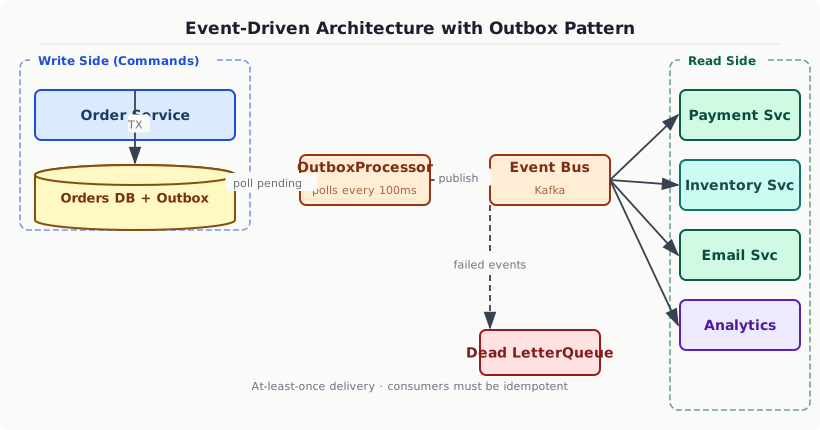
The Core Concept
In a synchronous world:
In an event-driven world:
The Order Service doesn’t know or care who’s listening. Adding a new subscriber requires zero changes to the Order Service.
Domain Events vs Integration Events
Domain Events represent something meaningful that happened within a bounded context:
Integration Events cross service boundaries. They’re domain events published to a shared event bus.
Event Sourcing
Instead of storing current state, store the sequence of events that led to it:
Current state = fold/reduce all events:
Benefits: Complete audit trail, time-travel debugging, event replay. Costs: Query complexity (need projections/read models), eventual consistency.
The Outbox Pattern: Ensuring Reliable Event Publishing
The #1 mistake in EDA: publishing events separately from database transactions.
Solution: Transactional Outbox
Idempotency in Event Consumers
Events can be delivered more than once (at-least-once delivery). Consumers must be idempotent:
CQRS with Event-Driven Architecture
Command Query Responsibility Segregation pairs naturally with EDA:
The read model is eventually consistent but optimized for query performance.
Common Pitfalls
1. Making Events Too Granular
2. Event Coupling via Shared Types
Don’t share event classes across service boundaries. Each service owns its own event schema.
3. Long Event Chains
Deep event chains make debugging a nightmare. If you have 8 services reacting to each other’s events, reconsider the design.
4. No Dead Letter Queue
Always have a DLQ for events that fail processing. Without it, you lose data silently.
EDA is powerful but adds complexity. Use it where the benefits — loose coupling, scalability, audit trail — clearly outweigh the operational overhead.