Epoll and io_uring: Async I/O Models Powering Modern Linux Network Servers
A deep technical comparison of epoll and io_uring for backend engineers building high-throughput Linux network servers.
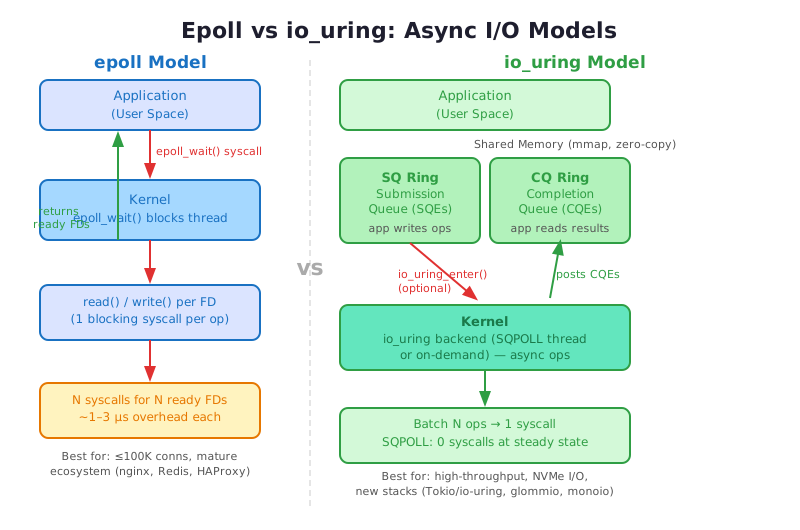
At 50,000 concurrent connections your nginx holds steady; at 500,000 it buckles—not because the CPU is saturated, but because each epoll_wait cycle is flushing TLB entries, churning through a ready-list, and then issuing a separate read() syscall per socket. That’s the syscall-per-event tax, and it compounds at scale. The move from select to epoll in the early 2000s bought a decade of headroom. The move from epoll to io_uring—available since Linux 5.1 (2019), production-hardened by 5.10 LTS—is the next leap. Understanding why each model is designed the way it is will help you pick the right one, tune it properly, and avoid the landmines that production teaches you the hard way.
How epoll Actually Works
epoll is a readiness-notification interface. The kernel maintains a red-black tree of watched file descriptors and an internal linked list of ready events. When a socket becomes readable—say, a TCP segment arrives and the receive buffer fills—the kernel appends the fd to the ready list. Your epoll_wait() call drains that list into a user-space array and returns.
// snippet-1
// Minimal epoll server loop — production skeleton in C
int epfd = epoll_create1(EPOLL_CLOEXEC);

struct epoll_event ev = {
    .events = EPOLLIN | EPOLLET,  // edge-triggered
    .data.fd = listen_fd,
};
epoll_ctl(epfd, EPOLL_CTL_ADD, listen_fd, &ev);

struct epoll_event events[MAX_EVENTS];
for (;;) {
    int n = epoll_wait(epfd, events, MAX_EVENTS, -1);
    for (int i = 0; i < n; i++) {
        int fd = events[i].data.fd;
        if (fd == listen_fd) {
            // accept loop until EAGAIN (edge-triggered requires draining)
            while (1) {
                int conn = accept4(listen_fd, NULL, NULL, SOCK_NONBLOCK | SOCK_CLOEXEC);
                if (conn == -1 && (errno == EAGAIN || errno == EWOULDBLOCK)) break;
                register_connection(epfd, conn);
            }
        } else {
            handle_client(fd);  // issues its own read()/write() calls
        }
    }
}
The critical detail is edge-triggered (ETELLIN) vs. level-triggered (EPOLLIN). Level-triggered (default) re-notifies you on every epoll_wait as long as data is available—which means if you do a short read, you’ll hear about it again. Edge-triggered fires once when the state transitions from unreadable to readable. ET forces you to drain the socket completely on each notification (loop until EAGAIN), but it eliminates spurious wakeups and scales better under high connection churn.
The cost: every notification still requires a separate read() or write() syscall, crossing the user-kernel boundary each time. At 100K events/second, that’s 100K mode switches. Each context switch on a modern x86 processor costs 1–3 μs plus cache/TLB disruption. The math hurts.
Edge Cases That Bite in Production
The thundering herd on accept(): Before Linux 4.5’s EPOLLEXCLUSIVE, multiple threads calling epoll_wait on the same epfd would all wake on a new connection, then race to accept(), with all but one returning EAGAIN. Fix: use EPOLLEXCLUSIVE or a per-thread epfd with SO_REUSEPORT.
EPOLLRDHUP: Without this flag, you won’t detect half-closed connections (peer sent FIN) until you attempt a read. Add EPOLLRDHUP to your event mask and handle it explicitly—otherwise you’ll accumulate zombie connections that appear open but deliver EOF on every read attempt.
Stale fds after dup2(): If you dup() a file descriptor and close the original, the epoll interest list still holds the duplicated fd. The kernel tracks fds by open-file-description, not fd number, so you’ll keep getting events from a fd you thought you closed. Always EPOLL_CTL_DEL before closing.
# snippet-2
# Python asyncio internals — epoll under the hood (CPython's DefaultEventLoopPolicy on Linux)
import asyncio
import socket

async def handle_client(reader: asyncio.StreamReader, writer: asyncio.StreamWriter):
    while True:
        data = await reader.read(65536)   # translates to epoll_wait + read()
        if not data:
            break
        writer.write(data)
        await writer.drain()              # translates to epoll_wait for writability
    writer.close()

async def main():
    server = await asyncio.start_server(
        handle_client,
        host="0.0.0.0",
        port=8080,
        reuse_port=True,          # SO_REUSEPORT: one epfd per worker thread
        backlog=4096,
    )
    async with server:
        await server.serve_forever()

asyncio.run(main())
# Under the hood: SelectorEventLoop → EpollSelector → epoll_ctl/epoll_wait
# Each awaited read/write is a registered EPOLLIN/EPOLLOUT event + syscall round-trip
Enter io_uring: Submission/Completion Rings
io_uring flips the model. Instead of asking the kernel “which fds are ready?”—then issuing separate I/O calls—you submit operations to the kernel and poll for completions. The interface is a pair of lock-free ring buffers shared between user space and kernel via mmap: the Submission Queue (SQ) and the Completion Queue (CQ).
You populate a Submission Queue Entry (SQE) describing an operation—IORING_OP_RECV, IORING_OP_SEND, IORING_OP_ACCEPT, even IORING_OP_OPENAT or IORING_OP_STATX—then tell the kernel (via io_uring_enter()) or let it poll. The kernel executes the operation asynchronously, possibly on a kernel thread pool, and posts a Completion Queue Entry (CQE) with the result code.
// snippet-3
// io_uring echo server using liburing — production-quality skeleton
#include <liburing.h>
#include <netinet/in.h>
#include <stdio.h>
#include <string.h>
#define QUEUE_DEPTH 256
#define BUFFER_SIZE 4096
enum op_type { OP_ACCEPT, OP_RECV, OP_SEND };
struct conn_info {
int fd;
enum op_type type;
char buf[BUFFER_SIZE];
};
static void add_accept(struct io_uring *ring, int listen_fd, struct sockaddr_in *addr, socklen_t *addrlen) {
struct io_uring_sqe *sqe = io_uring_get_sqe(ring);
io_uring_prep_accept(sqe, listen_fd, (struct sockaddr *)addr, addrlen, SOCK_NONBLOCK);
struct conn_info *ci = calloc(1, sizeof(*ci));
ci->fd = listen_fd;
ci->type = OP_ACCEPT;
io_uring_sqe_set_data(sqe, ci);
}
static void add_recv(struct io_uring *ring, int fd) {
struct io_uring_sqe *sqe = io_uring_get_sqe(ring);
struct conn_info *ci = calloc(1, sizeof(*ci));
ci->fd = fd;
ci->type = OP_RECV;
io_uring_prep_recv(sqe, fd, ci->buf, BUFFER_SIZE, 0);
io_uring_sqe_set_data(sqe, ci);
}
int main(void) {
struct io_uring ring;
// IORING_SETUP_SQPOLL: kernel thread polls SQ — zero syscalls at steady state
// Requires CAP_SYS_NICE or unprivileged io_uring (Linux 5.11+)
struct io_uring_params params = { .flags = IORING_SETUP_SQPOLL, .sq_thread_idle = 2000 };
io_uring_queue_init_params(QUEUE_DEPTH, &ring, ¶ms);
int listen_fd = setup_listen_socket(8080); // standard socket/bind/listen
struct sockaddr_in client_addr;
socklen_t addrlen = sizeof(client_addr);
add_accept(&ring, listen_fd, &client_addr, &addrlen);
io_uring_submit(&ring);
struct io_uring_cqe *cqe;
while (1) {
io_uring_wait_cqe(&ring, &cqe); // blocks until at least one completion
struct conn_info *ci = io_uring_cqe_get_data(cqe);
if (ci->type == OP_ACCEPT && cqe->res > 0) {
add_recv(&ring, cqe->res); // new connection: queue RECV
add_accept(&ring, listen_fd, &client_addr, &addrlen); // re-arm accept
} else if (ci->type == OP_RECV && cqe->res > 0) {
// echo back — queue SEND (not shown for brevity)
add_recv(&ring, ci->fd); // re-arm for next message
}
io_uring_cqe_seen(&ring, cqe); // advance CQ tail
io_uring_submit(&ring);
}
}
SQPOLL: The Zero-Syscall Mode
The deepest io_uring optimization is IORING_SETUP_SQPOLL. With this flag, the kernel spawns a dedicated kernel thread that busy-polls the SQ ring. Your application writes SQEs directly—without ever calling io_uring_enter()—and the kernel thread picks them up. At true steady state (the poller thread stays awake), you make zero syscalls for I/O operations. The kernel poller goes to sleep after sq_thread_idle milliseconds of inactivity and wakes on your next io_uring_enter().
The trade-off: the poller thread burns a CPU core. This only makes sense when your server is continuously saturated. For bursty workloads, stick to non-SQPOLL mode—batch submissions instead by calling io_uring_submit() once after populating multiple SQEs.
Benchmarks from the Tokio io-uring adapter show ~40% fewer context switches versus epoll at 200K RPS on a single core, translating to 8–12% lower CPU at equivalent throughput. For file I/O—which was never truly async before io_uring even with O_NONBLOCK (Linux just buffered it and pretended)—the gains are far larger: io_uring is the first genuinely async file I/O interface on Linux.
Rust and io_uring: glommio and monoio
The Rust ecosystem has moved fastest on io_uring. Two runtimes worth knowing:
glommio (DataDog, thread-per-core): Uses io_uring exclusively, pins each thread to a core, no work-stealing, no Arc<Mutex<>>. It achieves sub-100μs P99 latency for storage-intensive workloads because there’s no cross-thread locking anywhere in the hot path.
monoio (ByteDance): Also thread-per-core, io_uring native, with a compatibility layer for tokio types. Production-tested inside ByteDance at millions of RPS.
// snippet-4
// glommio HTTP-style server skeleton — io_uring, thread-per-core
use glommio::{net::TcpListener, LocalExecutorBuilder, Placement};
use futures_lite::io::{AsyncReadExt, AsyncWriteExt};

fn main() {
    // Spawn one executor per logical core, pinned (Placement::Fixed(core_id))
    let handles: Vec<_> = (0..num_cpus::get())
        .map(|core| {
            LocalExecutorBuilder::new(Placement::Fixed(core))
                .spawn(|| async move {
                    let listener = TcpListener::bind("0.0.0.0:8080").unwrap();
                    loop {
                        let (mut stream, _) = listener.accept().await.unwrap();
                        // glommio's task model: cooperative, single-threaded per executor
                        glommio::spawn_local(async move {
                            let mut buf = vec![0u8; 8192];
                            loop {
                                let n = stream.read(&mut buf).await.unwrap_or(0);
                                if n == 0 { break; }
                                // All I/O submits SQEs; completions via CQE polling
                                stream.write_all(&buf[..n]).await.unwrap();
                            }
                        }).detach();
                    }
                })
                .unwrap()
        })
        .collect();

    for h in handles { h.join().unwrap(); }
}
Choosing the Right Model for Production
Use epoll when:
- You’re deploying on kernels older than 5.10 (RHEL 8, Ubuntu 20.04 with stock kernel).
- You’re maintaining a codebase built on libuv, asyncio, or any mature event loop—rewriting the I/O layer for marginal gains is rarely worth it.
- Your bottleneck is application logic, not syscall overhead. Profile first.
- Connection counts are under ~100K. epoll’s overhead at this scale is negligible.
Use io_uring when:
- You’re building a new service and can target Linux 5.15+ (Ubuntu 22.04, RHEL 9).
- You’re doing significant file I/O—log ingestion, local storage engines, WAL writers.
- You need predictable low latency: io_uring’s fixed-buffer mode (
IORING_OP_READ_FIXED) eliminates per-operation buffer registration overhead. - You’re writing Rust and can adopt glommio or monoio from the start.
Hybrid is viable: Tokio (Rust’s dominant async runtime) has an io-uring feature flag that transparently replaces its epoll backend with io_uring while keeping the same API surface. You can run the same application code and just swap the reactor.
# snippet-5
# Verify io_uring availability and limits on your kernel
$ uname -r
5.15.0-100-generic

# Check if SQPOLL is available (requires CONFIG_IO_URING=y)
$ cat /boot/config-$(uname -r) | grep IO_URING
CONFIG_IO_URING=y

# Check the per-process locked memory limit (io_uring requires locked pages for ring buffers)
$ ulimit -l
unlimited   # must not be 64 (default) — increase via /etc/security/limits.conf

# Monitor io_uring operations in production
$ sudo bpftrace -e '
  tracepoint:io_uring:io_uring_submit_sqe {
    @ops[args->opcode] = count();
  }
  interval:s:5 { print(@ops); clear(@ops); }
'
Fixed Buffers and Registered Files
Two often-overlooked io_uring features that matter at high throughput:
Registered buffers (io_uring_register_buffers): Pre-pins user-space memory with the kernel so it doesn’t need to pin/unpin pages on every I/O operation. At 500K small reads/second, the page-pinning overhead is measurable. With fixed buffers, use IORING_OP_READ_FIXED / IORING_OP_WRITE_FIXED and pass the buffer index.
Registered files (io_uring_register_files): Submitting operations by fd requires the kernel to look up the open-file-description in the fd table on every SQE. Registering your fd table upfront lets the kernel cache these lookups. On servers with thousands of persistent connections, this is a real win.
// snippet-6
// io_uring registered buffers and files — eliminating per-op overhead
struct io_uring ring;
io_uring_queue_init(QUEUE_DEPTH, &ring, 0);

// Register a fixed buffer pool (e.g., 1024 x 4KB buffers)
#define NUM_BUFS 1024
#define BUF_SIZE 4096
char *bufs = mmap(NULL, NUM_BUFS * BUF_SIZE, PROT_READ|PROT_WRITE,
                  MAP_PRIVATE|MAP_ANONYMOUS, -1, 0);
struct iovec iovs[NUM_BUFS];
for (int i = 0; i < NUM_BUFS; i++) {
    iovs[i].iov_base = bufs + i * BUF_SIZE;
    iovs[i].iov_len  = BUF_SIZE;
}
io_uring_register_buffers(&ring, iovs, NUM_BUFS);  // pins pages once

// Register file descriptors
int fds[MAX_CONNS];  // fill with your connection fds
io_uring_register_files(&ring, fds, MAX_CONNS);

// Use IORING_OP_READ_FIXED + buf_index instead of IORING_OP_READ
struct io_uring_sqe *sqe = io_uring_get_sqe(&ring);
io_uring_prep_read_fixed(sqe,
    file_index,    // index into registered file table
    iovs[buf_idx].iov_base,
    BUF_SIZE,
    0,             // offset
    buf_idx        // index into registered buffer table
);
sqe->flags |= IOSQE_FIXED_FILE;  // use registered fd
What Doesn’t Change
Neither model removes the need to think carefully about backpressure. An overloaded server that can’t accept() fast enough will exhaust the listen backlog regardless of whether your I/O model is epoll or io_uring—the kernel will start dropping SYN packets at tcp_max_syn_backlog. Set your backlog parameter properly (SO_RCVBUF, net.core.somaxconn, net.ipv4.tcp_max_syn_backlog) and measure your accept latency under load before attributing tail latency to your I/O model.
Profiling remains the arbiter. Before migrating from epoll to io_uring, run perf stat -e syscalls:sys_enter_epoll_wait,syscalls:sys_enter_read,syscalls:sys_enter_write on your production workload. If syscall overhead doesn’t appear in your top-10 CPU consumers, the migration will not move your latency numbers. io_uring is a powerful tool—but like any optimization, it only matters where the actual bottleneck is.