Designing a Quantitative Framework for Evaluating Microservice API Backward Compatibility and Breakage Risk
A production-focused guide to designing a quantitative API risk scoring framework that integrates schema diffs with live gateway telemetry.
It is 2:14 AM on a Sunday, and your pager is screaming. The culprit is a cascading failure in the core checkout service, triggered by a deployment of a seemingly benign, additive API change in the downstream product catalog service. Syntactically, adding a new field is_hazmat_restricted to a JSON payload is backward-compatible according to standard specifications. Semantically and operationally, however, it acted as a landmine. An internal legacy service, written in Go and configured with json.Decoder.DisallowUnknownFields(), was unable to parse the payload and panic-looped, taking down checkout. Traditional static API compatibility checkers (such as OpenAPI diffs or Protobuf linters) declared this build green because they operate in a static vacuum. This outage exposes a critical flaw in modern API management: compatibility is not a binary, static attribute of a schema file. It is a dynamic, context-dependent risk variable that must be quantitatively calculated using live production traffic patterns and client behaviors before a single pull request is merged.
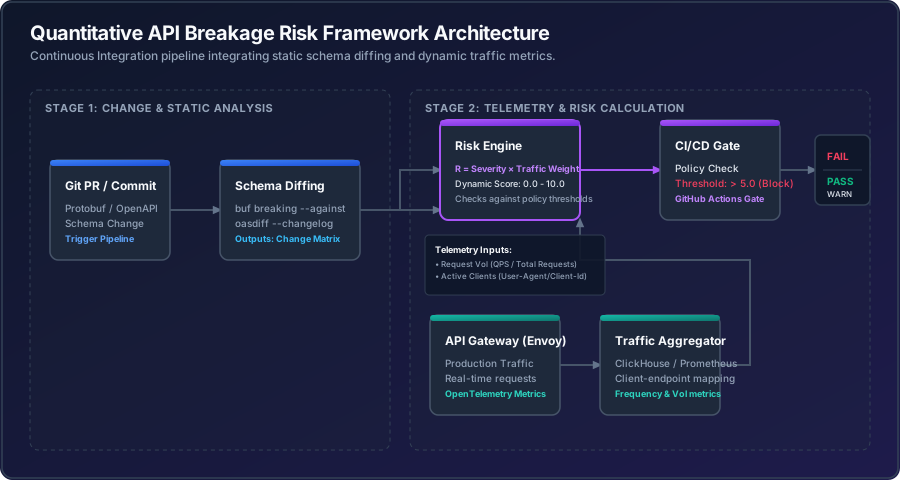
The Illusion of Binary Backward Compatibility
For years, the industry has relied on static contract testing and schema linting. We integrate tools like buf breaking for Protocol Buffers or oasdiff for OpenAPI into our CI/CD pipelines. These tools examine the schema at git commit $A$, compare it to commit $B$, and yield a binary decision: Pass or Fail.
While static analysis is a necessary baseline, it is a naive approach for large-scale microservice architectures due to two distinct failure modes:
- The False Positive (Developer Velocity Churn): A developer deletes an unused field
user_middle_nameon a high-throughput endpoint. Static analysis flags this as a breaking change and halts the pipeline. In reality, production telemetry shows this field hasn’t been requested or populated by any client in the last 180 days. The engineer is now blocked, forced to either seek manual bypass exemptions or maintain dead code indefinitely. - The False Negative (Silent Production Outages): An additive change is introduced. In OpenAPI rules, this is non-breaking. However, because a downstream consumer parses the payload using a strict decoder, it crashes. In Protobuf, changing a field from
optionaltorepeatedis technically wire-compatible, but it breaks the generated client code at the compile or runtime deserialization layer in languages like Java or Swift.
API breakage is a function of two variables: the structural severity of the schema mutation and the operational footprint of the affected endpoint in production. A breaking change to an endpoint that is never called, or only called by a single deprecated cron job, presents negligible risk. Conversely, a nominally “safe” change to a critical endpoint handling $10,000$ queries per second (QPS) across dozens of external clients carries catastrophic risk.
Classification of API Schema Changes
To quantify risk, we must first establish a taxonomy of schema changes and assign them a static severity score, denoted as $S(T) \in [0.0, 1.0]$. The following matrix classifies common OpenAPI and Protocol Buffer mutations:
| Mutation Type ($T$) | Schema Context | Static Severity $S(T)$ | Failure Mode |
|---|---|---|---|
FIELD_DELETE |
OpenAPI / Protobuf | 1.0 |
Immediate deserialization failure; missing expected keys in consumer business logic. |
FIELD_RENAME |
OpenAPI / Protobuf | 1.0 |
Equivalent to a simultaneous delete and add; breaks all existing consumers. |
FIELD_TYPE_MUTATION |
OpenAPI / Protobuf | 0.9 |
Type mismatch (e.g., converting string to object). Causes parsing crashes. |
ADD_REQUIRED_INPUT |
OpenAPI | 0.8 |
Client request payloads missing the new required field are rejected by gateway validation. |
FIELD_TYPE_COERCIBLE |
OpenAPI / Protobuf | 0.5 |
Type promotion (e.g., int32 to int64). Can cause buffer overflows or runtime cast errors in typed languages. |
ADD_OPTIONAL_FIELD |
OpenAPI | 0.2 |
Safe for standard decoders; crashes strict JSON parsers that disallow unknown properties. |
FIELD_DEPRECATION |
OpenAPI / Protobuf | 0.05 |
Non-breaking metadata change. Alerts consumers of future removal. |
Injecting Production Telemetry
Static severity alone is not enough. We must contextualize the structural mutation with production telemetry. We capture this using three runtime metrics collected over a rolling 30-day window:
- Request Volume ($V$): The total number of requests directed to the target endpoint.
- Client Diversity ($C$): The count of distinct, active consumer identities calling the endpoint. We track this by enforcing unique client identifiers in headers (e.g.,
X-Client-IdorUser-Agent) or extracting them from distributed tracing context headers (like W3C Trace Context). - Field-Level Access Frequency ($F$): The actual frequency with which the mutated field is accessed. In REST/JSON APIs, this requires analyzing payload logs or parsing GraphQL query ASTs. In Protobuf/gRPC services, it involves instrumenting interceptors to log the presence of field masks or populated fields.
To store and query this high-cardinality telemetry without impacting request latency, we stream API access logs from our gateway (e.g., Envoy or APISIX) via OpenTelemetry into a dedicated ClickHouse cluster.
Below is the ClickHouse DDL schema designed to track API schema usage:
CREATE DATABASE IF NOT EXISTS telemetry;

CREATE TABLE telemetry.api_field_usage (
    timestamp DateTime64(3) CODEC(DoubleDelta, LZ4),
    endpoint String CODEC(ZSTD),
    method String CODEC(ZSTD),
    client_id String CODEC(ZSTD),
    fields_accessed Array(String) CODEC(ZSTD),
    status_code UInt16 CODEC(T64)
) ENGINE = MergeTree()
PARTITION BY toYYYYMM(timestamp)
ORDER BY (endpoint, method, client_id, timestamp);
When a pull request proposes a mutation on a specific endpoint and field, the CI runner queries ClickHouse to evaluate usage. For instance, if a developer attempts to delete the field tax_identifier from the POST /v2/billing endpoint, the runner executes the following query:
SELECT
    count() AS total_requests,
    uniq(client_id) AS active_clients,
    countIf(has(fields_accessed, 'tax_identifier')) AS field_hits
FROM telemetry.api_field_usage
WHERE endpoint = '/v2/billing'
  AND method = 'POST'
  AND timestamp >= subtractDays(now(), 30);
The Quantitative Risk Formula
Once we have extracted both the static severity and the dynamic traffic metrics, we combine them into a single, normalized API Breakage Risk Score ($R$), where $R \in [0.0, 10.0]$.
The risk score is calculated as:
\[R = 10 \times S(T) \times W_{\text{traffic}}(E, F)\]Where:
- $S(T)$ is the static severity score of change type $T$.
- $W_{\text{traffic}}(E, F)$ is the traffic weight of field $F$ on endpoint $E$.
The traffic weight is a weighted average of request volume and client diversity, normalized to a $[0.0, 1.0]$ scale:
\[W_{\text{traffic}}(E, F) = w_v \cdot \Phi_{\text{vol}}(V(E, F)) + w_c \cdot \Phi_{\text{client}}(C(E))\]Subject to the constraint:
\[w_v + w_c = 1.0\]In production environments, we set $w_v = 0.4$ (volume weight) and $w_c = 0.6$ (client diversity weight). Client diversity is weighted higher because coordinating a breaking change across multiple distinct teams or external clients introduces significantly higher operational friction than fixing a high-volume endpoint consumed by only a single internal service.
The normalization functions are defined as:
-
Volume Normalization ($\Phi_{\text{vol}}$): A logarithmic scale is critical here. The difference between $10$ and $1,000$ requests is operationally massive, whereas the difference between $1,000,000$ and $1,001,000$ requests is negligible.
\[\Phi_{\text{vol}}(V) = \min\left(1.0, \frac{\log_{10}(V + 1)}{\log_{10}(V_{\text{max}} + 1)}\right)\]Where $V_{\text{max}}$ is the high-throughput baseline parameter, set to $1,000,000$ requests per 30 days.
-
Client Normalization ($\Phi_{\text{client}}$): A linear scale up to a saturation limit.
\[\Phi_{\text{client}}(C) = \min\left(1.0, \frac{C}{C_{\text{max}}}\right)\]Where $C_{\text{max}}$ is the saturation threshold, set to $10$ distinct client consumers.
Below is a complete Go implementation of this evaluation engine, designed to run inside a CI pipeline check:
package main

import (
	"fmt"
	"math"
)

type ChangeType string

const (
	FieldDelete        ChangeType = "FIELD_DELETE"
	FieldRename        ChangeType = "FIELD_RENAME"
	FieldTypeIncompat  ChangeType = "FIELD_TYPE_INCOMPAT"
	AddRequiredInput   ChangeType = "ADD_REQUIRED_INPUT"
	FieldTypeCoercible ChangeType = "FIELD_TYPE_COERCIBLE"
	AddOptionalField   ChangeType = "ADD_OPTIONAL_FIELD"
	FieldDeprecation   ChangeType = "FIELD_DEPRECATION"
)

// StaticSeverity maps change types to their static severity score S(T)
func StaticSeverity(t ChangeType) float64 {
	switch t {
	case FieldDelete, FieldRename:
		return 1.0
	case FieldTypeIncompat:
		return 0.9
	case AddRequiredInput:
		return 0.8
	case FieldTypeCoercible:
		return 0.5
	case AddOptionalField:
		return 0.2
	case FieldDeprecation:
		return 0.05
	default:
		return 0.1
	}
}

type TrafficMetrics struct {
	Volume30D     int64 // V(E, F)
	ActiveClients int   // C(E)
}

type RiskEngine struct {
	VMax float64
	CMax float64
	WVol float64
	WClt float64
}

func NewRiskEngine() *RiskEngine {
	return &RiskEngine{
		VMax: 1000000.0, // 1M requests threshold
		CMax: 10.0,      // 10 distinct clients threshold
		WVol: 0.4,       // 40% weight to volume
		WClt: 0.6,       // 60% weight to client diversity
	}
}

func (re *RiskEngine) CalculateRisk(change ChangeType, metrics TrafficMetrics) float64 {
	s := StaticSeverity(change)

	// Logarithmic normalization for request volume
	phiVol := math.Log10(float64(metrics.Volume30D)+1) / math.Log10(re.VMax+1)
	if phiVol > 1.0 {
		phiVol = 1.0
	}

	// Linear normalization for client diversity
	phiClt := float64(metrics.ActiveClients) / re.CMax
	if phiClt > 1.0 {
		phiClt = 1.0
	}

	trafficWeight := (re.WVol * phiVol) + (re.WClt * phiClt)
	riskScore := 10.0 * s * trafficWeight

	// Round to two decimal places
	return math.Round(riskScore*100) / 100
}

func main() {
	engine := NewRiskEngine()

	// Scenario 1: Deleting a field on a high-throughput endpoint consumed by many microservices
	m1 := TrafficMetrics{Volume30D: 850000, ActiveClients: 8}
	r1 := engine.CalculateRisk(FieldDelete, m1)
	fmt.Printf("Scenario 1 (Field Delete on Core API): Risk Score = %.2f/10.0\n", r1)

	// Scenario 2: Deleting a field on a legacy cron job endpoint (low volume, single client)
	m2 := TrafficMetrics{Volume30D: 50, ActiveClients: 1}
	r2 := engine.CalculateRisk(FieldDelete, m2)
	fmt.Printf("Scenario 2 (Field Delete on Cron API): Risk Score = %.2f/10.0\n", r2)

	// Scenario 3: Adding an optional field to a core API (strict parser check warning)
	m3 := TrafficMetrics{Volume30D: 900000, ActiveClients: 12}
	r3 := engine.CalculateRisk(AddOptionalField, m3)
	fmt.Printf("Scenario 3 (Add Optional on Core API): Risk Score = %.2f/10.0\n", r3)
}
Running this code demonstrates the divergence:
- Scenario 1 outputs a risk score of 8.76/10.0 (Hard Block).
- Scenario 2 outputs a risk score of 1.72/10.0 (Automatic Pass).
- Scenario 3 outputs a risk score of 1.96/10.0 (Automatic Pass, but warnings logged).
Even though Scenario 1 and Scenario 2 both involve deleting a field, they represent entirely different operational risk profiles. The framework correctly highlights the threat of Scenario 1 while greenlighting Scenario 2.
Architecting the Gatekeeper Pipeline
Integrating this framework into your engineering workflow requires a automated feedback loop embedded directly in the CI/CD pipeline.
Step 1: Schema Extraction and Diffing
When a pull request is opened, the CI runner extracts the schemas from both the source branch and target branch. It then generates a JSON representation of structural changes.
For OpenAPI specs:
oasdiff -base main.yaml -revision new.yaml -format json > schema_diff.json
For Protobuf:
buf breaking --against ".git#branch=main" --json > schema_diff.json
Step 2: Telemetry Correlation
A Go helper script reads the structural changes from schema_diff.json. For every change detected, it queries ClickHouse to retrieve telemetry data for the corresponding endpoint and field path.
Step 3: Risk Evaluation and CI Gate
The script applies the risk scoring formula to each change and generates a unified report. The CI job evaluates the maximum risk score ($R_{\text{max}}$) across all changes in the PR and enforces the following policy gates:
- $R_{\text{max}} < 2.0$ (Pass): The PR check passes automatically. No action required.
- $2.0 \le R_{\text{max}} < 5.0$ (Warn): The PR check passes, but a warning summary is posted as a PR comment. The pipeline sends a Slack notification to the consumer teams identified in the telemetry logs, warning them of the upcoming change.
- $R_{\text{max}} \ge 5.0$ (Block): The PR status check fails, blocking merges to
main. To bypass this, the author must either:- Coordinate with consumer teams to update their code (which shifts the ClickHouse telemetry to zero active clients over time, lowering the risk score below the threshold).
- Obtain an explicit manual bypass approval from the API architecture team, which injects an exception token into the PR metadata.
Here is the GitHub Actions workflow file that implements this orchestration:
name: API Compatibility Guard

on:
  pull_request:
    paths:
      - 'proto/**'
      - 'openapi/**'

jobs:
  evaluate-risk:
    runs-on: ubuntu-latest
    steps:
      - name: Checkout Source Code
        uses: actions/checkout@v4
        with:
          fetch-depth: 0

      - name: Set up Go
        uses: actions/setup-go@v5
        with:
          go-version: '1.22'

      - name: Install Schema Diff Tools
        run: |
          BIN="/usr/local/bin"
          curl -sSL "https://github.com/bufbuild/buf/releases/latest/download/buf-$(uname -s)-$(uname -m)" -o "$BIN/buf"
          chmod +x "$BIN/buf"

      - name: Generate Schema Diff
        run: |
          buf breaking --against "https://github.com/$.git#branch=main" --json > breaking_changes.json || true

      - name: Calculate Risk Score
        env:
          CLICKHOUSE_HOST: $
          CLICKHOUSE_PORT: 9440
          CLICKHOUSE_USER: $
          CLICKHOUSE_PASSWORD: $
        run: |
          go run scripts/calculate_risk.go \
            -diff breaking_changes.json \
            -output risk_report.json

      - name: Post PR Comment
        uses: actions/github-script@v7
        with:
          script: |
            const fs = require('fs');
            const report = JSON.parse(fs.readFileSync('risk_report.json', 'utf8'));

            let comment = `### 📊 API Risk Evaluation Report\n\n`;
            comment += `| Endpoint | Field | Change Type | Risk Score | Gate Decision |\n`;
            comment += `| :--- | :--- | :--- | :--- | :--- |\n`;

            for (const item of report.changes) {
              const status = item.risk_score >= 5.0 ? '❌ BLOCK' : (item.risk_score >= 2.0 ? '⚠️ WARN' : '✅ PASS');
              comment += `| \`${item.endpoint}\` | \`${item.field}\` | \`${item.type}\` | **${item.risk_score}** | ${status} |\n`;
            }

            github.rest.issues.createComment({
              issue_number: context.issue.number,
              owner: context.repo.owner,
              repo: context.repo.repo,
              body: comment
            });

            if (report.max_risk >= 5.0) {
              core.setFailed("API Breakage Risk score exceeds allowable threshold (5.0).");
            }
Failure Modes of Traditional Approaches in Detail
To understand why this quantitative framework is necessary, we must examine real-world failure modes that bypass traditional static checks:
1. The Strict JSON Parser Crash
In many languages, JSON parsing libraries fail by default when encountering properties that are not mapped to class properties. Jackson (Java) throws MismatchedInputException unless configured with @JsonIgnoreProperties(ignoreUnknown = true). Golang’s standard library does not fail, but engineers often use json.Decoder.DisallowUnknownFields() to prevent silent typos in configurations or incoming payloads.
Static checks like oasdiff mark additive changes as completely safe. However, in an architecture with dozens of internal services using strict parsers, an additive change has a high probability of crashing a downstream client. The risk engine handles this by assigning ADD_OPTIONAL_FIELD a base severity of 0.2. If the endpoint has high client diversity, the score pushes toward 2.0, triggering the warnings and Slack alerts needed to verify consumer compatibility.
2. Protobuf Tag Re-use
Protocol Buffers rely entirely on numeric tags for serialization. If a developer deletes optional string legacy_token = 4; and later defines optional int64 user_permission_mask = 4; in the same message definition, static analysis might fail to recognize the re-use if the changes happen across distinct PRs or if the developer deletes the field in one release and adds the new one in a subsequent release.
At the wire level, when an old client sends a request with string data in tag 4 (wire type 2, length-delimited) and the updated backend expects a varint (wire type 0), the parser will throw a deserialization exception or corrupt the input. The risk engine catches this by maintaining historical context of fields queried from the telemetry database. If the deleted field has shown active telemetry in ClickHouse within the last 30 days, the risk score for removing it remains at a maximum 10.0, blocking tag re-use.
3. Silent Deprecation Drift
Deprecating a field is statically safe. Engineers add @deprecated annotations to OpenAPI or deprecated = true to Protobuf fields, planning to delete them later. However, without metric confirmation, actually deleting those fields is a gamble.
Legacy systems, reporting cron jobs, or offline analytics engines might run once a month. During a standard 2-week sprint cycle, these consumers are silent, showing no traffic. If the field is deleted based on short-term logs, those monthly runs will fail. Our framework solves this by leveraging a rolling 30-day window in ClickHouse. If a field is accessed only once a month, it still registers in the telemetry query, elevating the risk score and preventing premature removal.
Conclusion: Moving from Fear to Metrics
API design is often paralyzed by fear. Engineers avoid refactoring old, broken schemas because they cannot confidently verify who is calling them. They write duplicate endpoints (/v2, /v3) to sidestep potential outages, leading to maintenance debt and fragmented logic.
Implementing a quantitative framework for evaluating API compatibility moves organizations from subjective fear to objective metrics. By linking static schema analysis with live, high-cardinality telemetry, you can automate safe refactoring. Unused code is pruned cleanly, risky changes are gated automatically, and developers move faster with the confidence that the CI pipeline is actively protecting the production environment.