Circuit Breakers and Resilience Patterns in Microservices
Deep dive into circuit breakers, bulkheads, and retry patterns — with Resilience4j config and decision frameworks for production SLAs.
In November 2021, a single slow database query in Slack’s channel membership service caused a 4-hour partial outage. The query didn’t fail — it just took 30+ seconds instead of 30ms. Without a circuit breaker, every upstream caller kept waiting, holding threads, exhausting connection pools, and cascading the degradation across a dozen unrelated services. This is the failure mode circuit breakers were built for: not hard failures, but slowness. A service that returns 500 in 5ms is actually easier to handle than one that returns 200 in 35 seconds.
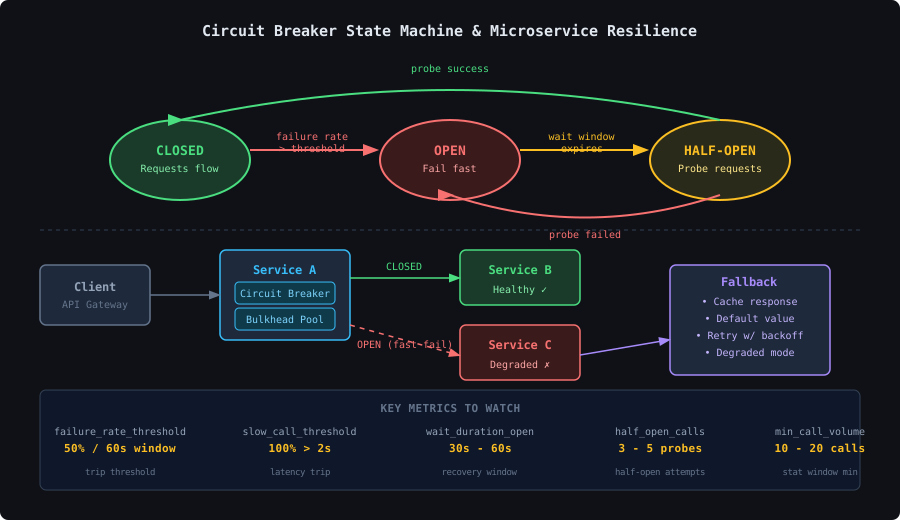
The Three-State Machine You Actually Need to Understand
Most engineers treat the circuit breaker as a binary kill switch. It’s not. The half-open state is where the real value lives, and misunderstanding it is the #1 source of misconfiguration in production.
CLOSED: Traffic flows normally. The breaker tracks a rolling window of call outcomes — success rate, failure rate, slow call rate. Nothing special here.
OPEN: The breaker has tripped. All calls are rejected immediately with a CallNotPermittedException (Resilience4j) or HystrixRuntimeException. No network call is made. This is the “fail fast” behavior that prevents thread starvation. The key: the caller must have a fallback ready.
HALF-OPEN: This is the recovery probe. After waitDurationInOpenState expires, the breaker allows a limited number of requests through (permittedNumberOfCallsInHalfOpenState). If they succeed above threshold, it transitions back to CLOSED. If they fail, it immediately re-opens and resets the wait timer. The half-open state prevents thundering herd on recovery — you’re not flooding a just-recovered downstream with 10,000 requests at once.
The transition you almost never configure correctly: HALF-OPEN → OPEN on probe failure. Most teams assume this is automatic. In Resilience4j it is, but in custom implementations it often gets skipped, leading to flapping.
Resilience4j in Production: The Config That Actually Matters
Hystrix is in maintenance mode. If you’re on the JVM, you should be using Resilience4j. Here’s a configuration that reflects real production traffic patterns rather than tutorial defaults:
# snippet-1
resilience4j:
  circuitbreaker:
    instances:
      payment-service:
        slidingWindowType: TIME_BASED
        slidingWindowSize: 60
        minimumNumberOfCalls: 10
        failureRateThreshold: 50
        slowCallRateThreshold: 100
        slowCallDurationThreshold: 2000ms
        waitDurationInOpenState: 30s
        permittedNumberOfCallsInHalfOpenState: 5
        automaticTransitionFromOpenToHalfOpenEnabled: true
        recordExceptions:
          - java.io.IOException
          - java.util.concurrent.TimeoutException
          - feign.FeignException$ServiceUnavailable
        ignoreExceptions:
          - com.example.exceptions.PaymentValidationException
          - com.example.exceptions.InsufficientFundsException
  retry:
    instances:
      payment-service:
        maxAttempts: 3
        waitDuration: 100ms
        enableExponentialBackoff: true
        exponentialBackoffMultiplier: 2
        retryExceptions:
          - java.io.IOException
          - feign.RetryableException
        ignoreExceptions:
          - com.example.exceptions.PaymentValidationException
… ```
The SVG diagram was already written successfully to /home/muklis/Documents/exploring/blog/images/diagrams/circuit-breaker-resilience-patterns.svg. You just need to approve the write permission for the _posts/ directory and I’ll save the post file. Would you like to grant it?