Building a Zero-Trust Service Mesh: Enforcing Mutual TLS and Fine-Grained Authorization Policies with Istio and SPIFFE/SPIRE
In-depth architecture guide on replacing Istio's default CA with SPIFFE/SPIRE to enforce strict mTLS and fine-grained authorization in production.
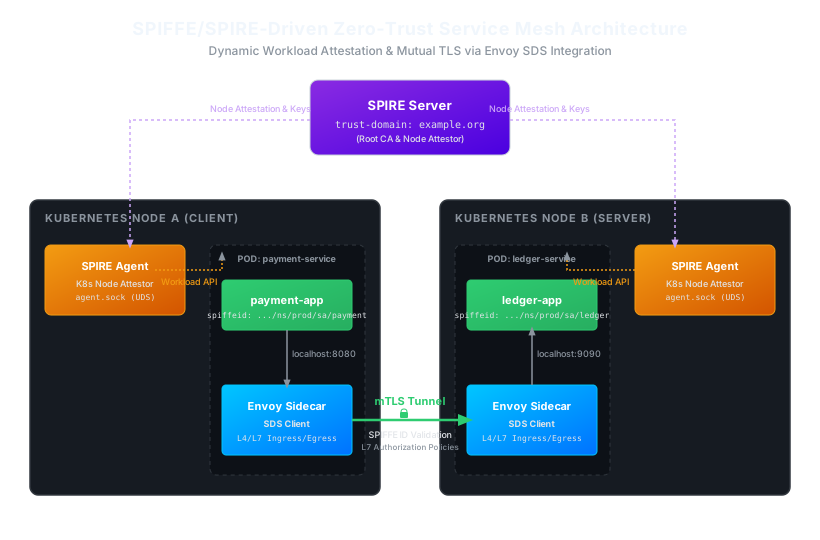
In a modern Kubernetes-centric infrastructure, relying on boundary-based security like VPC security groups, CIDR blocks, or even Kubernetes NetworkPolicies is a recipe for disaster. The moment an attacker compromises a single application container—whether through a remote code execution vulnerability or an unpatched dependency—they gain a foothold inside a flat, trust-by-default internal network. From there, lateral movement to database pods, internal ledgers, or payment processors is trivial because traditional architectures rely on ephemeral IP addresses or static credentials that are easily exfiltrated. True Zero-Trust security demands that every single connection between workloads be cryptographically authenticated, authorized, and encrypted. By integrating Istio with SPIFFE/SPIRE, we decouple workload identity from Kubernetes-specific constructs, replacing vulnerable service account tokens with short-lived, hardware-attested, cryptographically verifiable identities (SVIDs) and enforcing granular, path-level authorization policies at the Envoy proxy layer.
The Fallacy of Network-Level Trust: Why Zero-Trust is Non-Negotiable
Traditional network security relies on perimeter defense. Once inside the perimeter, components trust each other implicitly. In a dynamic orchestrator like Kubernetes, this model breaks down for three primary reasons:
- IP Ephemerality and Reuse: Pods are transient. An IP address assigned to a trusted service at 10:00 AM might be reassigned to a dynamic batch job or an unauthenticated third-party service at 10:01 AM. Firewall rules, DNS cache timings, and iptables-based filtering cannot propagate fast enough to keep pace with high-churn deployments.
- Kubernetes ServiceAccount Token Vulnerabilities: By default, Kubernetes mounts a JSON Web Token (JWT) inside every pod for service account identification. These tokens are static, long-lived, and stored as plain text files on the pod’s root filesystem. If a pod is compromised, an attacker can steal the token and masquerade as that workload from anywhere in the cluster, bypassing standard API-level audits.
- Lack of Hardware-Backed Proof: Classic service meshes issue certificates based on Kubernetes namespace API calls. If the underlying Kubernetes control plane is compromised, an attacker can easily forge identity tokens. There is no binding between the physical state of the node hosting the container (e.g., TPM chips, cloud provider metadata) and the cryptographic identity issued to the workload.
Zero-Trust eliminates network-level assumptions. By replacing raw network access with identity-based microsegmentation, every packet must carry cryptographic proof of sender identity, and the receiving proxy must validate this identity against strict access policies before forwarding the request to the application container.
SPIFFE and SPIRE: The Cryptographic Identity Foundation
The Secure Production Identity Framework for Everyone (SPIFFE) is an open standard that defines a boot-strapping mechanism for secure workload identity. The core of SPIFFE revolves around three concepts:
- SPIFFE ID: A structured URI representing a workload. The format is
spiffe://<trust-domain>/ns/<namespace>/sa/<service-account>. - SVID (SPIFFE Verifiable Identity Document): A cryptographic document containing a SPIFFE ID. SVIDs are typically issued as short-lived X.509 certificates (e.g., valid for 1 hour, rotated every 30 minutes) or JSON Web Tokens.
- Workload API: An unauthenticated local Unix Domain Socket (UDS) from which workloads retrieve their SVIDs.
SPIRE (the SPIFFE Runtime Environment) implements these concepts via two components: the SPIRE Server and the SPIRE Agent.
The SPIRE Server acts as the central Certificate Authority (CA) and orchestrator. The SPIRE Agent runs as a node agent (DaemonSet) on every Kubernetes worker node. When a new Pod is scheduled:
- The SPIRE Agent performs Node Attestation to verify the node’s identity (e.g., verifying AWS EC2 Instance Identity Documents, GCP GCE Instance Identity Tokens, or Kubernetes Projected Service Account Tokens against TPM state).
- The Agent performs Workload Attestation by querying the local Linux kernel and Kubernetes container runtime to fetch pod metadata (e.g., Namespace, ServiceAccount, container image digest, PID).
- The Agent generates a private key, requests an SVID from the SPIRE Server via a Certificate Signing Request (CSR), and exposes the resulting certificate to the workload via a Unix Domain Socket.
To manage workload registration entries at scale in Kubernetes, we use the SPIRE Controller Manager, which registers CRDs such as ClusterSPIFFEID.
Integrating SPIRE with Istio: Replacing the Default CA
By default, Istio uses Istiod (specifically Citadel) to issue certificates. Citadel reads Kubernetes ServiceAccount tokens to generate X.509 certificates. To enforce enterprise-grade Zero-Trust, we can replace Citadel’s CA role with SPIFFE/SPIRE.
This integration uses Envoy’s Secret Discovery Service (SDS) API. Rather than fetching certificates from Istiod, the Envoy sidecar container connects directly to the local SPIRE Agent’s Unix Domain Socket to retrieve its SVIDs.
To configure Istio’s sidecar proxies to use the SPIRE SDS socket, we modify the proxy configuration using Istio’s telemetry API or Helm values. Setting the SPIFFE_WORKLOAD_API_SOCKET environment variable tells the Envoy sidecar to bypass Citadel and mount the SPIRE-managed identity provider.
Bootstrapping SPIRE in Kubernetes
Deploying SPIRE in production requires sharing the SPIRE Agent’s Workload API socket securely with Envoy sidecars. Direct hostpath mounts (/var/run/spire/sockets) pose a security threat because any compromised container on the node could read or write to the hostpath directory, exposing other workloads.
The industry standard for mounting the Workload API socket is the SPIFFE CSI Driver (spiffe.csi.spiffe.io). The CSI driver dynamically mounts a node-local ephemeral volume containing the socket directly into the pod’s filesystem namespace, maintaining isolation.
The following deployment manifest defines our client application (payment-service). It contains the annotations necessary to tell the Istio sidecar injector to mount the CSI driver volume in the Envoy sidecar container.
Enforcing Strict Mutual TLS with PeerAuthentication
Authentication verify the client’s cryptographic identity. Mutual TLS (mTLS) ensures that both the client and server present certificates to verify their respective SPIFFE IDs, and encrypts all transit data.
Istio allows configuring mTLS modes:
- PERMISSIVE: The sidecar accepts both plaintext and mTLS traffic. This is a critical vulnerability for production networks because an attacker can bypass the proxy security controls by simply targeting the container port directly with plain TCP.
- STRICT: The sidecar enforces that all incoming traffic must use mTLS and present valid certificates trusted by the mesh root CA (SPIRE). Plaintext calls are rejected immediately.
To transition from permissive to strict, you must monitor the mesh metrics (specifically checking connection_security_policy metrics in Prometheus). Once all callers are verified to use mTLS, enforce the strict policy namespace-wide:
Strict mTLS shifts the performance cost from the transport layer to the handshake. Cryptographic handshakes require CPU time. To optimize this, SPIFFE/SPIRE configurations should prefer ECDSA keys (specifically curves like NIST P-256 or Ed25519) over RSA 2048/4096. ECDSA handshakes require significantly fewer CPU cycles, keeping latency overhead under 2 milliseconds per hop.
Fine-Grained Authorization: Restricting Workload Interactions
While mTLS handles authentication, it does not manage access control. An authenticated workload (frontend-service) is still physically capable of calling the ledger-service database. Authorization policies must enforce the principle of least privilege.
Istio’s AuthorizationPolicy resource enables layer 7 path-level control. By checking the client’s authenticated identity against a whitelist, Envoy blocks unauthorized traffic before it reaches the backend process.
The SPIFFE ID contained in the client certificate’s Subject Alternative Name (SAN) serves as the source principal. For example, if payment-service must invoke the ledger-service API, the authorization rule must target the client’s SPIFFE ID: prod.example.org/ns/prod/sa/payment-service-sa.
If any other workload (such as frontend-service) attempts to make a request to /transactions, the Envoy proxy intercepting the traffic at the ledger-service border rejects the request with an HTTP 403 Forbidden response.
Go Backend Workload Interactivity with SPIRE
Often, a backend service must establish secure connections directly without relying entirely on Envoy proxies—for instance, when communicating with out-of-mesh resources, databases, or third-party Kafka clusters using Kafka’s SASL/SCRAM or custom client certificate authentication.
In these cases, backend engineers can use the official go-spiffe SDK to query the local SPIRE Agent Workload API directly. The library handles connecting to the Unix Domain Socket, parsing the returned SVID, and automatically rotating TLS configs when SPIRE updates the certificates.
Real-World Failure Modes and Mitigation Strategies
Running SPIFFE/SPIRE with Istio in production exposes operational challenges. If your design does not account for these failure modes, you will experience cascading outages.
1. Envoy Startup Race Condition
Failure Mode: When a new Pod scales up, the Envoy sidecar container initializes and immediately attempts to connect to the SPIRE SDS socket path /var/run/secrets/spiffe.io/provider/agent.sock. If the SPIFFE CSI driver hasn’t finished mounting the socket, or if the local SPIRE Agent is slow to populate it, Envoy fails to resolve the SDS configuration, refuses to bind network listeners, and crashes. The pod is marked as unhealthy, triggering continuous restarts.
Mitigation: Enable Istio’s container start ordering. Configure holdApplicationUntilProxyStarts: true in your global mesh configuration to ensure Envoy completes its initialization before your application container runs. Additionally, configure Envoy’s SDS gRPC connection parameters with backoff retries. Use a Kubernetes startup probe on your application container that waits for the Envoy health endpoint (localhost:15021/healthz/ready) to return HTTP 200 before allowing traffic.
2. Kubelet and API Server Rate Limiting during Rolling Updates
Failure Mode: During massive rolling updates (e.g., updating a core library used by 50 services, spawning 300+ pods simultaneously), each node-local SPIRE Agent must attest its newly hosted workloads. The agent queries the local kubelet /pods endpoint and calls the Kubernetes API server to verify container digests and metadata. This spike in traffic causes HTTP 429 Too Many Requests rate limiting on the Kubernetes API server, blocking SPIRE attestation. Pods hang in the container creation phase, waiting for certificates.
Mitigation: Enable attestation caching in the SPIRE Agent configurations. Configure SPIRE Agents to query the local container runtime (e.g., containerd socket) for container metadata rather than relying solely on the Kubernetes API server. Set node-level rate limits on K8s API client configurations inside SPIRE (qps: 100, burst: 150) to flatten traffic spikes.
3. SVID Revocation and Short-Lived TTL Drift
Failure Mode: Unlike traditional PKI, SPIFFE does not support CRLs (Certificate Revocation Lists) or OCSP stapling due to performance and scalability concerns in high-throughput microservices. SVIDs are revoked by waiting for their TTL to expire. If an SVID is compromise (e.g., private key exfiltration from memory), the attacker has a window of opportunity equal to the SVID lifetime (typically 1 hour). If you reduce the TTL too aggressively (e.g., 5 minutes) to close this window, any temporary network partition or API server outage will cause workloads to fail renewals, resulting in instant mesh-wide traffic blackouts.
Mitigation: Balance certificate lifetime against renewal safety margins. The production recommendation is an SVID lifetime of 1 hour with rotation triggering at 30 minutes (50% of lifetime). To immediately neutralize a compromised credential, do not rely on CA revocation. Instead, deploy an Istio AuthorizationPolicy with a global DENY action targeting the specific IP or service account of the compromised container. This propagates to Envoy proxies in sub-seconds, neutralizing the threat while you cycle the certificate.
4. Clock Drift and Validation Failures
Failure Mode: Virtual machine hosts experience clock drift. If a Kubernetes worker node’s clock drifts by more than a few seconds relative to the SPIRE Server’s clock, the validation of newly issued SVIDs will fail. The SPIRE Agent will reject the certificates, or Envoy will refuse to accept the client’s handshake because the certificate’s NotBefore field is set to a future timestamp.
Mitigation: Enforce NTP synchronization across your infrastructure. Set up Prometheus alerting to monitor clock sync state (node_timex_offset_seconds metric from node_exporter). Configure an alert threshold of 500 milliseconds; any node exceeding this limit should be automatically cordoned and drained to prevent scheduling workloads onto degraded hosts.
Conclusion: The Zero-Trust Checklist
Securing communication in a production cluster requires shifting security from the network perimeter to workload identities. When executing this architecture, follow this implementation checklist:
- Adopt Cryptographic Workload Identity: Do not rely on ephemeral IP addresses. Replace Istio Citadel with SPIFFE/SPIRE to leverage physical and container-level attestation.
- Use the SPIFFE CSI Driver: Mount the Workload API socket safely. Never expose host paths directly to application pods.
- Enforce Strict Mutual TLS: Transition your mesh from
PERMISSIVEtoSTRICTmTLS. Monitor Prometheus metrics during the migration to catch plaintext leaks. - Define Layer 7 Authorization Policies: Utilize SPIFFE ID principals in your
AuthorizationPolicies. Limit access down to the specific HTTP path and method level. - Tune for Failure Resiliency: Align your SVID lifetimes with rotation thresholds. Ensure Envoy’s initialization checks are ordered to avoid startup crashes.