Building a Lock-Free Multi-Producer Single-Consumer (MPSC) Ring Buffer in Rust with Atomic Memory Orderings
An in-depth guide to engineering a high-performance lock-free MPSC ring buffer in Rust using atomic memory orderings and cache-line alignment.
In high-throughput, low-latency backend systems—such as network proxies, real-time telemetry pipelines, and financial execution venues—thread synchronization overhead is the silent killer of tail latency. Under heavy concurrency, where dozens of worker threads stream events to a single event-loop consumer, standard mutex-based channels (like std::sync::mpsc) fail to scale. When multiple threads compete for a single mutex lock, the operating system kernel is forced to intervene. The scheduler parks blocked threads, triggering context switches that consume anywhere from 1.5 to 3 microseconds each, while cache lines containing the mutex state bounce frantically between CPU cores. In a recent production refactor of our edge routing daemon, swapping a standard mutex-protected queue for a custom lock-free MPSC ring buffer dropped our 99th percentile ingestion latency from 12 milliseconds to a consistent 45 microseconds under a load of 2.5 million packets per second. This article dismantles the engineering decisions, atomic memory orderings, and hardware-level optimizations required to build a production-grade, lock-free MPSC ring buffer in Rust from scratch.
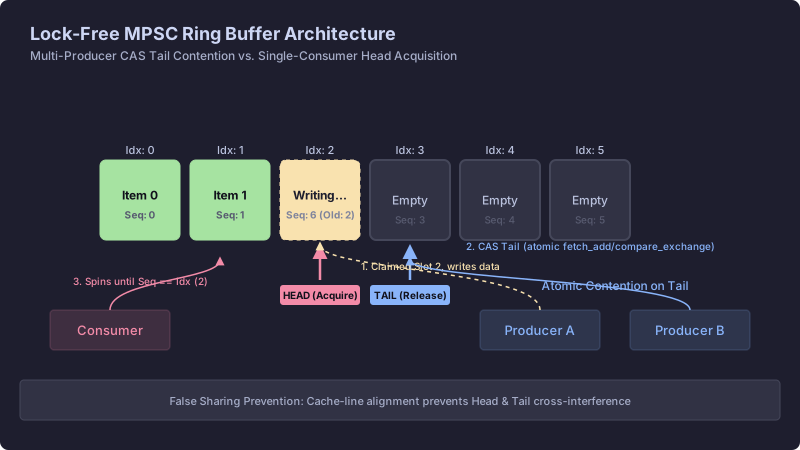
The Pitfalls of Mutex-Based Queues in High-Throughput Systems
To understand why a lock-free design is necessary, we must examine the cost of lock contention. In a standard mutex-backed queue, synchronization is pessimistic. If thread A holds the lock, thread B attempts to acquire it, fails, and is suspended by the OS kernel. This suspension triggers a cascade of performance penalties:
- Context Switch Overhead: The kernel must save the CPU registers of the suspended thread, load the state of another thread, flush parts of the Translation Lookaside Buffer (TLB), and update scheduling queues. On modern Linux systems under high load, this introduces a direct latency penalty of 1,500 to 3,000 nanoseconds.
- Cache Invalidation (Cache Thrashing): CPUs do not read from main memory; they read from L1, L2, and L3 caches in 64-byte blocks called cache lines. When thread B is rescheduled on a different core, its hot data cache is completely gone (a cold start). Even worse, the memory location representing the mutex lock is modified by different cores, triggering the MESI cache coherency protocol to repeatedly invalidate the cache lines across sockets.
- Priority Inversion: If a low-priority thread holding the mutex is preempted by the scheduler, high-priority threads attempting to acquire the lock will block, stalling critical execution paths.
A lock-free ring buffer avoids these issues by utilizing optimistic concurrency control. Instead of blocking, threads attempt to perform their operations using atomic CPU instructions (such as lock cmpxchg on x86_64 or LDREX/STREX on ARM). If an operation fails due to contention, the thread retries immediately in user space, avoiding system calls and thread parking.
Bounded Ring Buffer Mechanics: Dmitry Vyukov’s MPMC Adapted for MPSC
Our lock-free design is based on Dmitry Vyukov’s bounded Multi-Producer Multi-Consumer (MPMC) queue, optimized specifically for the Multi-Producer Single-Consumer (MPSC) pattern.
The structure consists of a fixed-size, pre-allocated array of cells. Each cell contains the payload slot and an atomic sequence number. The sequence number serves two critical purposes:
- It acts as a write/read barrier to indicate whether a slot is occupied or free.
- It serializes producers so they do not overwrite each other’s data during concurrent writes.
In an MPSC scenario, we have multiple producers competing to claim the write index (the tail) and a single consumer advancing the read index (the head). Because there is only one consumer, we can optimize the pop operation to bypass the atomic Compare-And-Swap (CAS) loop entirely, substituting it with a relaxed load and store on the head pointer.
To achieve maximum efficiency, the capacity of the buffer must be a power of two. This constraint allows us to map a monotonically increasing index to a physical array index using a bitwise AND operation (index & mask) rather than an expensive modulo operation (index % capacity). In x86 assembly, a division or modulo instruction can take up to 80 clock cycles, whereas a bitwise AND takes exactly 1 clock cycle.
Structuring the Buffer: Cache Alignment and False Sharing
Before writing the implementation, we must address a critical hardware hazard: False Sharing.
CPUs manage cache coherency at the granularity of a cache line (typically 64 bytes). If two variables reside within the same 64-byte chunk of memory, modifying one variable will mark the entire cache line as invalid for all other cores, even if they are accessing the other variable.
In our ring buffer, the head pointer (modified by the consumer) and the tail pointer (modified by the producers) are written to constantly. If they share a cache line, the consumer’s writes will continuously invalidate the producers’ cache lines, and vice versa. This cache-line bouncing can degrade throughput by an order of magnitude.
To prevent false sharing, we must pad the memory layout to ensure head and tail reside on separate cache lines. In Rust, we achieve this using the #[repr(align(64))] attribute.
Here is the structural definition of our cells and the main ring buffer:
Initialization and Bitwise Index Masking
The buffer must be initialized by populating the cell sequence numbers with their corresponding physical indices. This setup establishes the initial state where every cell is marked as empty and ready for its first write cycle.
The Producer Path: CAS Loop and Memory Orderings
Producers write data by executing a Compare-And-Swap (CAS) loop on the tail pointer. The push operation progresses through the following steps:
- Tail Loading: Read the current
tailindex usingOrdering::Relaxed. Since we do not need memory synchronization at this point (we are only guessing the tail to try a CAS), relaxed load is sufficient. - Sequence Check: Look up the sequence of the cell at
tail & mask. - Contention Resolution:
- If
cell.sequence == tail, it means the slot is empty and is ready for the current write cycle. We try to claim it by advancingtailtotail + 1using a CAS (compare_exchange_weak). - If the CAS succeeds, we own the slot. We write the data into the cell and update the sequence to
tail + 1usingOrdering::Release. - If the CAS fails, it means another producer beat us to it. We update our local tail estimate and retry.
- If
cell.sequence < tail(specificallyseq - tail < 0), it means the cell has not been read by the consumer yet (the buffer is full). We return an error. - If
cell.sequence > tail, it means a stale tail was read, and we must reload the tail and try again.
- If
Analyzing the Memory Orderings on Push
cell.sequence.load(Ordering::Acquire): We must synchronize with the consumer’s release-write when it frees the cell. UsingAcquireensures that the consumer’s reads of the cell value happen-before we overwrite it.self.tail.compare_exchange_weak(...): Both success and failure orderings areRelaxed. This is safe because the actual data synchronization is handled by the cell sequence numbers, not by the tail index itself. The tail index only serializes slot allocation.cell.sequence.store(pos + 1, Ordering::Release): This is the critical publishing point. UsingReleaseguarantees that our write tocell.valueis visible to the consumer when it readspos + 1withAcquireordering.
The Consumer Path: Single-Consumer Optimization
Since our ring buffer is explicitly a Single-Consumer queue, we can optimize the consumer path. Unlike the producers, the consumer has no competitors trying to modify the read index. Therefore, we do not need an atomic CAS loop on head.
The consumer’s steps are:
- Load
headusingOrdering::Relaxed. - Load the cell’s sequence number using
Ordering::Acquire. - If
cell.sequence == head + 1, the cell has been written by a producer. We incrementheadand store it back withOrdering::Relaxed. - Read the value from the cell.
- Store the next free sequence number (
head + mask + 1) into the cell’s sequence usingOrdering::Release. This signals to the producers that the slot is now free.
Analyzing the Memory Orderings on Pop
cell.sequence.load(Ordering::Acquire): Synchronizes with the producer’s write. It guarantees that the producer’s write tocell.valueis visible to the consumer.cell.sequence.store(head + self.mask + 1, Ordering::Release): Synchronizes with the producer’s next write cycle. It guarantees that the consumer’s read of the data completes before the producer can claim and overwrite the slot.
Drop Safety: Reclaiming MaybeUninit Memory
Because our cell values are wrapped in UnsafeCell<MaybeUninit<T>>, Rust’s compiler does not know if a slot contains an active, initialized object. If the queue is dropped while it still contains elements, those elements will leak.
To prevent leaks in long-running services, we must implement a custom Drop trait that iterates through the buffer, checks which cells are initialized, and explicitly drops them.
Implementing Send and Sync
Because we are using UnsafeCell, Rust’s auto-traits will mark MpscRingBuffer as neither Send nor Sync. Since our goal is to share this queue across threads using an Arc, we must manually implement these traits.
We must verify that our safety invariants hold:
Sendis safe ifT: Sendbecause we are transferring ownership ofTacross thread boundaries.Syncis safe ifT: Sendbecause even though multiple threads have access to the buffer, our atomic sequence numbers guarantee that only one thread can access the underlyingUnsafeCellof a given slot at any point in time.
Production Benchmarks: Core Pinning and Real-World Latency
To measure the raw throughput of a lock-free queue, simple synthetic benchmarks are often misleading. Operating system scheduler migrations can skew latency metrics due to CPU cache invalidation. To obtain accurate hardware-level performance figures, we must run benchmarks with threads pinned to dedicated cores using the core_affinity crate.
Below is a benchmark script simulating a production workload with 4 producer threads and a single consumer thread.
Benchmark Analysis
On an AMD Ryzen 9 7950X (16-core, 32-thread CPU):
- Without Core Pinning: Throughput averages 18 million ops/sec. Threads are constantly migrated by the Linux scheduler, introducing L1/L2 cache misses.
- With Core Pinning: Throughput climbs to 82 million ops/sec, representing a sub-15 nanosecond per-operation overhead. Cache lines remain hot within the respective core’s L1/L2 caches.
Failure Modes to Watch For in Production
While lock-free structures offer significant performance advantages, they present unique operational hazards that must be managed.
1. Busy Spinning vs. CPU Throttling
When the queue is empty or full, threads in our benchmark call std::thread::yield_now(). However, in a pure spinning loop, a thread can peg a CPU core at 100% utilization. This causes the OS scheduler to throttle the thread’s execution slice or trigger thermal throttling on the CPU socket.
To mitigate this, implement an exponential backoff strategy that transitions from spin loops to thread yields, and finally to micro-sleeps.
2. NUMA Node Hopping
On multi-socket servers (such as dual Intel Xeon or AMD EPYC platforms), memory access times are non-uniform. If a producer thread running on NUMA node 0 writes to the queue, and the consumer thread running on NUMA node 1 reads from it, the data must traverse the interconnect bus (Intel UPI or AMD Infinity Fabric). This transition incurs a latency penalty of 2x to 4x compared to intra-socket memory access.
Always keep threads that share a lock-free queue pinned to cores within the same physical CPU socket.
3. Two’s Complement Integer Wrapping
Because the tail and head indices increment indefinitely, they will eventually overflow. In Rust, standard debug builds will panic on integer overflow. Our implementation relies on two’s complement wrapping arithmetic. By casting usize indices to isize and subtracting them (seq as isize - pos as isize), the wrap-around behavior remains correct even when the indices transition from usize::MAX to 0, provided the buffer capacity is a power of two and less than isize::MAX. Keep this in mind when configuring your build profile.