Building a Custom Thread Pool in Rust: Synchronizing Task Queues with Mutexes and Condvars
A deep dive into building a production-ready custom thread pool in Rust using raw Mutex and Condvar primitives with panic isolation and graceful shutdown.
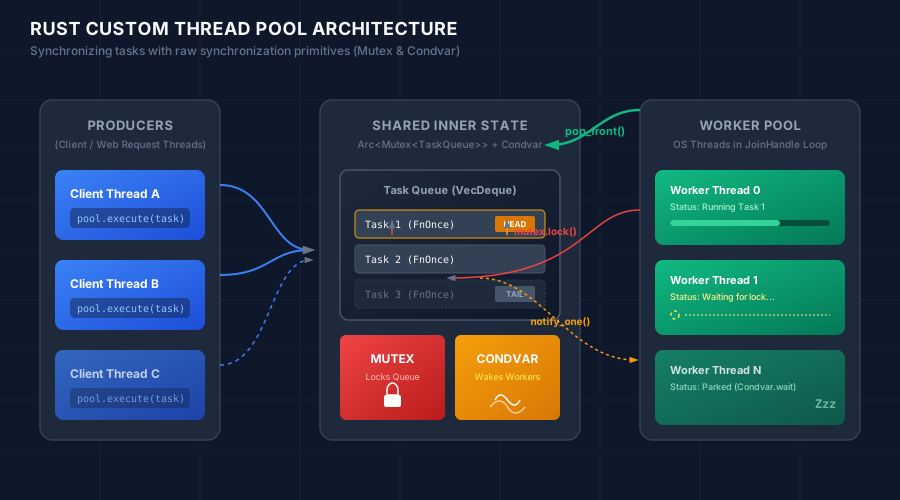
In production, when a backend service scales to process millions of CPU-intensive transactions—such as cryptographic hashing, JSON parsing, or image resizing—spawning threads on demand is an architectural anti-pattern. OS thread creation incurs significant latency overhead, requiring system calls (clone on Linux) to allocate page-aligned stack spaces (typically 2MB in Rust, or 8MB by default on Linux) and register scheduling metadata with the kernel. When traffic spikes, a naive backend will spawn thousands of concurrent threads, prompting the Linux CFS (Completely Fair Scheduler) to waste precious CPU cycles on context switching, TLB invalidation, and cache line bouncing rather than actual execution. To solve this, high-performance backends implement a thread pool pattern: a fixed set of pre-allocated OS worker threads that share a single task queue, blocking efficiently when idle and processing work sequentially without scheduler thrashing.
Why Spawn-on-Demand Kills Production Performance
Before diving into the synchronization primitives, we must quantify why creating threads on the fly is unacceptable in production environments. An operating system thread is not cheap. Under the hood, the Linux kernel manages threads using the task_struct structure. When you call std::thread::spawn in Rust:
- Memory Allocation: The kernel allocates a thread stack (usually 2MB for Rust threads) and page tables. While these pages are allocated lazily via copy-on-write (COW), the virtual memory space allocation and initial page faulting introduce significant latency.
- Context Switching Overhead: When the active thread count exceeds the number of physical CPU cores, the OS scheduler must multiplex threads. A context switch requires saving the CPU registers, instruction pointers, stack pointers, and loading the state of the next thread. This process invalidates the L1/L2 data and instruction caches, as well as the translation lookaside buffer (TLB).
- Cache Line Bouncing: Multiple threads accessing shared memory locations cause the CPU’s MESI cache coherence protocol to constantly invalidate cache lines across different cores, forcing slow L3 or main memory lookups.
Under a load of 100,000 requests per second, spawning threads on demand results in immediate CPU saturation, latency spikes exceeding 2,000ms, and eventual process crashes due to OOM (Out Of Memory) limits or system file descriptor/thread limits (/proc/sys/kernel/threads-max).
To address this, we must build a system that pools a fixed number of threads (often matching the logical core count of the host CPU) and shares a queue of jobs. In Rust, synchronizing this shared task queue requires understanding three core concepts: Mutex (Mutual Exclusion), Condvar (Condition Variable), and the lifetime guarantees of the type system.
Core Architecture: Designing the Shared Task Queue
The foundation of our thread pool is a thread-safe task queue. A naive queue in a single-threaded program uses std::collections::VecDeque. However, in a multithreaded context, multiple threads will simultaneously attempt to push tasks (producers) and pop tasks (workers). This is a classical data race, which Rust’s compiler prevents at compile time by requiring synchronization wrapper types.
To make the queue thread-safe, we encapsulate the VecDeque and a shutdown state (is_closed) inside a Mutex. While the Mutex guarantees exclusive access to the queue data, it does not provide an efficient way for idle worker threads to wait for new tasks. Without a condition variable, workers would have to run in a spin-lock loop, checking the queue continuously. This spin-lock would consume 100% of a CPU core just to wait, starving actual workloads.
We solve this using a Condvar. A condition variable allows a thread to park itself (yielding CPU execution back to the OS scheduler) until it receives a notification that a specific condition (e.g., "the queue is no longer empty") is met.
The Rust Type System: Send and 'static
Notice the type signature of our task: Box<dyn FnOnce() + Send + 'static>. This design uses Rust’s type system to enforce memory safety:
FnOnce(): The task is executed exactly once. This aligns with standard queue execution mechanics.Send: The closure captures values that can be safely transferred across thread boundaries. If the task captures a type that is not thread-safe (likeRc), Rust will reject compilation.'static: Because the pool worker threads execute asynchronously and outlive the function that submitted the task, the closure cannot capture borrowed references (&T) that might go out of scope, causing dangling pointers. The static lifetime guarantees that the closure owns all captured data.
Worker Thread Orchestration
With the thread-safe TaskQueue in place, we construct the ThreadPool container and define the Worker loops. The worker threads are spawned at initialization and run indefinitely until the queue signals shutdown.
A critical design pitfall in custom thread pool implementations is holding the lock too long. If a worker retrieves a task and runs it while still holding the mutex guard, no other worker thread can acquire the lock to pull new tasks. The thread pool effectively degrades into a single-threaded serializer. We must ensure the mutex lock guard is dropped before the closure is invoked.
Graceful Shutdown Mechanics
A robust production thread pool must handle graceful shutdown. If the pool is dropped while worker threads are executing, we cannot simply kill the threads abruptly (e.g., using OS-level thread cancellation signals like pthread_cancel). Abrupt termination leaves mutexes poisoned, breaks database connection pools, corrupts open file write buffers, and leaks memory.
We implement the Drop trait for ThreadPool to orchestrate a clean shutdown. When the ThreadPool goes out of scope:
- We close the queue, preventing new task submissions.
- We broadcast a notification (
notify_all) to wake up all idle worker threads currently parked on the condition variable. - The worker threads detect that
is_closedis true and their local queue buffers are empty. They break out of their processing loops. - The drop implementation block waits for each thread to finish executing its active job and terminates cleanly using
.join().
Thread Isolation: Handling Panics and Worker Regeneration
In production, code will panic. Whether it is an out-of-bounds array access, an unhandled database connection failure, or an explicit unwrap(), a thread pool must survive worker panics.
If a task executed by a worker thread panics, and the panic is unhandled:
- The call stack unwinds.
- The worker thread dies.
- The pool size decreases.
Under heavy, continuous workload spikes, a series of panicking tasks will gradually kill off all worker threads. The thread pool will continue to accept tasks but will never process them, leading to a silent, permanent outage.
To build a resilient pool, we must isolate panics. We achieve this using a two-pronged strategy:
- Catching panics at the execution boundary using
std::panic::catch_unwind. - Implementing the Sentinel Pattern via Rust’s
Dropmechanism to automatically spawn a replacement thread if a worker dies unexpectedly.
Lock Contention Benchmarks: The Cost of Synchronization
While building a custom thread pool with a single Mutex and Condvar is highly educational and functionally correct, it has clear performance scaling limitations. As the CPU core count increases, the single mutex becomes a hot spot of contention.
When 64 producer threads submit tasks, and 8 worker threads attempt to pop tasks simultaneously, they all must obtain the same mutex lock. The threads spend significant time waiting in kernel-level futex queues, leading to high system CPU overhead and lower throughput.
To demonstrate this limit, Snippet 5 outlines a benchmark harness that submits rapid, short-duration tasks to measure lock contention throughput.
If you run this benchmark and profile the process using perf record or cargo-flamegraph, you will notice that a substantial percentage of execution time is spent in kernel space within the sys_futex system call. The CPU spends more cycles negotiating lock state than executing the user closures.
In production scenarios, we use diagnostic tools to monitor thread pools:
lsof -p <PID>: Verifies the file descriptors and thread allocations.perf top: Inspects kernel CPU spikes caused by lock contention.- Lock Profiling: Swapping standard
Mutexfor theparking_lotcrate’sMutex, which offers lighter, user-space adaptive spin-locks before falling back to kernel-level waits.
Scaling Lock Throughput: Sharding and Work Stealing
To bypass the bottleneck of a single lock, advanced system architectures use sharded task queues or work-stealing queues.
In a sharded task queue, we create $N$ separate task queues, each protected by its own mutex. Producers distribute tasks across these shards using a round-robin atomic index or a hash of the task identifier. Worker threads are assigned to a primary shard. When their primary shard is empty, they attempt to lock other shards via a non-blocking try_lock() call to steal work. This approach dramatically reduces lock acquisition contention.
Comparing Thread Pool Designs
When choosing or designing a thread pool for a production Rust service, engineers must select the right design architecture for the specific hardware configuration and workload type:
| Pattern | Throughput (Low Cores) | Scalability (High Cores) | Latency P99 | Complexity | Use Case |
|---|---|---|---|---|---|
| Raw Mutex + Condvar | High | Low | Medium-High (Lock Bottlenecks) | Low | Small-scale background worker pools, internal CLI pipelines. |
| Sharded Queue | Very High | High | Low | Medium | High-concurrency message brokers, memory caches. |
| Lock-Free / Ring Buffer | Extremely High | High | Extremely Low | High | Financial trading gateways, high-frequency telemetry. |
| Work-Stealing (Vek/Rayon) | High | Extremely High | Low | Very High | General-purpose web frameworks (Tokio), parallel computation pipelines. |
By mastering raw synchronization primitives in Rust, you gain a deep understanding of how task scheduling works at the operating system level. Building a custom thread pool with Mutexes and Condvars allows you to control thread scaling, isolate panics, and optimize low-level memory layout, giving you full leverage over the performance characteristics of your backend infrastructure.